Key Takeaways: We must optimize content for AI generated answers, not only for search rankings. Clear structure, statistics, and citations strongly increase AI visibility. Consistent topical authority helps our content get selected and reused.
Generative engine optimization (GEO) is the practice of designing content so AI systems can easily understand it, trust it, and reuse it in their generated answers. Instead of chasing blue links on a results page, GEO focuses on becoming a cited source inside AI summaries. As search shifts from long lists of links to short, direct responses, visibility depends on structure, clarity, and authority, not just keywords. If we want our work to be quoted by these systems, we need to adjust how we plan, write, and format pages. Keep reading to see how GEO works and how to apply it step by step.
Generative Engine Optimization: What Brands Need Now
Generative engine optimization focuses on how large language models collect and combine information, a shift closely aligned with answer engine optimization, where visibility depends on how clearly facts can be extracted and reused inside generated answers.
Unlike traditional search engines, these systems do not present ten blue links. They generate a single response from a limited group of sources.
The term was introduced in 2023 by researchers at Princeton University, who studied how retrieval augmented generation selects evidence. Their findings showed that structure and authority shape which sources are reused.
Generative engine optimization applies familiar practices like clarity and accuracy. It also adds new priorities such as answer first formatting and semantic relevance. The following points explain the core purpose of generative engine optimization and why it matters today.
Increase the chance our content is selected as a source in generated answers.
Help AI systems extract facts quickly and correctly.
Build trust signals that support repeated citation over time.
How Is GEO Different From Traditional SEO?
Person reading tablet at night implementing generative engine optimization strategies for AI-generated answer visibility
Generative engine optimization competes for inclusion in AI generated answers, while traditional SEO competes for ranking positions in search results. Traditional SEO focuses on signals like backlinks and click through rates. Generative engine optimization focuses on citation, accuracy, and clarity within synthesized responses.
AI systems usually combine content from only 2 to 7 sources per answer. This makes selection more competitive and raises the value of authority. Industry research predicts that traditional search traffic could decline by 25 percent by 2026 as AI answers become more common. This shifts attention from ranking to relevance.
Dimension
Generative Engine Optimization
Traditional SEO
Output target
AI generated answers
Ranked search results
Core signals
Citations, statistics, authority
Backlinks, engagement
Success metric
Inclusion frequency
Ranking position
This comparison shows why generative engine optimization requires a different mindset. We must write for machines that summarize, not users who browse.
How Do Generative Engines Retrieve and Synthesize Content?
Research documents and laptop workspace showing generative engine optimization content planning with annotations and notes
Generative engines use retrieval augmented generation to fetch trusted sources, score relevance, and synthesize facts into a single response, which shows why content must be structured to optimize how answer engines identify, evaluate, and reuse information. Retrieval augmented generation combines search and generation into one process. The system first retrieves documents, then evaluates their authority and relevance.
After retrieval, the model extracts key facts and combines them into a coherent answer. Poorly structured content is harder to parse and less likely to be reused. Adoption of retrieval augmented generation increased rapidly after 2023, as AI answers became a core search experience.
Retrieve documents based on query intent and entity relevance.
Rank sources using authority and factual signals.
Extract facts and compose a synthesized response.
Research from Princeton University explains that retrieval augmented generation improves factual accuracy by grounding answers in external sources.
Which Ranking Factors Influence GEO Visibility Most?
AI models tend to favor content that looks reliable and easy to verify. When claims are supported by data, named experts, or clear references, those sentences are more likely to be pulled into generated answers.
This behavior reflects a broader shift toward fact-level evaluation rather than page-level signals. As explained by Frase.io, AI systems increasingly avoid ambiguity and prioritize corroborated information:
"Model behaviour shift: Preference for concise, structured, corroborated facts; ambiguity aversion; reliance on widely repeated truths... SEO optimizes at the page level: keyword in title, strong headings, comprehensive coverage. GEO optimizes at the fact level: each statistic, definition, or concept needs standalone clarity." — Frase.io
Testing across different queries supports this shift. Pages that add expert quotations can see about a 41 percent increase in GEO visibility. Adding statistics and inline citations can drive around a 30 percent lift each, especially when they appear close to direct answers. Fluent language and correct terminology further improve extraction and trust.
Factor
Visibility Impact
Expert quotations
41 percent increase
Statistics
30 percent increase
Inline citations
30 percent increase
Fluency optimization
22 percent increase
Technical terminology
21 percent increase
All of this reinforces one point: generative engine optimization rewards precise, well-supported facts that can stand on their own inside AI-generated responses.
How Do We Implement GEO Step by Step?
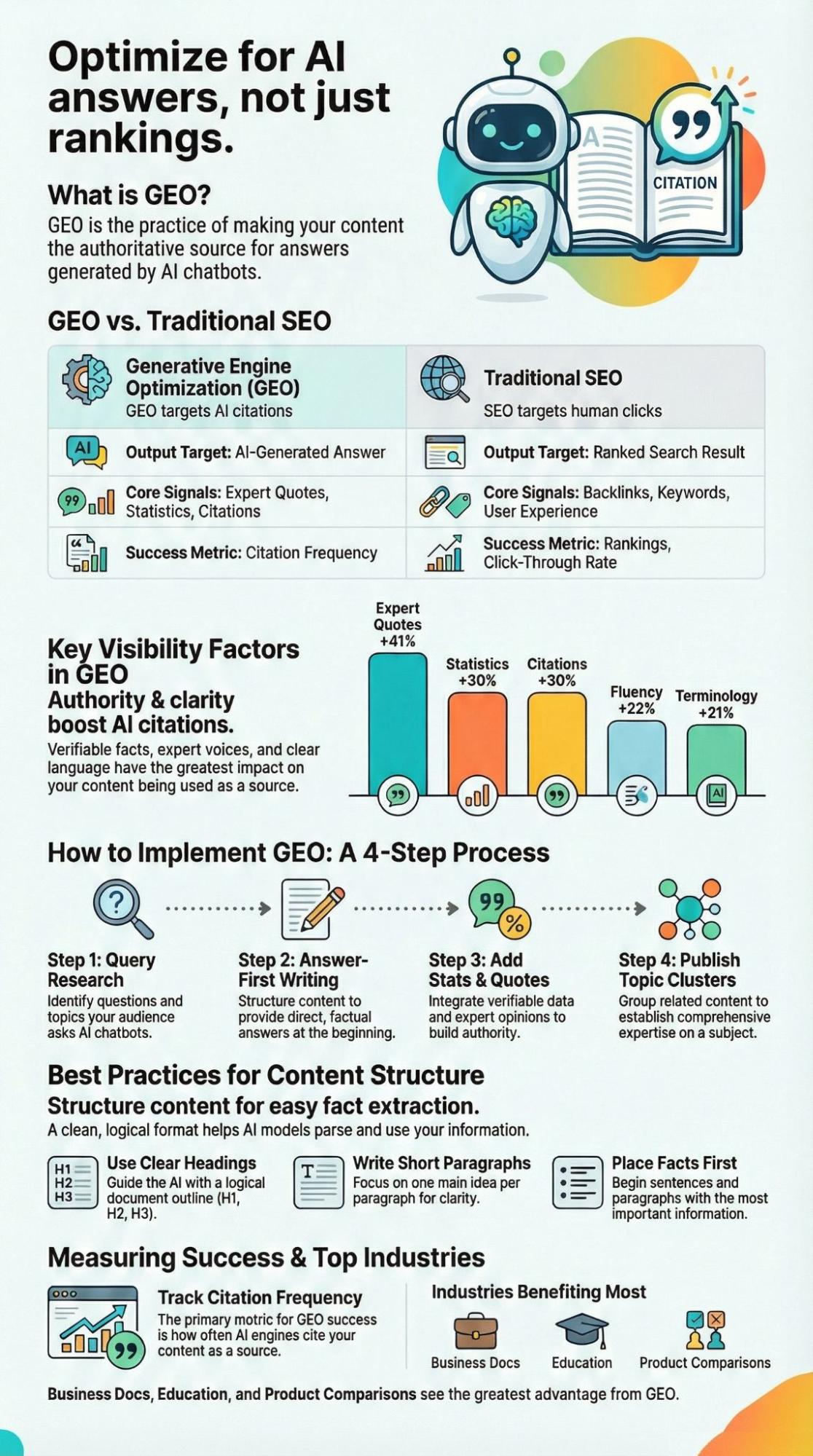
Infographic explaining generative engine optimization vs SEO with visibility factors, implementation steps, and best practices
Generative engine optimization starts with AI focused query research and continues with structured, evidence based content within topical clusters, following an AEO optimization strategy that prioritizes answer-first formatting over traditional page-level optimization. The process begins before writing.
Once queries are defined, content must be structured for easy extraction. Headings, lists, and short paragraphs support parsing. Testing shows that structured content can lift AI visibility by up to 40 percent when combined with authoritative signals.
Identify conversational queries tied to user intent.
Write answer first sections with clear headings.
Add statistics and factual data with attribution.
Include expert quotations where relevant.
Publish related content within a defined topic area.
This approach aligns writing with how AI systems evaluate and reuse information.
How Should Content Be Structured for GEO?
Scannable, semantically clear structure makes it easier for AI systems to extract and reuse information accurately. When content is packed into dense blocks, models struggle to identify which sentence answers which question.
This is especially important for vague or broad queries. According to guidance summarized by Hostinger, AI systems process content from the top down and evaluate intent quickly:
"Your content should serve users who are learning (informational), comparing (comparative), and deciding (transactional). ... Since the AI parses your content from the top down, providing the primary intent in the main heading enables it to quickly identify whether your content is relevant to the query." — Hostinger
Clear headings, short paragraphs, and lists help AI locate definitions, steps, and facts with less uncertainty. Placing the most direct answer at the top of each section improves relevance matching, while layered structure allows the same page to satisfy multiple intents without confusion.
How Do We Measure GEO Performance?
Generative engine optimization performance is best measured by how often your content is cited or summarized inside AI generated answers. Traditional SEO metrics like rankings, impressions, and clicks only tell part of the story, because AI answers can use your content without always sending traffic.
For GEO, the key signal is inclusion: whether your pages show up, and how consistently, across related prompts and topics. Benchmark studies using more than 10,000 queries suggest that repeated citation is a strong proxy for trust and topical authority.
Track how often your content appears in AI generated answers for target queries.
Monitor how consistent those citations are across similar or related prompts.
Review whether facts are reused accurately and in the correct context.
If your pages are showing up frequently, consistently, and correctly, that is a strong sign AI systems recognize and trust your content.
Generative Engine Optimization Conclusion
Generative Engine Optimization Conclusion
That's exactly it. You're not aiming to be a result on a page anymore. You're aiming to be the single answer the AI pulls up and quotes. The goal is to be the definitive source, the one it sees as the safest, most reliable place to get the information. It's about structure, clear authority, and evidence that makes a model trust your page above all others.
If you want to optimize for being the answer, not just a link, you need to see a system built for that purpose. That's the core of what GeekyExpert does. It's engineered to build the kind of authoritative, structured content that answer engines learn from and cite. For tools and strategies that support GEO at scale, see GeekyExpert.
What is generative engine optimization in AI-driven search results?
Generative engine optimization explains how content is selected and cited by AI-driven search systems. It focuses on semantic relevance, topical authority, and clear source attribution so answer engines can trust and reuse information. Instead of rankings alone, GEO improves citation visibility, supports zero-click answers, and aligns content with real user intent across conversational and synthesized search responses.
How does RAG optimization improve answer engine accuracy and trust?
RAG optimization strengthens retrieval augmented generation by ensuring AI systems pull reliable context before generating answers. It relies on structured data, entity recognition, and strong source alignment. Clear citations, factual accuracy, and diverse references reduce hallucinations. This approach improves trust, supports complex informational queries, and helps answer engines produce consistent, verifiable responses.
Why do E-E-A-T signals influence citation ranking in generative search?
E-E-A-T signals guide answer engines toward credible and reliable content. Expert quotations, peer-reviewed sources, and verified statistics demonstrate domain expertise and authority. When supported by clear research summaries and data-driven claims, these signals increase citation likelihood. They also reduce errors in synthesized responses and improve long-term AI visibility for in-depth informational content.
How should content be structured for better AI visibility?
Content structure directly affects how answer engines extract information. Clear headings, short paragraphs, bullet points, and logical sections improve readability and parsing. Schema markup, FAQ schema, and comparison tables help systems identify key facts. This structure supports featured excerpts, controls response length, and matches different query types across generative search experiences.
Why does content freshness matter for zero-click answers?
Content freshness signals ongoing relevance to generative search systems. Regular updates with current data, benchmarks, and analysis maintain topical authority. Refreshing multimedia elements and sources helps content stay accurate and competitive. Fresh content adapts to search evolution, improves zero-click answer performance, and sustains long-term visibility without relying on traditional clicks.
About Geeky Expert
Geeky Expert is a leading provider of research and insights, dedicated to helping businesses make informed decisions through comprehensive analysis.