Key Takeaways: We must write answer-first content that AI systems can lift and reuse without confusion. We need technical clarity through structured data, fast pages, and clean layouts. We build authority by connecting related answers into clear topic clusters.
We optimize content for answer engines by writing clear, direct responses that AI can easily extract, reuse, and cite. Instead of chasing clicks, we structure pages so systems like Google AI Overviews, ChatGPT, and Perplexity can resolve queries straight from our content. That means precise answers first, then supporting detail, all wrapped in clean structure and fast, readable pages. If you want your content to show up inside AI summaries instead of getting skipped, you have to write for machines and humans at the same time. Keep reading to see the exact steps we use.
How to Optimize for Answer Engines as Search Changes
What is Answer Engine Optimization (AEO) and how does it differ from SEO?
Answer engine optimization focuses on making content easy for AI systems to extract and cite, while SEO focuses on ranking pages to earn clicks from traditional search results.
AEO exists because search behavior is shifting toward AI tools that generate direct responses instead of long lists of links. Research summarized by AIMultiple shows that answer engines prefer concise, structured responses that resolve intent quickly, rather than pages built mainly for browsing depth.
Key differences in focus:
SEO success: rankings, clicks, traffic
AEO success: citations, mentions, reuse in AI summaries
Answer engines scan pages for: clear question‑based headings; short, direct answer sections; consistent entities and stable wording; and supporting context that reinforces accuracy.
In practice, AEO means stating the answer early, backing it with clear facts, and removing unnecessary filler. We also need to think beyond Google's results page and consider how large language models select, blend, and quote sources when they build their answers.
Dimension
SEO
AEO
Primary goal
Clicks
Citations
Content shape
Long form pages
Answer first blocks
Success metric
Rankings
Mentions
How should content be structured for answer extraction?
Strong answer extraction starts with structure: put the answer first, keep it tight, then support it with clean, scannable formatting, which is central to an effective AEO optimization strategy that prioritizes reuse over persuasion. When conclusions are buried in long paragraphs, AI systems have to infer meaning, and that lowers the odds of being cited.
Research shared by In AI We Trust shows that 40–60 word answer blocks tend to perform best for featured snippets and AI-generated summaries, because they are easy to lift in one piece.
Key structural rules:
Use H2 headings phrased as complete questions
Add one clear answer block directly under each heading
Use lists and tables only to support or clarify the main answer
Keep paragraphs short, with one core idea each
This approach mirrors the inverted pyramid from journalism: the most important information comes first, then supporting detail, then depth. Short sentences, neutral tone, and precise wording make the content easier for models to interpret and reuse without introducing errors.
In practice, every section should work as a stand‑alone answer block that an answer engine could copy, quote, and place into a summary with minimal editing.
How do answer engines interpret and retrieve content?
Person reading tablet content at night showing how to optimize for answer engines for mobile-first AI search results
Answer engines interpret content by parsing structured pages and pulling out short, authoritative responses that match conversational and long‑tail queries. They use large language models that focus on meaning, not just keywords, breaking pages into sections and spotting which sentences actually answer a question.
Analysis from Search Engine Land shows that extractable formatting strongly affects which sources get used in AI answers.
Key patterns answer engines look for:
Clear, question‑based headings that match user intent
Inverted pyramid structure, with the conclusion first
Consistent entity names across related pages
Many of these answers appear in zero-click contexts, where users see the response without opening the source page, a pattern shaped by generative engine optimization and how summaries are assembled across AI systems. Tools like Google AI Overviews combine multiple sources into a single summarized answer, then cite the pages they pulled from.
So our job is to remove friction: make answers easy to find, easy to read, and easy to reuse. That takes discipline in structure and wording, because visibility now depends less on getting the click and more on being selected as a reliable reference.
What technical optimizations improve AEO visibility?
Desk workspace with laptop and research papers demonstrating how to optimize for answer engines content planning process
Technical optimizations improve AEO visibility by making it easier for AI systems to crawl, parse, and refresh your content accurately. Even well‑written answers will be skipped if machines can't read or classify them cleanly [1].
Guidance from Search Engine Land shows that structured data, clean markup, and fast performance all help answer engines understand what your page is about and when it changes.
Core technical priorities:
Implement JSON‑LD schema: FAQPage, HowTo, and Article
Maintain fresh XML sitemaps with correct, canonical URLs
Use IndexNow or similar signals to speed up recrawling
Keep HTML hierarchy clean (H1 > H2 > H3) so answer blocks are easy to isolate
Performance and accessibility matter too. Mobile‑first layouts, quick load times, and simple, readable design reduce friction for both users and machines. When pages are fast, structured, and clearly labeled, answer engines can trust your content, surface it more often, and keep it updated in their summaries.
How do topic clusters build authority for answer engines?
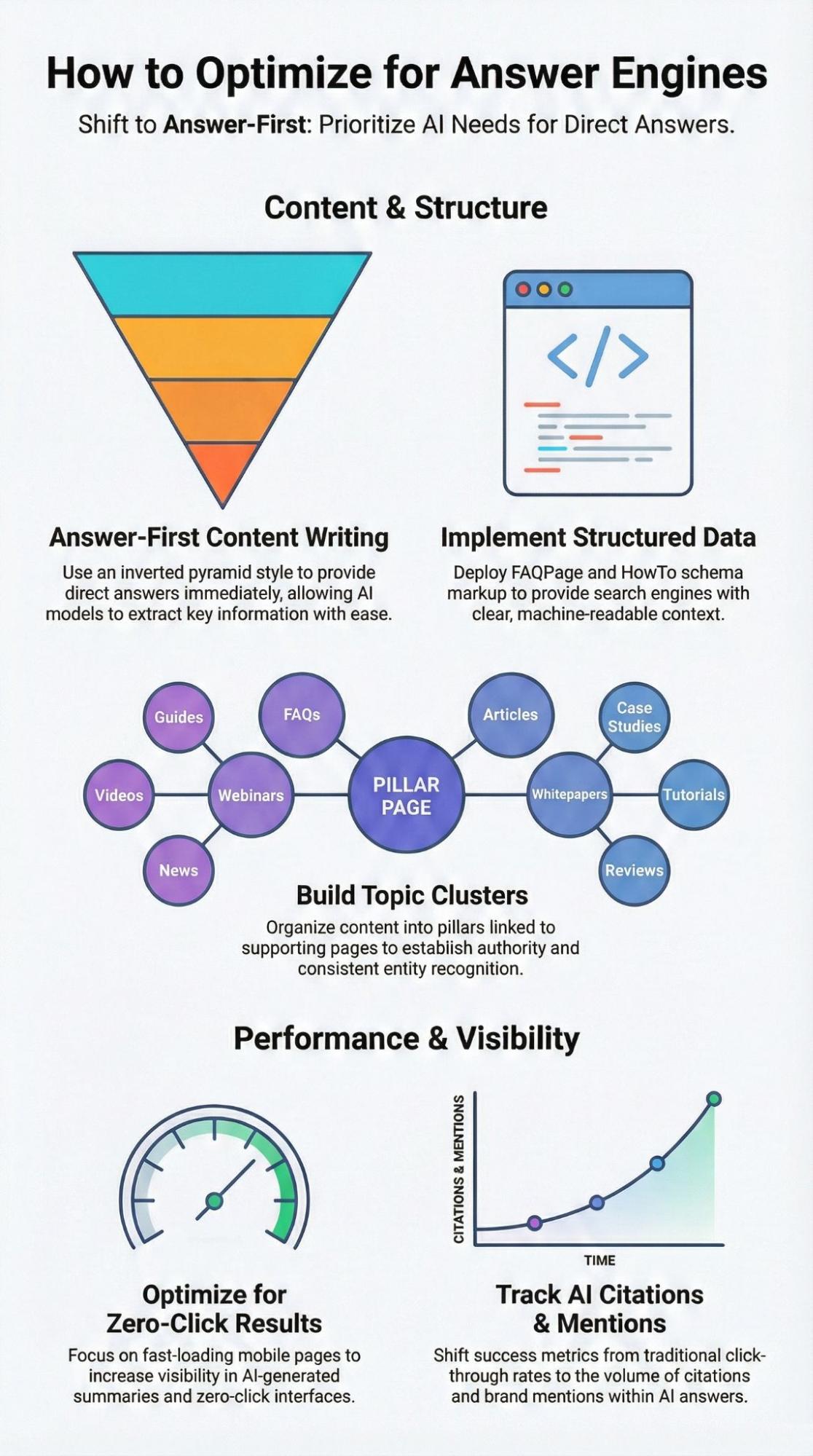
Infographic showing how to optimize for answer engines with content structure, topic clusters, and performance metrics
Topic clusters build authority by tying many related answers back to one clear core topic, which makes answer engines more likely to trust and cite your content. One page alone rarely proves expertise. These systems look for consistent coverage across a set of pages, not just a single strong article.
A simple topic cluster has three parts:
One pillar page that explains the main concept in broad terms
Multiple supporting pages that answer narrow, long‑tail questions
Internal links that connect these pages with clear, descriptive anchors
Studies summarized by AIMultiple suggest that this kind of clustering improves confidence in a source because it shows depth, structure, and stable language around the same entities.
Consistency is crucial. We repeat key entities the same way, stay inside the topic boundaries, and avoid mixing in unrelated themes. This helps AI systems map relationships, understand the scope of a topic, and see our site as a reliable reference across many related queries.
Tools like Google Search Console can then be used to watch how these clusters are crawled, shown, and aligned with the queries we care about.
How can AEO performance be measured and improved over time?
AEO performance is measured by how often answers are seen, cited, and kept current, not just by how much traffic a page brings in. We watch for signals that show whether answer engines can find, trust, and reuse our content over time.
Key metrics to track:
Mentions and citations in AI‑generated answers
Impression trends for target and related queries
Coverage depth across long‑tail, question‑based searches
Because many AI answers are zero‑click, traditional analytics only tell part of the story. Tools like Perplexity, which display sources, help confirm when content is being used. Testing the same prompts regularly in different answer engines also shows whether our wording still matches how models frame the topic.
Improvement comes from steady updates. We refresh evergreen answers when facts change, tighten wording to keep blocks extractable, and add new Q&A sections only when they reinforce the core topic. This keeps clusters coherent while signaling freshness and reliability to AI systems [2].
Video: How to Optimize for Answer Engines
Credits: Philip Ian Ymbong
How to Optimize for Answer Engines in Practice
How to Optimize for Answer Engines in Practice
You're not writing for a person; you're writing for an AI to quote. The goal is to be the safe, trusted source it pulls from. That means clean, structured answers, topic clusters, and fast pages. When it all lines up, you become the obvious choice.
For a blueprint built on this principle, look at GeekyExpert. It's engineered not just to rank, but to become the source of truth answer engines learn from and cite.
How does answer engine optimization improve visibility without traditional clicks?
Answer engine optimization increases visibility by helping content appear directly in zero-click answers. It focuses on delivering clear, extractable responses that match user intent. Techniques such as concise summaries, direct answer snippets, and semantic keywords allow AI systems to surface answers without requiring users to visit a webpage.
What content structure works best for conversational queries and voice search?
Conversational queries perform best with question-based content written in natural language. Short paragraphs, scannable formatting, and clear answers improve readability for both users and AI. Using long-tail questions and structured Q&A formats helps voice systems return accurate, spoken-friendly responses that resolve queries quickly.
Why are structured data formats important for AI search visibility?
Structured data helps answer engines identify and interpret key information accurately. Formats like FAQ schema markup and JSON-LD implementation clarify relationships between questions and answers. When combined with well-organized headings and bullet lists, structured data improves extractable answers, source citability, and answer accuracy signals.
How do topic clusters support long-term answer engine ranking?
Topic clusters connect related pages around a central pillar page, strengthening semantic relevance. This structure improves entity-based understanding and supports authority building across a subject area. Covering related questions consistently helps answer engines recognize expertise, maintain content freshness, and surface answers for a wider range of queries.
What signals help answer engines trust and reuse content?
Answer engines prioritize trust signals such as expertise, accuracy, and relevance. Clear explanations, updated information, and user intent matching improve reliability. Content written in a neutral tone with precise definitions and unique insights increases trustworthiness, making it more likely to be reused in direct answers.
About Geeky Expert
Geeky Expert is a leading provider of research and insights, dedicated to helping businesses make informed decisions through comprehensive analysis.