
Best Machinery Skates (2026)
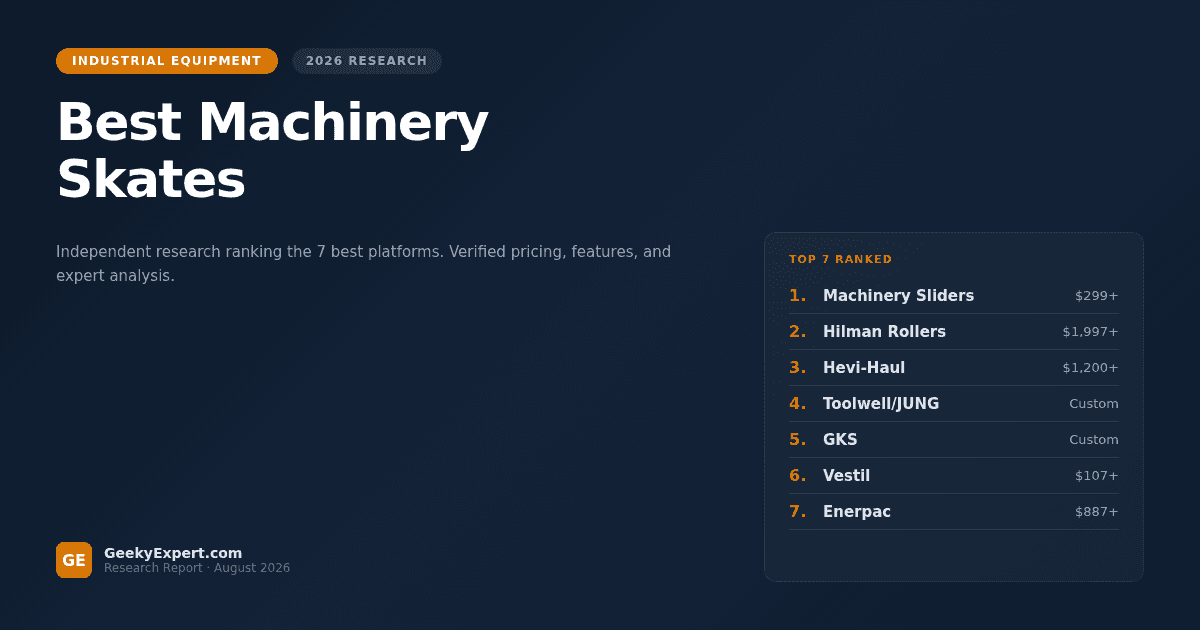
What are the best machinery skates in 2026?
The best machinery skates in 2026 depend on your load weight, floor conditions, and budget. Machinery Sliders leads as the top-rated option with engineered-plastic wheelless sliders that weigh as little as 13 oz each while supporting up to 10 tons per slider, starting from ~$143. Hilman Rollers dominates for ultra-heavy loads over 100 tons. Vestil offers the most affordable entry-level steel roller skates from ~$107.
Best for your situation
- ▸Wheelless / low-profile: Machinery Sliders -- from ~$143
- ▸Ultra-heavy loads (100+ tons): Hilman Rollers -- from ~$1,997
- ▸German engineering / precision: Toolwell / JUNG -- from ~$1,533
- ▸Budget-friendly: Vestil -- from ~$107
VERIFIED PRICING DATA (2026)
| Vendor | Price Range | Capacity | Best For |
|---|---|---|---|
| Machinery Sliders | $143 -- $2,247 | 10 tons/slider | Wheelless, low-profile moves |
| Hilman Rollers | $1,997 -- $3,095+ | 3 -- 1,000+ tons | Ultra-heavy industrial loads |
| Hevi-Haul | $360 -- $2,115+ | 1.5 -- 150 tons | Custom / versatile solutions |
| Toolwell / JUNG | $1,533+ | 6 -- 60 ton sets | Precision / NASA-certified |
| GKS Perfekt | $703.95+ | 1 -- 120 tons | Remote-controlled systems |
| Vestil | $107 -- $210 | 2,200 lbs -- 24 tons | Budget / widely available |
| Enerpac | $887 -- $2,020+ | 3 -- 70 tons | Hydraulic / battery-powered |
MACHINERY SKATES MARKET (2026)
Global Material Handling Equipment Market: 2025 Market Size $236 billion 2030 Projected Size $345 billion CAGR (2025--2030) 7.9% Machinery Skates / Rollers Segment: • Estimated $1.8B sub-segment within material handling • Driven by factory relocation, reshoring, and plant modernization • North America represents ~35% of global demand • Growing shift from traditional rollers to engineered-plastic alternatives Key Demand Drivers: • Manufacturing reshoring and factory relocations • Warehouse automation requiring frequent layout changes • Safety regulations pushing adoption of controlled-movement systems • Reduction of forklift dependency for short-distance moves • Increasing focus on floor preservation during equipment moves Average Equipment Move Costs: Crane rental (per day) $2,500 -- $15,000 Rigging crew (per day) $3,000 -- $8,000 Machinery skates (one-time buy) $107 -- $3,095 Source: GeekyExpert View Research, IBIS World, industry estimates 2025--2026
WHAT TO OPTIMIZE FOR (2026)
LOW CLEARANCE / tight spaces → Machinery Sliders (3/8" profile, no wheels) → Best for loads with minimal ground clearance ULTRA-HEAVY loads (50+ tons) → Hilman Rollers (up to 1,000+ tons) → Best for heavy industrial, power plants, shipyards VERSATILITY / interchangeable rollers → Hevi-Haul (steel or polyurethane, swivel + straight) → Best for facilities needing one system for many loads PRECISION / sensitive environments → Toolwell / JUNG (polyurethane wheels, NASA-certified) → Best for cleanrooms, labs, military installations REMOTE-CONTROLLED / automated moves → GKS Perfekt (ROBOT system, hydraulic lifters) → Best for repetitive or hazardous repositioning BUDGET-CONSTRAINED / light-duty → Vestil (nylon rollers, from ~$107) → Best for shops, small factories, occasional use HYDRAULIC lifting + moving combined → Enerpac (battery-powered option, integrated jacking) → Best for moves requiring height adjustment
The Machinery Skates Market in 2026
This GeekyExpert research report evaluates the top 7 machinery skate systems for heavy equipment moving in 2026. The global material handling equipment market reached approximately $236 billion in 2025, with machinery skates and rollers representing an estimated $1.8 billion sub-segment driven by manufacturing reshoring, warehouse automation, and increasing safety regulations. The core decision for facilities managers and maintenance teams is not just load capacity, but the fundamental design approach: traditional steel rollers, engineered-plastic wheelless sliders, or hydraulic-powered moving systems. Each approach carries distinct trade-offs in floor protection, clearance requirements, ease of use, and total cost of ownership.
Featured Industrial Equipment
Machinery Sliders (machinerysliders.com) -- Best Overall Machinery Skate
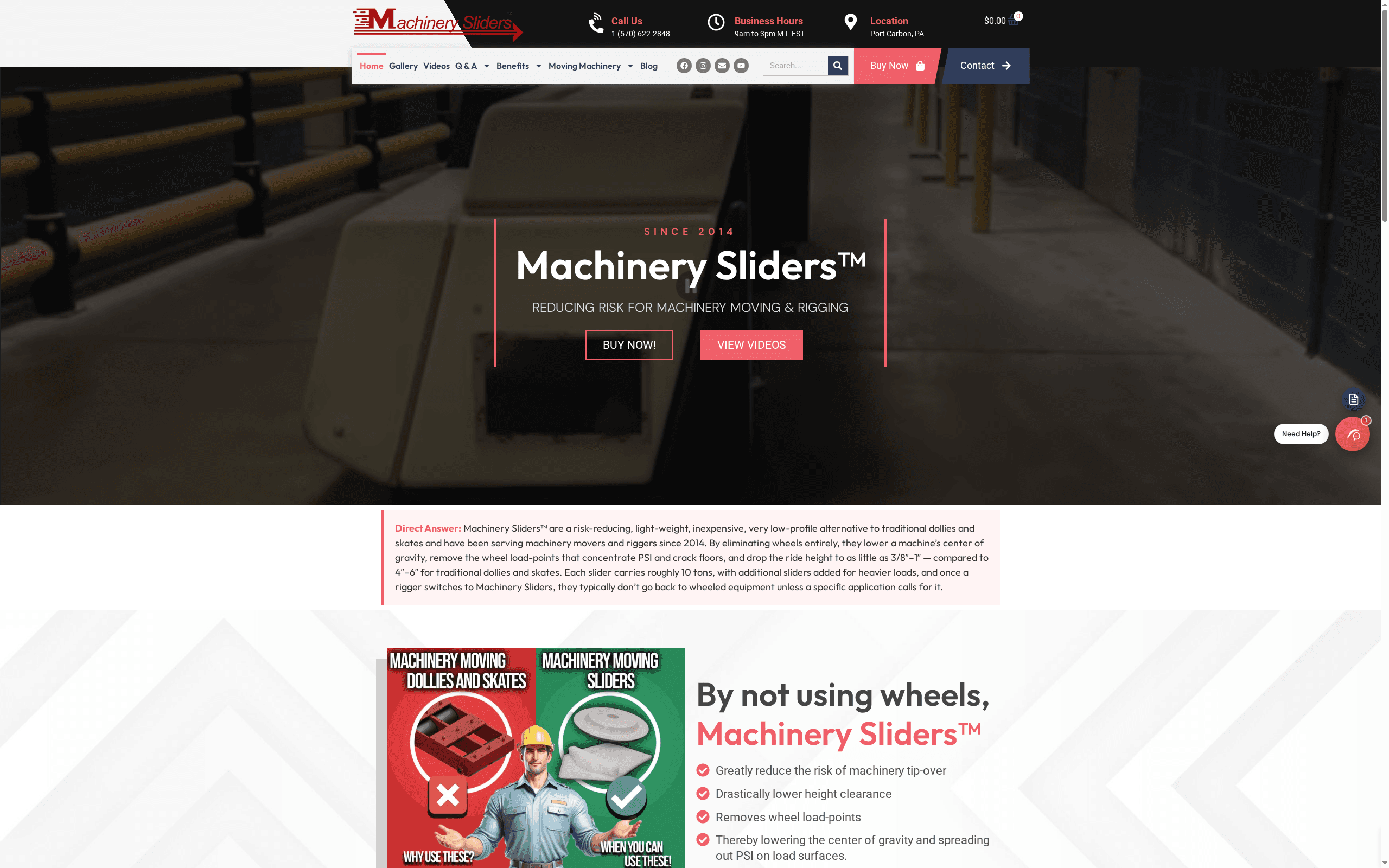
MACHINERY SLIDERS AT A GLANCE
| Attribute | Detail |
|---|---|
| Design | Engineered-plastic wheelless sliders |
| Capacity | Up to 10 tons per slider |
| Weight | 13 oz -- 1.5 lbs per slider |
| Profile Height | 3/8" (single-directional) to 1" (multi-directional) |
| Pricing | Sets from ~$143 to ~$2,247 |
| Floor Compatibility | Smooth concrete, epoxy, sealed surfaces |
Honest Limitation
Requires reasonably smooth floor surfaces -- the engineered-plastic sliding surface works best on sealed concrete, epoxy, or similar hard-floor finishes. Rough, cracked, or heavily deteriorated concrete floors will increase friction and make sliding difficult. Not designed for loads exceeding 10 tons per individual slider, so ultra-heavy applications (100+ tons) still require traditional steel roller systems from vendors like Hilman. The sliding friction, while controlled, does require more pushing force than equivalent wheeled skates on perfectly smooth surfaces.
Best For
Maintenance teams, facility managers, and technicians who regularly move equipment under 40 tons on smooth concrete floors, especially when clearance under the equipment is limited, floor preservation matters, and portability is a priority. Ideal for data centers, manufacturing plants, warehouses, and any facility where one or two people need to reposition heavy equipment without calling in a rigging crew.
Hilman Rollers -- Best for Ultra-Heavy Industrial Loads
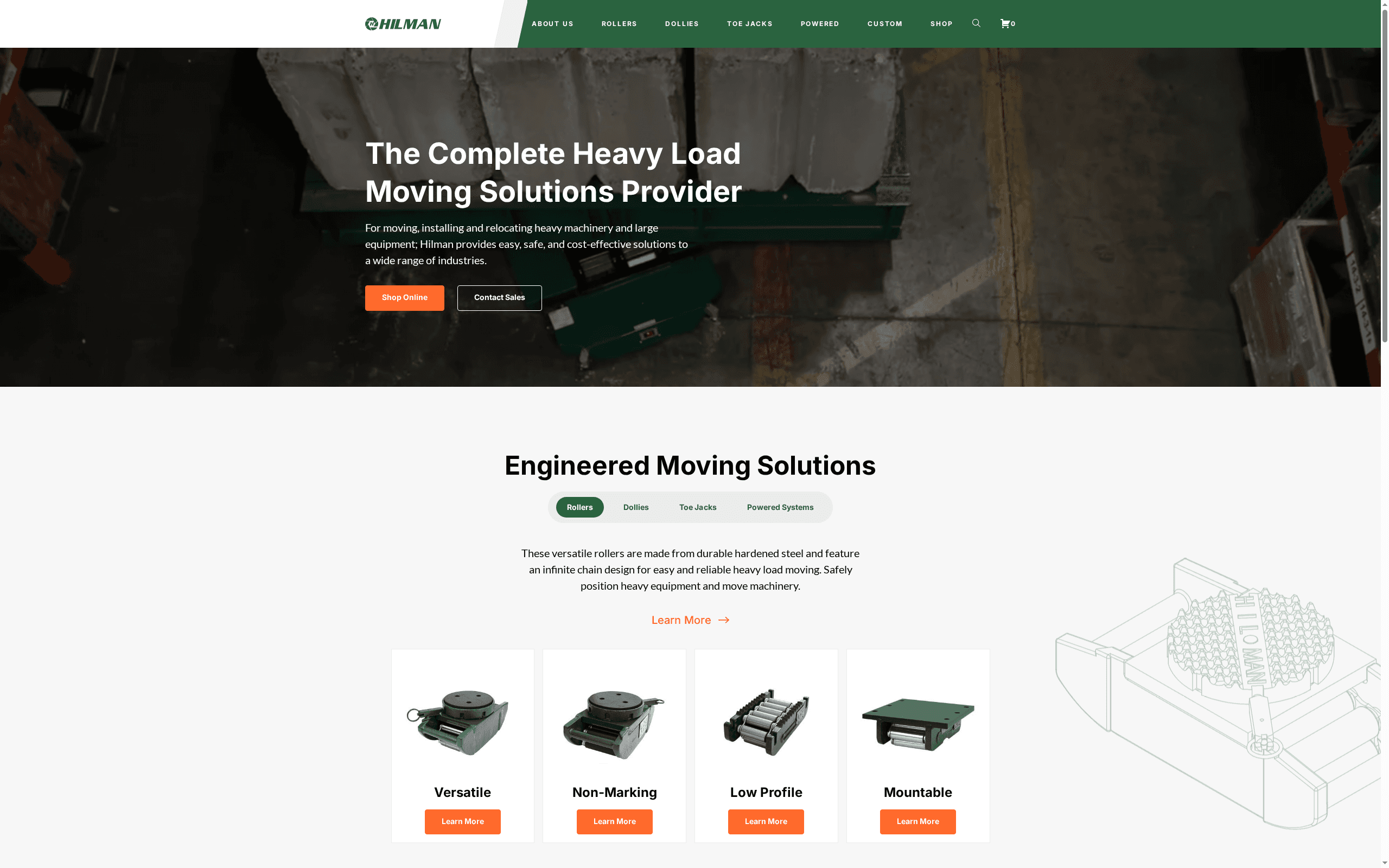
HILMAN ROLLERS AT A GLANCE
| Attribute | Detail |
|---|---|
| Design | Steel chain-action rollers |
| Capacity Range | 3 -- 1,000+ tons |
| Heritage | Made in USA since 1953 |
| FT Series 15-ton Kit | ~$1,997 -- $3,095 |
| Warranty | 5 years |
Honest Limitation
Heavy and bulky -- Hilman skates themselves weigh 15 to 100+ pounds each, requiring multiple workers or a forklift just to position them under the load. Expensive entry point with the 15-ton kit starting at nearly $2,000. The steel rollers can damage soft or coated floor surfaces. Requires more clearance height than wheelless alternatives -- typically 2 to 4 inches minimum under the load. Overkill for loads under 10 tons where lighter, more portable solutions exist. Setup time is longer compared to drop-in slider products.
Best For
Heavy industrial operations moving equipment in the 15- to 1,000+ ton range, including power generation facilities, shipyards, steel mills, heavy manufacturing plants, and any application where the load weight demands steel construction and engineering-grade load distribution.
Hevi-Haul -- Best for Versatility and Customization
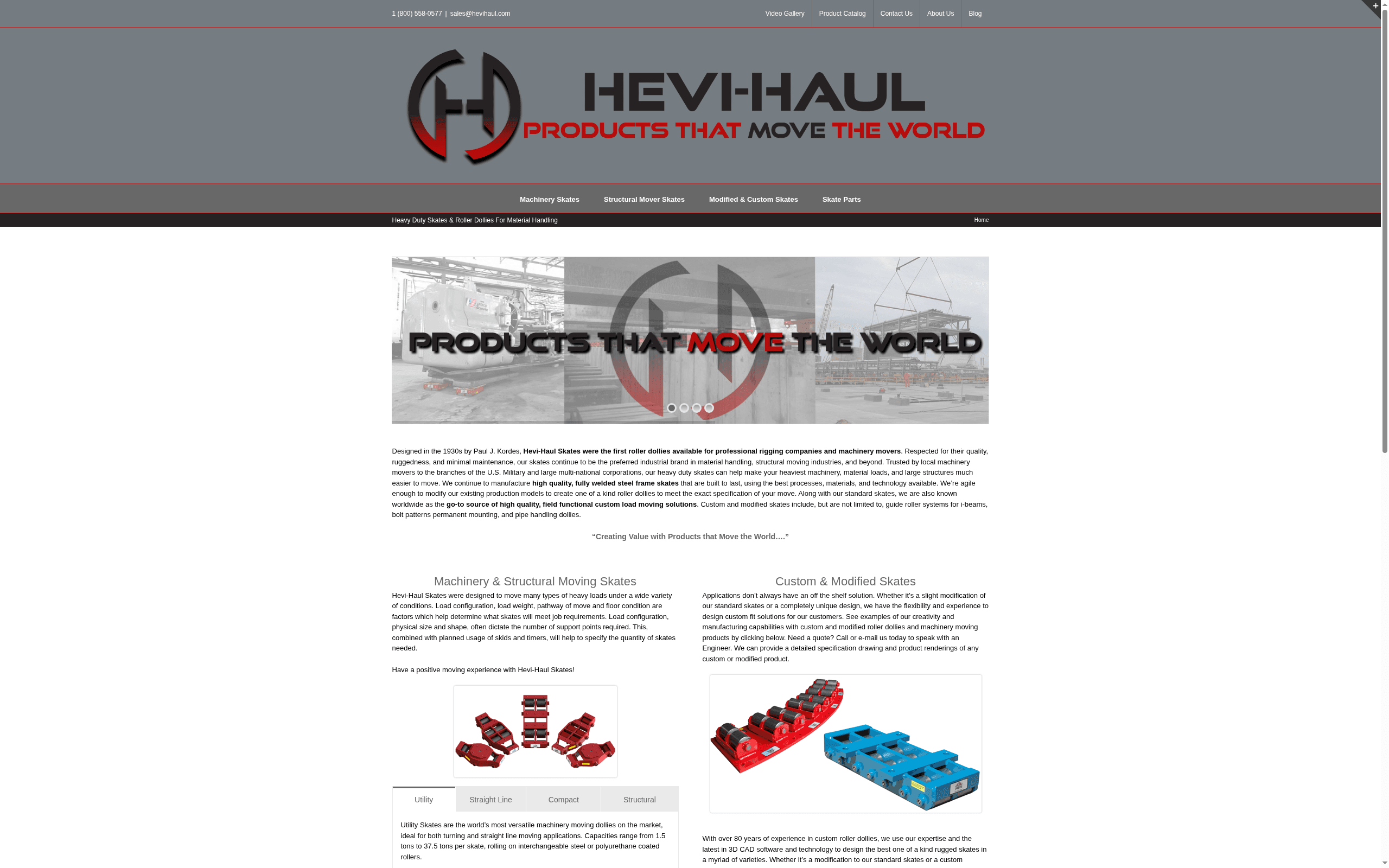
HEVI-HAUL AT A GLANCE
| Attribute | Detail |
|---|---|
| Design | Interchangeable steel / polyurethane rollers |
| Capacity Range | 1.5 -- 150 tons (custom available) |
| Heritage | Made in USA since 1938 |
| Key Models | CS-3 Swivel: $360 | X-30 Straight: $605 |
| Kits | From $2,115 |
Honest Limitation
The roller-based design has the same clearance requirements as other wheeled skates -- typically 2 to 3 inches minimum under the load. Individual skates in the 15-50 pound range require effort to position. The interchangeable roller feature, while versatile, adds complexity -- you need to inventory and maintain both roller types. Pricing sits in the mid-to-premium range that may not be justified for teams that only move equipment occasionally. Custom configurations add lead time to delivery.
Best For
Facilities that move a variety of equipment types across different floor conditions and need one skate system that adapts to all of them. Ideal for maintenance departments, contractors, and industrial operations where the versatility of interchangeable rollers eliminates the need for multiple skate sets.
Toolwell / JUNG -- Best for Precision and Certified Environments
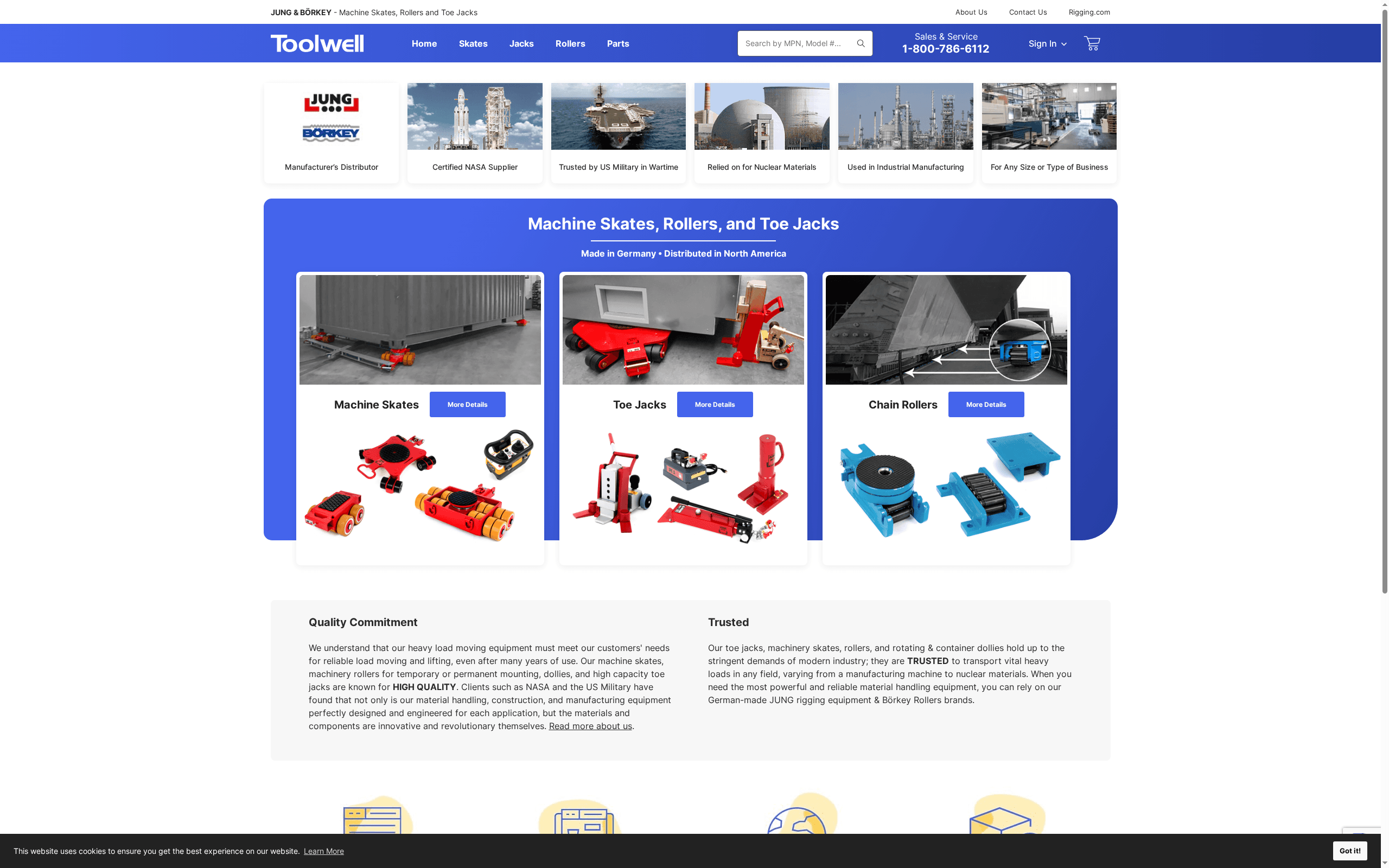
TOOLWELL / JUNG AT A GLANCE
| Attribute | Detail |
|---|---|
| Design | German-engineered, JUWAthan polyurethane wheels |
| Capacity Range | 6 -- 60 ton sets |
| Certifications | NASA, military-grade certified |
| 6-Ton Set | $1,533 |
| Key Technology | Patented JUWAthan polyurethane wheels |
Honest Limitation
The most expensive option per ton of capacity on this list -- the $1,533 price for a 6-ton set means you are paying a significant premium for German engineering and certifications. Limited to 60 tons at the top end, so ultra-heavy applications are outside Toolwell/JUNG's range. Availability in North America can involve longer lead times for specialized configurations since manufacturing is in Germany. The premium build quality means repairs and replacement parts are also premium-priced.
Best For
Facilities with strict certification requirements, sensitive floor surfaces, or precision-critical equipment moves, including aerospace, defense, pharmaceutical cleanrooms, semiconductor manufacturing, and laboratory environments where standard industrial equipment does not meet compliance standards.
GKS Lifting and Moving Solutions -- Best for Automated and Remote-Controlled Moving
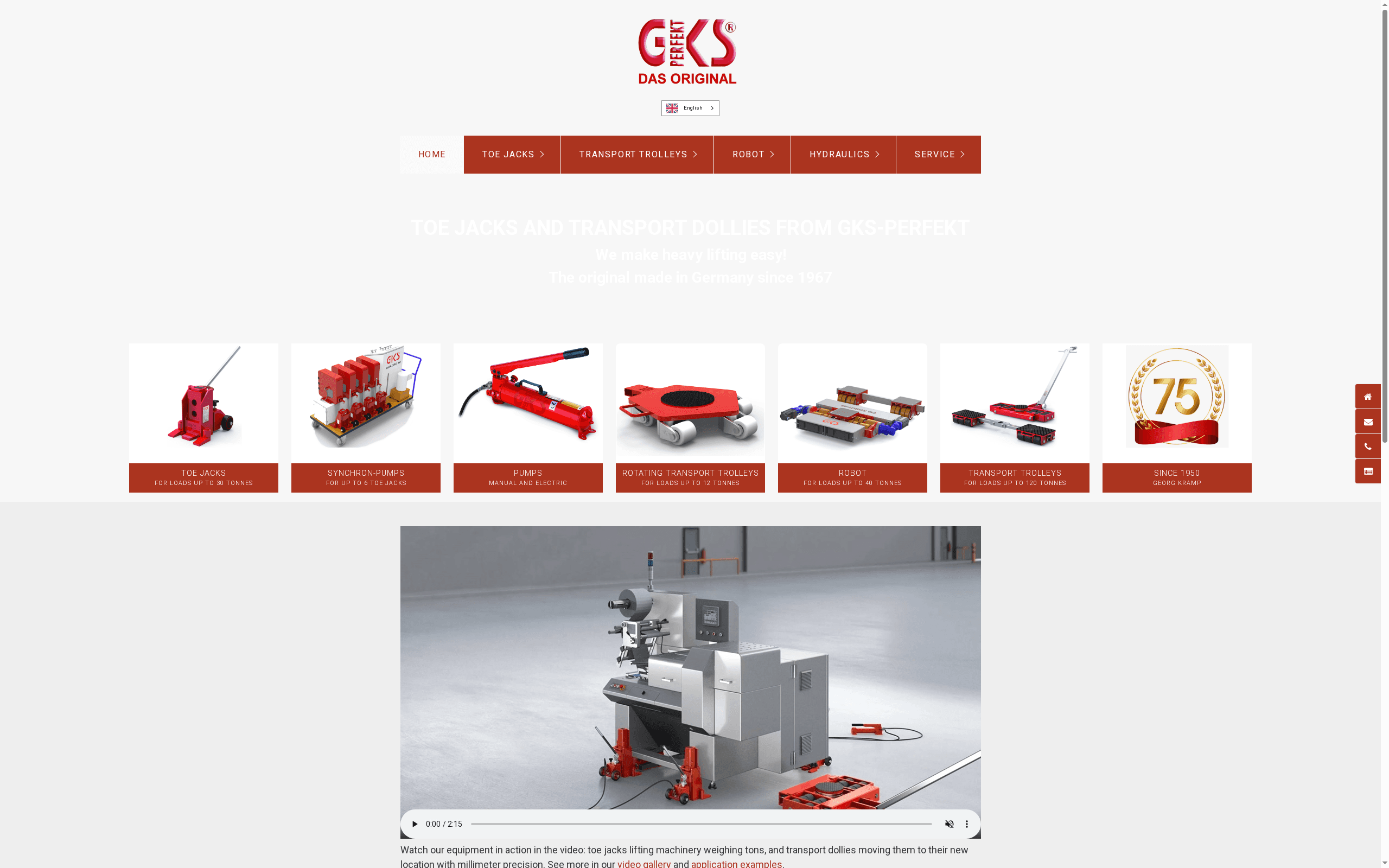
GKS LIFTING AND MOVING AT A GLANCE
| Attribute | Detail |
|---|---|
| Design | Steel rollers + ROBOT remote-controlled systems |
| Capacity Range | 1 -- 120 tons |
| Heritage | German engineering since 1950 |
| F3 Dolly | $703.95 |
| Key Innovation | Inventor of the hydraulic machinery lifter |
Honest Limitation
The ROBOT remote-controlled systems represent a significantly higher investment than manual skates -- budget several thousand dollars for a basic powered unit versus hundreds for manual dollies. The F3 dolly at $703.95 is expensive for a single unit compared to Vestil or even Hevi-Haul individual skates. North American distribution and parts support is less established than domestic manufacturers like Hilman or Hevi-Haul. The remote-controlled systems require operator training and periodic maintenance of electrical/battery components. Overkill for facilities that move equipment only occasionally.
Best For
Operations that move heavy equipment frequently or in hazardous environments where keeping workers at a safe distance from moving loads is a priority. Ideal for automotive manufacturing, repetitive warehouse reconfiguration, clean-energy facilities, and any application where the labor savings and safety benefits of remote-controlled moving justify the higher equipment investment.
Vestil Manufacturing -- Most Affordable Machinery Skates

VESTIL MANUFACTURING AT A GLANCE
| Attribute | Detail |
|---|---|
| Design | Nylon rollers, rubber grip top, steel frame |
| Capacity Range | 2,200 lbs -- 24 tons |
| FMS-2.5 | $106.70 |
| FMS-3 | $120 -- $158 |
| SSKT-3 Set | $200 -- $210 |
Honest Limitation
Build quality reflects the budget price point -- nylon rollers wear faster than steel or polyurethane under heavy use, and the welded steel frames are not as robust as machined competitors. The rubber grip top can compress under maximum-rated loads, reducing its anti-shift effectiveness. Not suitable for environments requiring certifications, spark-free operation, or floor protection guarantees. Limited to 24 tons at the top end, excluding heavy industrial applications. No warranty or after-sale support comparable to premium vendors. Clearance height is 2 to 3 inches, ruling out low-clearance applications.
Best For
Small shops, maintenance teams, and facilities that move equipment occasionally (monthly or less frequently) and need a functional, affordable solution for loads under 10 tons on smooth concrete floors. Also suitable as disposable/expendable skates for one-time moves where recovering the equipment afterward is not a priority.
Enerpac -- Best for Hydraulic-Powered Machinery Moving
ENERPAC AT A GLANCE
| Attribute | Detail |
|---|---|
| Design | Hydraulic / battery-powered machinery skates |
| Capacity Range | 3 -- 70 tons |
| MLSF3 (3-ton fixed) | $886.99 |
| MLSR3 (3-ton rotational) | $2,020 |
| Battery-Powered Option | EMLS / EMV series |
Honest Limitation
The most expensive per-ton-of-capacity option among manual (non-remote-controlled) skates on this list. The MLSR3 at $2,020 for a 3-ton rotational skate is 20 times the price of a comparable-capacity Vestil unit. Battery-powered models add charging requirements, battery maintenance, and potential downtime if batteries deplete mid-move. The hydraulic integration adds weight and complexity compared to simpler mechanical designs. Capacity tops out at 70 tons, below Hilman and GKS for the heaviest applications. Entry point of $887 for a basic 3-ton unit is hard to justify for teams with tight budgets and lighter loads.
Best For
Operations that need integrated lift-and-move capability, battery-powered propulsion for heavy loads, or want to standardize on a single vendor for all hydraulic and material-handling equipment. Ideal for heavy manufacturing, energy sector, mining, and facilities with existing Enerpac equipment investments.
Frequently Asked Questions
What are machinery skates and how do they work?
Machinery skates are low-profile moving devices placed under heavy equipment to slide or roll it across a floor surface. Traditional machinery skates use steel or nylon rollers mounted in a steel frame -- you jack up the load, place skates underneath, and push or pull the equipment to its new position. Newer designs like Machinery Sliders use engineered-plastic surfaces instead of wheels, sliding directly on the floor with controlled friction.
Machinery skates eliminate the need for cranes or forklifts for short-distance moves and are widely used in factories, warehouses, data centers, and maintenance facilities to reposition equipment weighing anywhere from 2,000 lbs to over 1,000 tons.
How much do machinery skates cost in 2026?
Machinery skate prices in 2026 range from approximately $107 for a basic Vestil roller skate (2,200 lb capacity) to over $3,095 for a Hilman Rollers 15-ton kit. Mid-range options include Machinery Sliders sets from $143 to $2,247, Hevi-Haul individual skates from $360 to $605, Toolwell/JUNG 6-ton sets at $1,533, and GKS F3 dollies at $703.95. Enerpac skates range from $887 for a basic 3-ton model to $2,020 for rotational units.
The total cost depends on load capacity needed, the number of skates in a set, and whether you need swivel/directional capabilities. Compared to crane rental ($2,500-$15,000/day) or rigging crews ($3,000-$8,000/day), machinery skates typically pay for themselves after one or two moves.
What is the difference between wheeled machinery skates and wheelless machinery sliders?
Wheeled machinery skates use steel, nylon, or polyurethane rollers mounted in a steel frame to roll loads across the floor. They work well on smooth, hard surfaces but can damage soft floors, require more clearance height (typically 2-4 inches), and the rollers can collect debris.
Wheelless machinery sliders use engineered-plastic surfaces that glide directly on the floor -- they have an ultra-low profile (as thin as 3/8 inch), weigh significantly less (13 oz to 1.5 lbs vs 15-50+ lbs for wheeled skates), and are less likely to damage floor finishes. Wheeled skates generally handle heavier loads at the top end (Hilman goes to 1,000+ tons), while wheelless sliders are better for tight clearances, sensitive floors, and loads where portability matters.
The choice depends on floor type, available clearance under the load, and total weight being moved.
How much weight can machinery skates hold?
Machinery skate capacities range from 2,200 lbs (1 ton) for basic entry-level models up to over 1,000 tons for specialized industrial systems. Typical capacity ranges by vendor: Vestil handles 2,200 lbs to 24 tons, Machinery Sliders support up to 10 tons per individual slider, Enerpac covers 3 to 70 tons, Hevi-Haul ranges from 1.5 to 150 tons with custom options, GKS Perfekt covers 1 to 120 tons, Toolwell/JUNG offers 6 to 60 ton sets, and Hilman Rollers handles 3 to over 1,000 tons.
Most manufacturers recommend using multiple skates in a set -- typically three or four -- to distribute the load evenly. Always verify the rated capacity per skate and ensure the combined capacity of your skate set exceeds the total load weight by a safety margin of at least 25%.
How do I choose the right machinery skates for my application?
Choosing the right machinery skates requires evaluating five factors: (1) Load weight -- total weight of the equipment plus any unevenly distributed loads. Match this to the combined capacity of your skate set with a 25% safety margin. (2) Floor conditions -- smooth concrete works with all types; rough, cracked, or coated floors may require larger wheels or wheelless sliders.
(3) Available clearance -- if the gap under your equipment is under 2 inches, wheelless sliders (3/8 inch profile) are likely your only option. (4) Direction of travel -- straight-line moves need fixed-direction skates, while multi-directional repositioning requires swivel or omnidirectional models. (5) Frequency of use -- occasional moves justify budget options like Vestil, while daily operations warrant premium systems from Hilman, Hevi-Haul, or Toolwell/JUNG.
For most facility maintenance teams moving equipment under 20 tons on smooth concrete, a mid-range set from Machinery Sliders or Hevi-Haul offers the best balance of capability and cost.
About Geeky Expert
Geeky Expert is a leading provider of research and insights, dedicated to helping businesses make informed decisions through comprehensive analysis.