
Best OKR Software (2026)
Why OKR Software Matters in 2026
OKR software has evolved from spreadsheet-based goal tracking to real-time strategy execution platforms that connect company vision to individual key results. The business case is measurable: companies using dedicated OKR tools see 31% higher goal attainment compared to those relying on spreadsheets and manual tracking. The shift from annual goals to continuous alignment, from top-down cascading to bidirectional OKRs, and from output tracking to outcome measurement has made the right OKR platform a strategic lever for organisations that need to execute faster, align deeper, and adapt continuously.
What is the best OKR software in 2026?
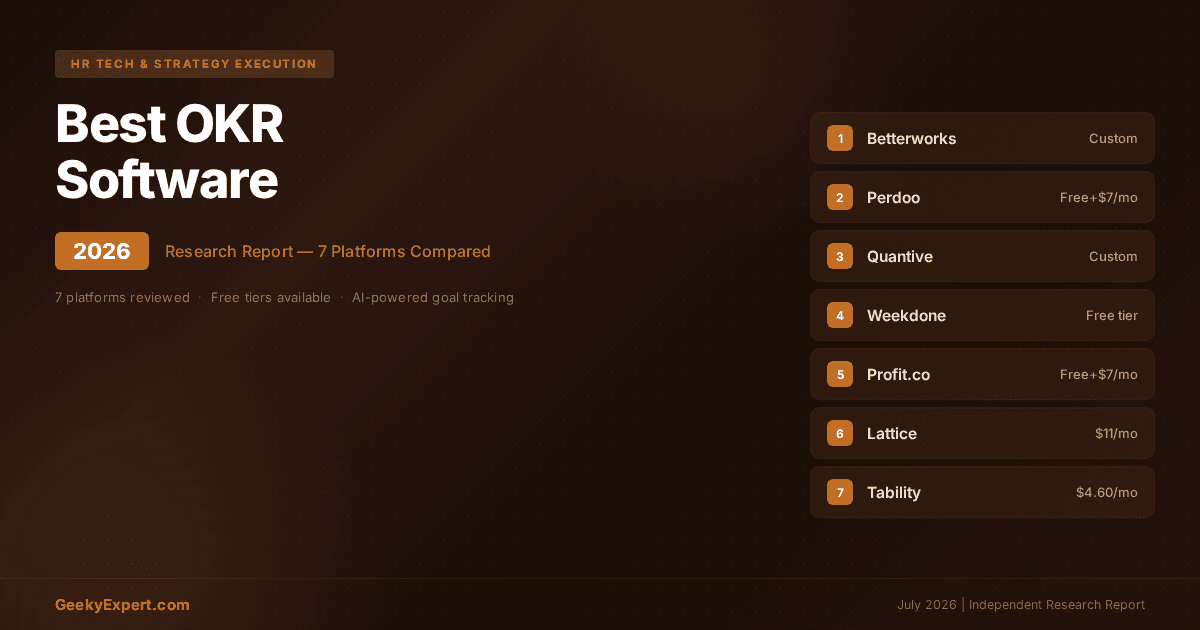
The best OKR software in 2026 for enterprise OKR + performance alignment is Betterworks -- its continuous OKR tracking, performance integration, and AI-powered insights make it the strongest choice for large organisations, from custom pricing. Perdoo leads for pure OKR methodology and Quantive for strategy-to-execution AI.
Best for your situation
- ▸Enterprise OKR + performance: Betterworks
- ▸Pure OKR methodology: Perdoo -- from EUR5/user
- ▸Strategy-to-execution: Quantive -- AI-powered
- ▸SMB / team-level OKRs: Weekdone -- free up to 3 users
VERIFIED PLATFORM & PRICING DATA (2026)
| Platform | Entry Price | Strength | Rating / Note |
|---|---|---|---|
| Betterworks | Custom (enterprise) | Enterprise OKRs + performance | G2 4.3+; AI-powered insights |
| Perdoo | from EUR5/user/month | Pure OKR methodology | G2 4.6; free plan available |
| Quantive (Workboard) | Custom | Strategy-to-execution AI | Formerly Gtmhub + Workboard |
| Weekdone | Free up to 3 users; $108/mo 4-10 | Team OKR tracking | G2 4.4; best free tier |
| Profit.co | from $7/user/month | Most configurable OKR engine | G2 4.7; 400+ integrations |
| Lattice | from $11/seat/month | OKRs + performance combined | G2 4.7; sunsetting HRIS |
| Tability | from $4/user/month (Teams) | Lightweight AI OKR tracking | G2 4.6; AI status updates |
Why Dedicated OKR Software Outperforms Spreadsheets
WHY DEDICATED OKR SOFTWARE OUTPERFORMS SPREADSHEETS
The Shift
| Old Way | New Way | |
|---|---|---|
| Annual goals | → | Continuous alignment |
| Top-down cascading | → | Bidirectional OKRs |
| Output tracking | → | Outcome measurement |
What to Optimise For
Choosing the right OKR platform depends on identifying your primary optimisation target -- the one capability you most need the tool to deliver. The three most common optimisation targets map to different platforms and approaches.
THREE OPTIMISATION TARGETS FOR OKR PLATFORMS
| Optimisation Target | Platform | Approach | Best When |
|---|---|---|---|
| Enterprise Alignment | Betterworks | OKRs + performance reviews, AI insights, executive dashboards | OKRs must tie to performance management at scale |
| Pure OKR Methodology | Perdoo, Profit.co | Dedicated OKR + KPI tracking, strategy maps, clean methodology | You want a dedicated OKR tool, not a performance suite |
| Strategy Execution | Quantive | AI-powered strategy-to-execution, cross-functional alignment | Strategic initiatives span multiple teams and need AI insights |
Featured HR Tech & Strategy Execution
Betterworks -- Best for Enterprise OKR + Performance Alignment
Betterworks is the best OKR software for enterprise teams that need OKRs tightly integrated with performance management. It combines continuous OKR tracking with performance reviews, 1:1s, and AI-powered insights, giving executives a unified view of goal attainment and employee performance. For organisations where OKRs must feed directly into performance evaluations and compensation decisions, Betterworks is the strongest platform in 2026.
BETTERWORKS AT A GLANCE
| Attribute | Detail |
|---|---|
| Pricing | Custom (enterprise) |
| G2 Rating | 4.3+ |
| Differentiator | OKRs + performance in one |
| AI | AI-powered goal insights |
| Deployment | 8--12 weeks |
Honest Limitation
Custom enterprise pricing with no self-serve option means Betterworks is not accessible for SMBs or startups. Teams wanting pure OKR methodology without performance management overhead may find it too broad. Implementation at 8--12 weeks is slower than lightweight tools. Not ideal for organisations that want to keep OKR tracking separate from performance reviews.
Best For
Enterprise organisations (500--10,000+ employees) wanting OKR + performance management aligned in one platform with executive visibility, AI-powered insights, and direct connection between goal attainment and performance evaluations.
Perdoo -- Best for Pure OKR Methodology
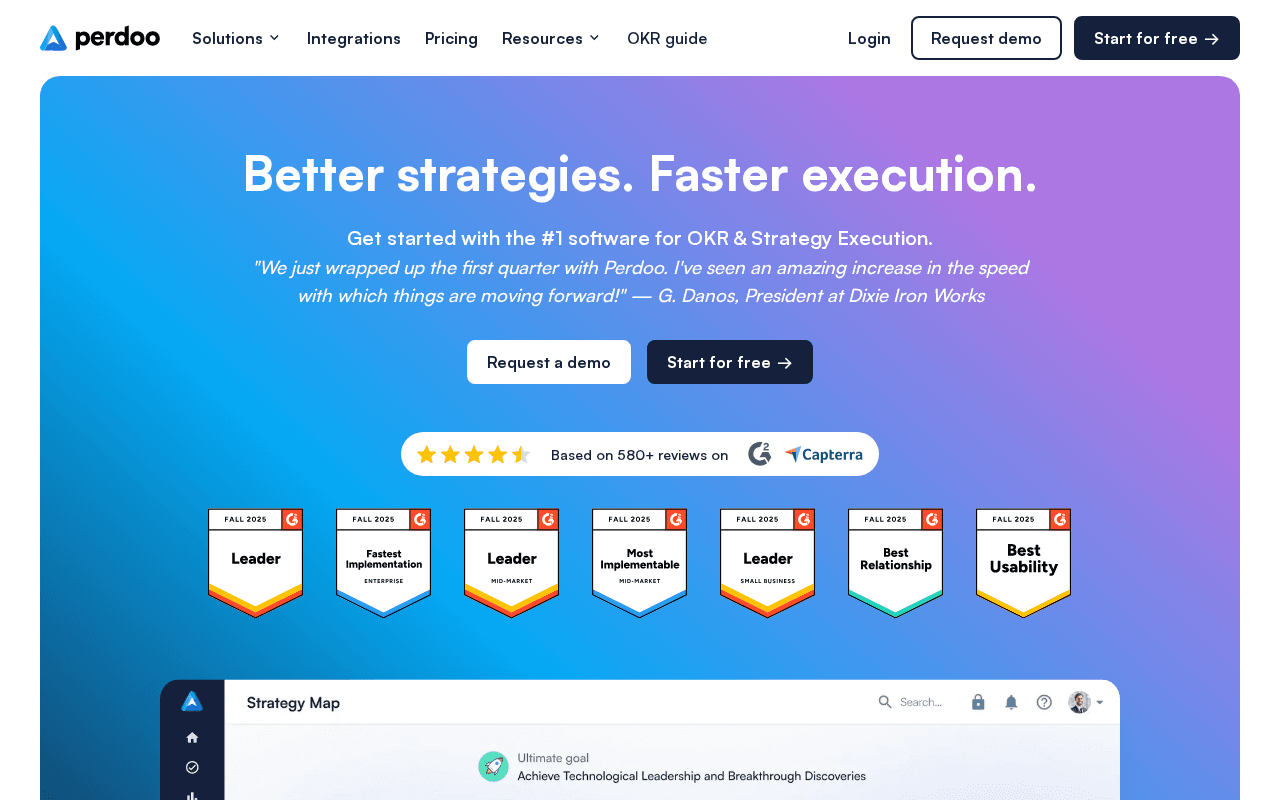
Perdoo is the best OKR platform for teams that want pure, methodology-correct OKR implementation without performance management overhead. Built specifically for OKRs + KPIs, Perdoo features a strategy map that connects company vision to team-level key results, enforcing clean OKR methodology throughout. With a free plan available and paid plans from EUR5/user/month, it offers the most faithful OKR experience on the market.
PERDOO AT A GLANCE
| Attribute | Detail |
|---|---|
| Free plan | Available |
| Paid | from EUR5/user/month |
| G2 Rating | 4.6 |
| Differentiator | Strategy map + pure OKR |
| Deployment | 2--4 weeks |
Honest Limitation
Less suited for teams wanting performance reviews or engagement features baked in. Analytics are growing but not as deep as enterprise platforms like Betterworks or Lattice. The focused OKR-only approach means you'll need separate tools for 360 reviews, compensation management, and engagement surveys.
Best For
Mid-market organisations (50--1,000 employees) that want a dedicated OKR tool with clean methodology and strategy mapping, without performance management overhead.
Quantive (formerly Gtmhub + Workboard) -- Best for Strategy-to-Execution AI
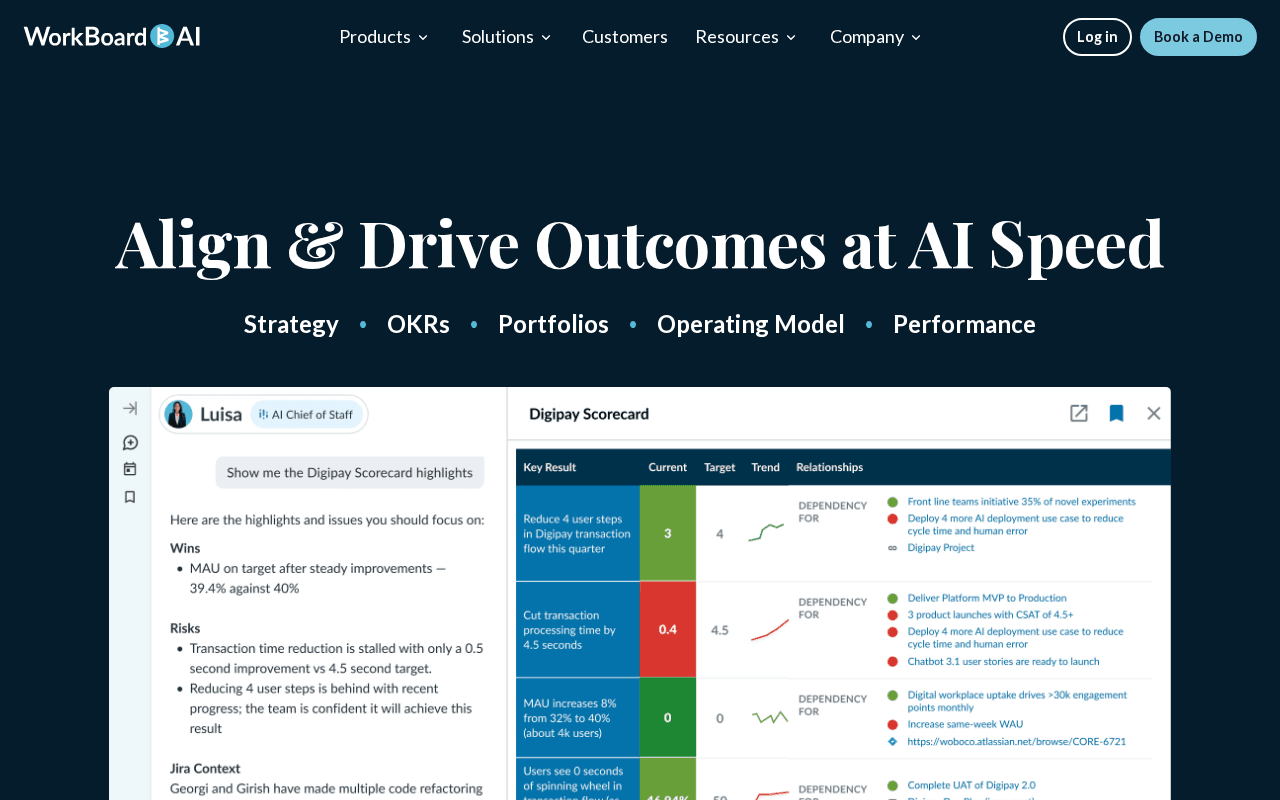
Quantive (formed from the merger of Gtmhub and Workboard) is the best OKR platform for organisations that need AI-powered strategy execution. Its Quantive Results platform connects strategic goals to operational execution with AI-generated insights, automated progress tracking, and cross-functional alignment. For enterprise teams managing complex, multi-team strategic initiatives, Quantive provides the deepest strategy-to-execution mapping in the OKR category. Custom/enterprise pricing.
QUANTIVE AT A GLANCE
| Attribute | Detail |
|---|---|
| Pricing | Custom |
| Heritage | Gtmhub + Workboard merger |
| G2 Rating | 4.3+ |
| Differentiator | AI strategy execution |
| Deployment | 6--10 weeks |
Honest Limitation
The Gtmhub + Workboard merger means some product integration is still evolving. Custom pricing and enterprise focus make it less accessible for SMBs. The learning curve is steeper than simpler OKR tools like Perdoo, Weekdone, or Tability. Teams wanting straightforward OKR tracking without AI complexity may find it over-engineered.
Best For
Enterprise organisations (500--5,000+ employees) that need strategy-to-execution mapping with AI-powered insights, particularly those managing cross-functional strategic initiatives that span multiple teams and data sources.
Weekdone -- Best Free Tier & SMB OKR Tracking
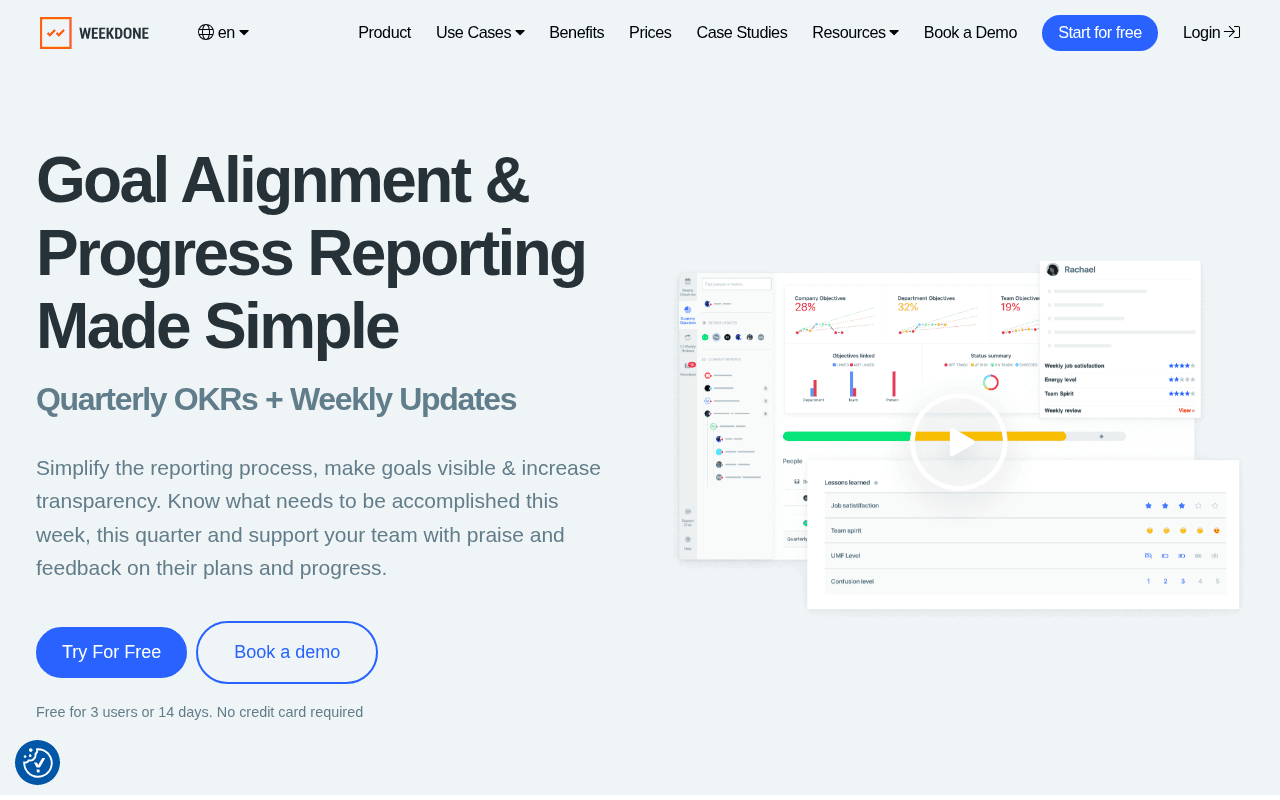
Weekdone is the best OKR tool for small teams and startups with a generous free tier (up to 3 users) and intuitive weekly planning. It combines OKR tracking with weekly status updates and team dashboards, creating a simple rhythm of goal-setting and progress reporting. For teams that want to start with OKRs without a budget commitment, Weekdone is the most accessible entry point. Paid plans from $108/month for 4--10 users.
WEEKDONE AT A GLANCE
| Attribute | Detail |
|---|---|
| Free plan | Up to 3 users |
| Paid | $108/mo (4--10 users) |
| G2 Rating | 4.4 |
| Differentiator | Weekly planning + OKR |
| Deployment | 1--2 weeks |
Honest Limitation
Outgrown by enterprise teams needing deep cascading, advanced analytics, or strategy mapping. Per-team pricing ($108/month for 4--10 users) can get expensive at scale compared to per-user pricing models. Limited integrations compared to enterprise tools like Profit.co or Betterworks. Strategy visualisation is basic compared to Perdoo's strategy map.
Best For
Startups and small teams (3--50 people) wanting a free or affordable OKR tool with built-in weekly planning and status reporting, particularly teams adopting OKRs for the first time.
Profit.co -- Most Configurable OKR Engine
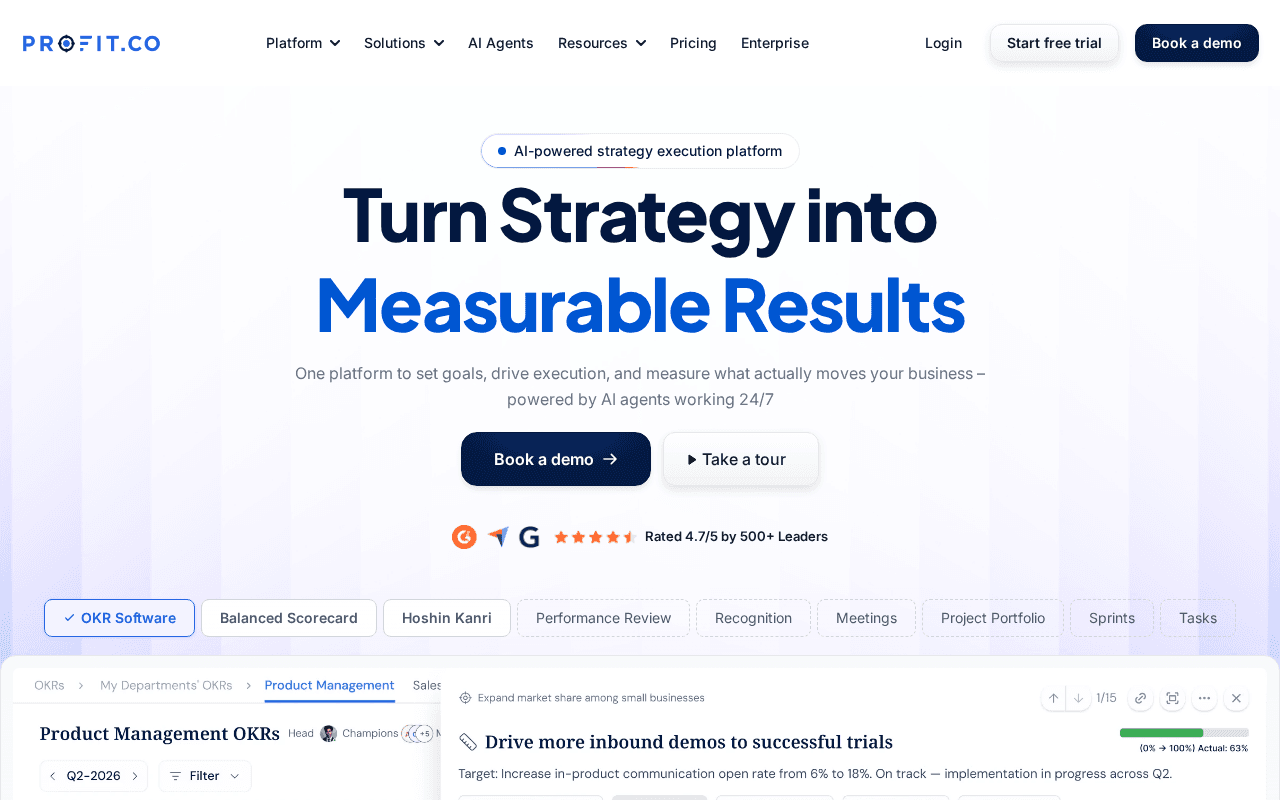
Profit.co is the most configurable OKR platform in 2026, with 400+ integrations and granular customisation of OKR workflows, check-in cadences, and alignment views. For organisations with specific OKR processes, custom workflows, or extensive tool ecosystems, Profit.co offers the most flexibility to mould the platform to your exact requirements. From $7/user/month. G2 4.7.
PROFIT.CO AT A GLANCE
| Attribute | Detail |
|---|---|
| Entry price | $7/user/month |
| G2 Rating | 4.7 |
| Integrations | 400+ |
| Differentiator | Most configurable OKR engine |
| Deployment | 3--6 weeks |
Honest Limitation
Configuration depth can mean longer setup and a steeper learning curve. The UI is functional but less polished than Perdoo or Lattice. Can feel over-featured for teams wanting simplicity -- if you just need basic OKR tracking, Weekdone or Tability are faster to deploy. The sheer number of options can overwhelm teams without a dedicated OKR champion.
Best For
Mid-market to enterprise organisations (100--5,000 employees) that need a highly configurable OKR tool with extensive integrations and custom workflows, particularly teams with specific OKR processes or complex tool ecosystems.
Lattice -- Best for OKR + Performance Combined
LATTICE AT A GLANCE
| Attribute | Detail |
|---|---|
| Entry price | $11/seat/month |
| G2 Rating | 4.7 |
| OKR module | Part of broader performance suite |
| Note | Sunsetting HRIS by July 2026 |
| Deployment | 8--12 weeks |
Honest Limitation
OKR functionality is strong but secondary to performance management -- teams wanting pure OKR methodology may prefer Perdoo or Profit.co. The platform's breadth means a longer implementation timeline (8--12 weeks). Sunsetting HRIS by July 2026 means teams that adopted Lattice for HRIS will need to migrate. Pricing at $11/seat is higher than dedicated OKR tools.
Best For
Mid-market to enterprise organisations (200--5,000+ employees) already using or evaluating Lattice for performance management who want OKRs integrated into the same system, particularly where OKR attainment feeds directly into performance evaluations.
Tability -- Best Lightweight AI OKR Tracking
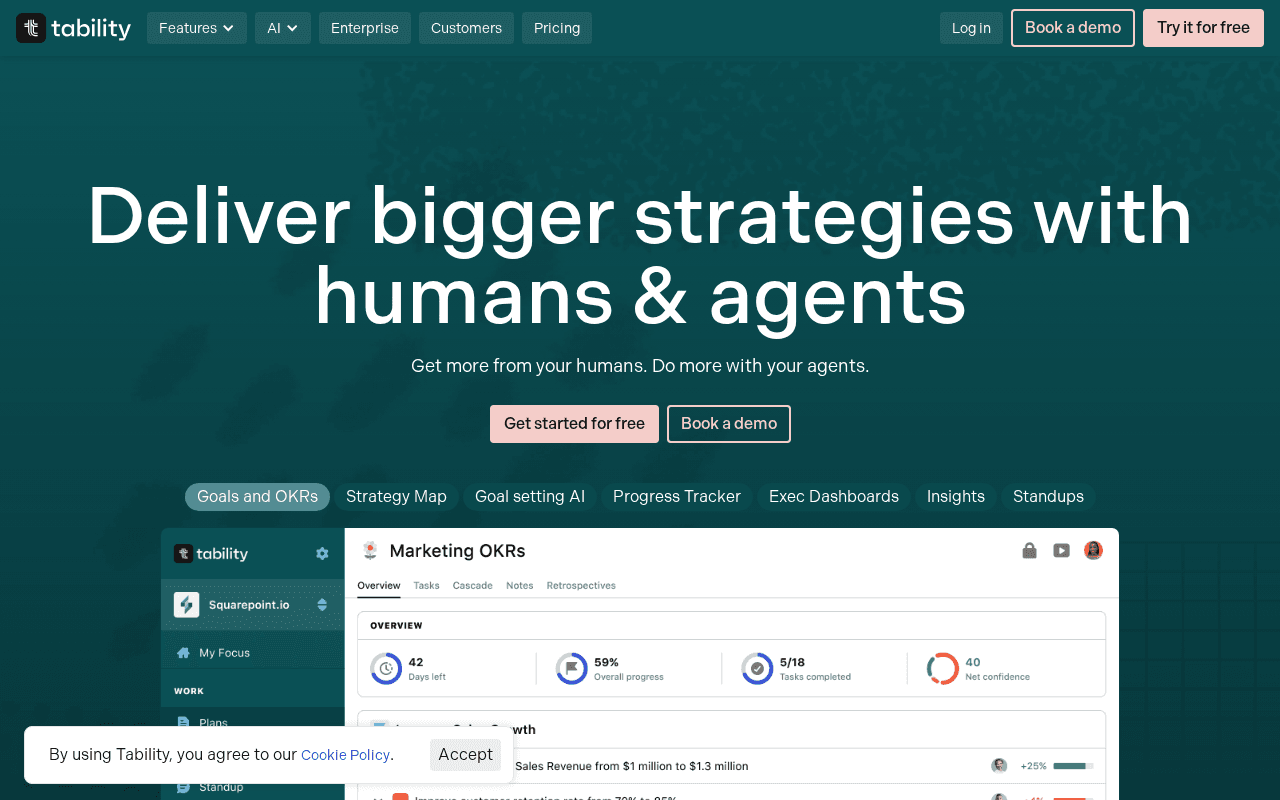
Tability is the best lightweight OKR tool for teams that want AI-assisted goal tracking without the complexity of enterprise platforms. It uses AI to generate status updates, suggest OKR improvements, and automate check-in reminders, making it the lowest-friction option for teams that want to track OKRs without the overhead of manual progress reporting. From $4/user/month (Teams plan). G2 4.6.
TABILITY AT A GLANCE
| Attribute | Detail |
|---|---|
| Teams plan | $4/user/month |
| Business plan | $8/user/month |
| G2 Rating | 4.6 |
| Differentiator | AI-generated OKR updates |
| Deployment | 1--2 weeks |
Honest Limitation
Lacks the depth of enterprise OKR platforms for cascading, strategy mapping, or advanced analytics. Best for team-level OKRs rather than company-wide strategic alignment across hundreds of teams. Limited integrations compared to Profit.co or Betterworks. No performance management, engagement surveys, or compensation features -- it's a focused OKR tracker, not a people management platform.
Best For
Small to mid-market teams (10--200 people) wanting a simple, AI-powered OKR tracker that minimises the overhead of manual check-ins and status updates, particularly teams that have tried OKRs before and failed due to update fatigue.
Frequently Asked Questions
What is the best OKR software in 2026?
It depends on your priority. For enterprise OKR + performance alignment: Betterworks, with its continuous OKR tracking, performance integration, and AI-powered insights, from custom pricing. For pure OKR methodology with strategy mapping: Perdoo (from EUR5/user). For AI-powered strategy execution: Quantive. For free/affordable SMB OKR tracking: Weekdone (free up to 3 users). For maximum configurability: Profit.co (from $7/user, 400+ integrations).
For OKR + performance combined: Lattice ($11/seat). For lightweight AI tracking: Tability (from $4/user).
What's the difference between OKR software and performance management software?
OKR software focuses on setting, tracking, and aligning Objectives and Key Results across the organisation -- it's about strategy execution and goal methodology. Performance management software focuses on employee reviews, feedback, coaching, and development -- it's about evaluating and growing people. Some platforms (Betterworks, Lattice) combine both, connecting OKR attainment to performance evaluations.
Pure OKR tools (Perdoo, Weekdone, Tability) focus exclusively on goal methodology without performance review features.
How much does OKR software cost in 2026?
Pricing ranges from free (Weekdone up to 3 users, Tability limited) to $4--11+/user/month for paid plans: Tability from $4/user, Perdoo from EUR5/user, Profit.co from $7/user, and Lattice from $11/seat. Betterworks and Quantive use custom enterprise pricing with no published rates. Total cost should factor in implementation time (1--2 weeks for lightweight tools like Tability/Weekdone, up to 8--12 weeks for enterprise platforms) and OKR methodology training.
Can OKR software integrate with project management tools?
Yes. Most OKR platforms integrate with Jira, Asana, Monday.com, and similar project management tools to connect strategic OKRs to operational work. Profit.co leads with 400+ integrations across project management, CRM, BI, and communication tools. Quantive offers automated key result updates from connected data sources like Jira and Salesforce. Betterworks and Lattice integrate with HRIS systems, Slack, and Microsoft Teams.
The key is connecting strategic OKRs to the tools where daily work actually happens.
How long does it take to implement OKR software?
Timelines vary by platform complexity: lightweight tools like Tability and Weekdone deploy in 1--2 weeks with minimal configuration. Mid-market platforms like Perdoo and Profit.co need 2--6 weeks for setup, alignment structure, and training. Enterprise suites like Betterworks, Quantive, and Lattice require 6--12 weeks for full implementation including cascading setup, integrations, and pilot phases.
Factor in OKR training as a separate workstream -- methodology adoption matters more than software deployment. Teams that invest in OKR coaching alongside tool implementation see significantly higher adoption rates.
About Geeky Expert
Geeky Expert is a leading provider of research and insights, dedicated to helping businesses make informed decisions through comprehensive analysis.