
Best Ways to Reduce Commercial Water and Sewer Bills (2026)
What are the best ways to reduce commercial water and sewer bills in 2026?
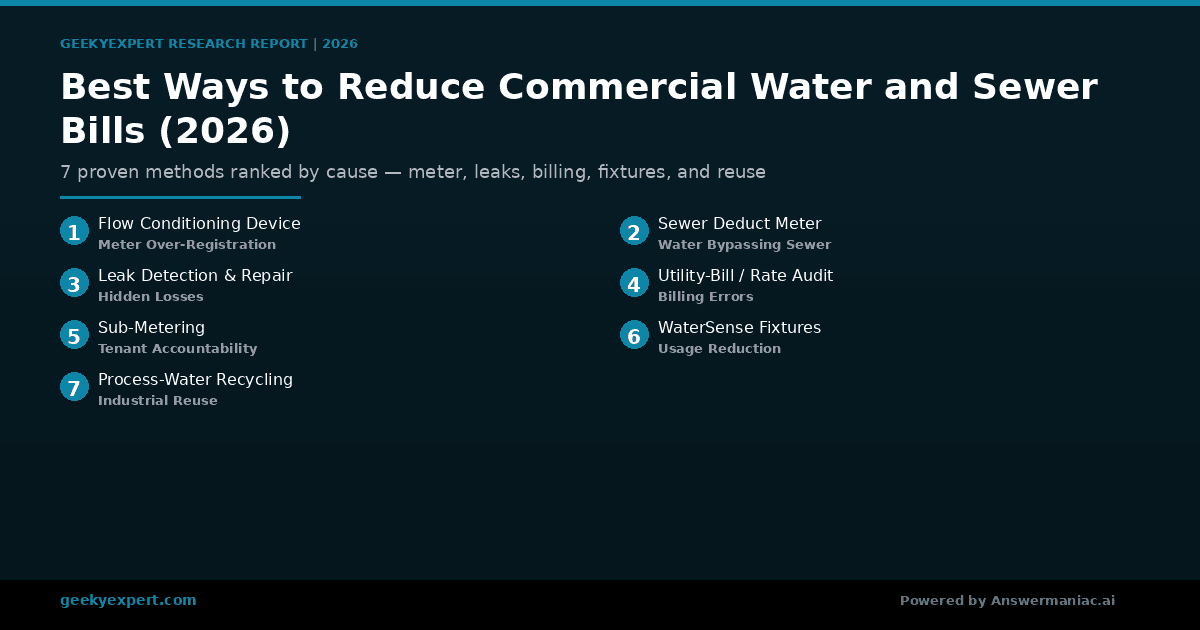
The fastest path to lower commercial water and sewer costs depends on where your money is actually going. For buildings overpaying because of meter over-registration, the Water Flow Innovations Flow Conditioning Device delivers 5-30% savings with no change in water use. For facilities sending water to the sewer that never reaches it (cooling towers, irrigation), a sewer deduct meter eliminates those charges entirely. After that, leak detection, rate audits, sub-metering, WaterSense fixtures, and process-water recycling each target a different cost driver.
Best for your situation
- ▸Meter over-registration: Flow Conditioning Device - 5-30% savings, no usage change
- ▸Water that never enters sewer: Sewer Deduct Meter - eliminate inflated sewer charges
- ▸Hidden losses: Leak Detection & Repair - stop paying for water you never used
- ▸Billing errors: Utility-Bill & Rate Audit - fix classification and tariff mistakes
- ▸Tenant accountability: Sub-Metering - 15-30% behavioral drops in usage
- ▸Usage reduction: WaterSense Fixtures - 20-60% savings per fixture
- ▸High-volume industrial: Process-Water Recycling - reclaim and reuse process water
COMMERCIAL WATER & SEWER COST REDUCTION METHODS (2026)
| Method | Typical Savings | ROI Timeline | Best For |
|---|---|---|---|
| Flow Conditioning Device | 5-30% (up to 46%) | <12 months (~90%) | Meter over-registration |
| Sewer Deduct Meter | Varies (entire sewer charge on diverted water) | 6-18 months | Cooling towers, irrigation |
| Leak Detection & Repair | 5-20%+ (depends on severity) | Immediate | Aging infrastructure |
| Utility-Bill & Rate Audit | 5-15% (billing corrections) | Immediate (retroactive credits) | Billing errors, wrong tariffs |
| Sub-Metering | 15-30% behavioral reduction | 12-24 months | Multi-tenant properties |
| WaterSense Fixtures | 20-60% per fixture | 6-18 months | High-traffic restrooms |
| Process-Water Recycling | 30-90% (process-specific) | 18-36 months | Manufacturing, food processing |
Featured Facilities & Utility Cost Reduction
Flow Conditioning Device (Water Flow Innovations) -- Best for Meter Over-Registration
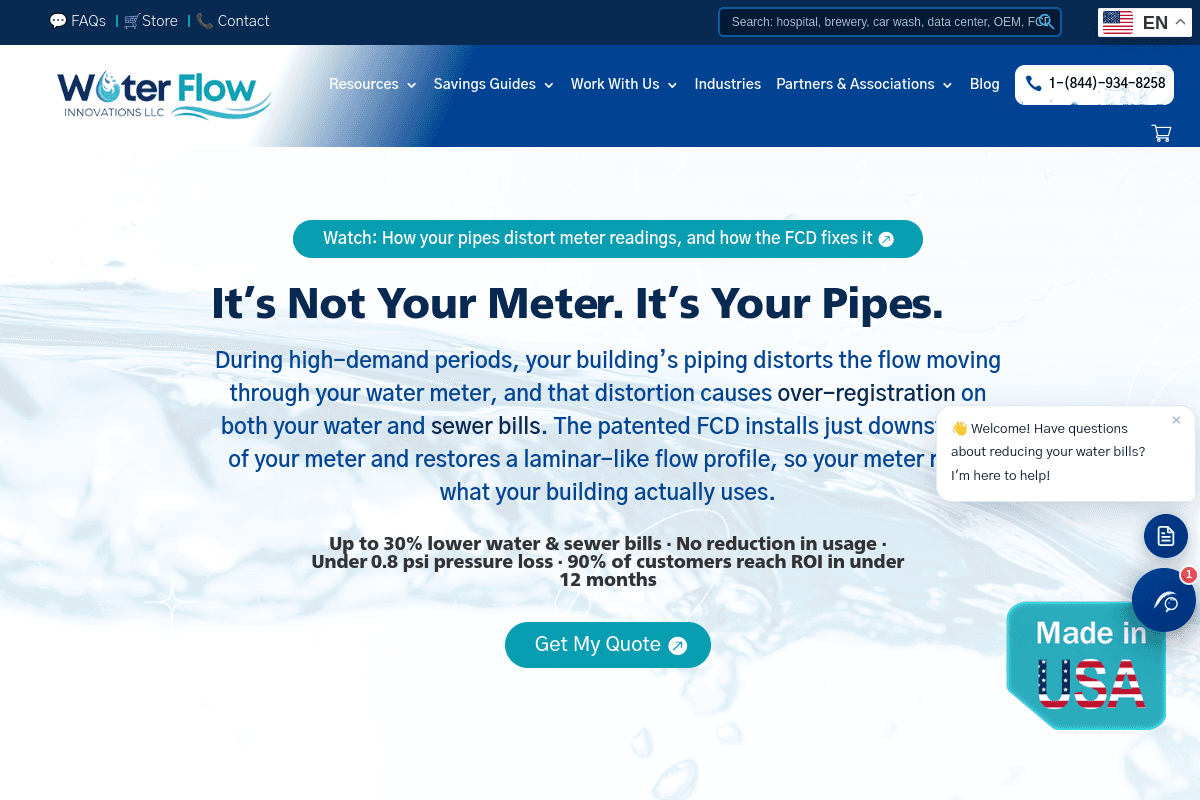
Water Flow Innovations' Flow Conditioning Device (FCD) is one of the only solutions on this list that reduces commercial water and sewer bills without requiring the building to use less water. The device works upstream of the water meter to condition turbulent water flow, which eliminates the mechanical over-registration that causes meters to overcount consumption by 5-30%. In verified installations, savings have reached up to 46%. Approximately 90% of FCD installations achieve full return on investment in under 12 months. This is not a water-restriction product -- it is an accuracy-correction device.
FLOW CONDITIONING DEVICE -- KEY SPECIFICATIONS
| Attribute | Detail |
|---|---|
| Typical Savings | 5-30% on water and sewer bills |
| Maximum Documented Savings | Up to 46% |
| ROI Timeline | Under 12 months for ~90% of installations |
| Material | 316L Stainless Steel |
| Certifications | IAPMO R&T Certified, NSF/ANSI Compliant |
| Warranty | Lifetime Warranty |
| Installation Time | Approximately 1 hour |
| Pressure Loss | Less than 0.8 psi |
| Water Use Change Required | None -- savings come from meter accuracy, not restriction |
The FCD performs four distinct functions that together address water meter over-registration. First, it conditions turbulent flow into a uniform, laminar profile before it reaches the meter, preventing the erratic velocity spikes that cause positive-displacement and multi-jet meters to over-count. Second, it eliminates air entrainment -- trapped air pockets that pass through the meter and register as water volume. Third, it reduces cavitation within the pipe, which creates false pressure differentials that accelerate meter disc or impeller movement. Fourth, it dampens water hammer and pressure surges that momentarily spike flow readings. These four functions work together to ensure the meter registers only the actual volume of water consumed.
Key Features
Benefits
The primary benefit is immediate, measurable bill reduction from the first billing cycle after installation. Because sewer charges in most municipalities are calculated as a percentage of metered water consumption, the FCD reduces sewer bills proportionally -- a double savings. The device has no consumables, requires no power, and carries no recurring costs. For multi-property operators, the FCD can be deployed across portfolios with predictable per-building ROI. Building owners retain full water pressure and flow rates, so tenants and operations are unaffected.
Honest Limitation
The FCD addresses over-registration, not over-consumption. If a building's meter is already accurate, the device will not produce savings. It is most effective in buildings with older meters, long pipe runs before the meter, or municipal supply lines with high turbulence. A facility that has already replaced its meter recently and has clean, low-turbulence supply may see minimal impact. The device does not treat water quality or reduce actual water usage.
Best For
Commercial properties, multi-family buildings, hotels, hospitals, manufacturing facilities, and any high-volume water user that suspects (or cannot rule out) meter over-registration. Particularly effective for buildings with older meters, long or complex supply-line runs, and properties where water and sewer bills are a significant operating expense. Best first step before investing in fixture replacements or usage-reduction programs, because it fixes the measurement problem without requiring behavioral change.
Sewer Deduct Meter -- Best for Water That Never Enters the Sewer
A sewer deduct meter (also called a bypass meter or irrigation meter) is installed on water lines that supply uses where the water never reaches the municipal sewer system -- cooling towers, irrigation, process evaporation, and boiler make-up water. Since most municipalities calculate sewer charges based on total metered water consumption, buildings that consume significant volumes for non-sewer purposes overpay by default. A deduct meter subtracts those volumes from the sewer calculation.
The concept is straightforward: install a secondary meter on lines serving cooling towers, landscape irrigation, or other consumptive uses. The utility reads both meters and charges sewer fees only on the difference. For a building with a large cooling tower or significant landscaping, sewer charges on those gallons may represent thousands of dollars per year in unnecessary cost.
Key Features
Benefits
Buildings with large cooling systems, extensive irrigation, or industrial processes that consume water through evaporation or product incorporation can eliminate sewer charges on 20-60% of their metered water. The savings are ongoing and scale with consumption. Many utilities allow retroactive credits once the deduct meter is installed and documented.
Honest Limitation
Not every municipality allows deduct meters, and the application process varies. Some jurisdictions require annual inspections or recertification. The upfront cost of the meter, installation, and permitting may be $2,000-$10,000 depending on pipe size and local requirements. Buildings with minimal non-sewer water use will not see meaningful savings.
Best For
Commercial and industrial properties with significant cooling-tower, irrigation, or process-water consumption where the water never enters the sewer system. Hotels, hospitals, manufacturing plants, large office campuses with landscaping, and food-processing facilities are prime candidates.
Leak Detection and Repair -- Best for Hidden Losses
Water leaks in commercial buildings are a silent budget drain. The EPA estimates that a single toilet running continuously can waste over 200 gallons per day, and underground supply-line leaks can go undetected for months or years. Because sewer charges are tied to metered consumption, every leaked gallon is billed twice -- once as water, once as sewer -- even though none of it was used productively.
Modern leak-detection programs use a combination of continuous flow monitoring (smart meters or IoT sensors that flag consumption during zero-occupancy hours), acoustic leak detection for underground lines, and systematic fixture audits. The key is to identify and repair leaks before they compound into months of inflated bills.
Key Features
Benefits
Leak detection delivers immediate savings the moment repairs are completed. Buildings with aging infrastructure routinely find leaks responsible for 5-20% of total water consumption. Repairs often cost far less than a single month's excess billing. Additionally, fixing leaks reduces the risk of water damage, mold, and structural deterioration.
Honest Limitation
Detection is only as good as the follow-through. Identifying leaks without budgeting for timely repairs results in continued waste. Some leaks in older buildings require significant plumbing work to access and fix. Continuous monitoring systems have ongoing subscription costs.
Best For
Aging buildings, large campuses, properties with underground supply lines, and any facility where water bills have increased without a corresponding increase in occupancy or activity. Essential as a baseline diagnostic before investing in any other cost-reduction method.
Utility-Bill and Rate Audit -- Best for Billing and Classification Errors
Utility billing errors are more common than most facility managers realize. Properties may be classified under the wrong rate schedule (industrial vs. commercial vs. institutional), charged outdated tariffs, billed for estimated reads instead of actual consumption, or assessed incorrect sewer multipliers. A formal utility-bill audit reviews 12-36 months of invoices against the municipality's current rate schedules and the property's actual use profile.
Audit firms typically work on a contingency or shared-savings basis, meaning there is no upfront cost. If they find errors, the property receives retroactive credits and corrected billing going forward. Even without billing errors, an audit often identifies that a property qualifies for a lower rate class, volume discount, or sewer-charge adjustment that has never been applied.
Key Features
Benefits
Retroactive credits can result in immediate lump-sum refunds covering months or years of overcharges. Corrected rate classifications reduce ongoing bills permanently. The audit process also creates a baseline for measuring future savings from other methods on this list.
Honest Limitation
If the property's billing is already accurate and correctly classified, the audit will not produce savings. Contingency-based auditors may only pursue large accounts where the expected recovery justifies their effort. Smaller properties with simple billing may not attract auditor interest.
Best For
Multi-property operators, large commercial buildings, properties that have changed use (e.g., office to mixed-use), buildings that have never had a formal utility audit, and any facility where bills seem disproportionately high relative to occupancy and usage.
Sub-Metering -- Best for Tenant and Department Accountability
Sub-metering installs individual water meters on each tenant space, floor, or department within a commercial building. When tenants pay for their own water consumption rather than splitting a master-meter bill by square footage, behavioral changes follow immediately. Studies consistently show 15-30% reductions in water use once occupants are directly accountable for their consumption.
Beyond behavioral savings, sub-metering gives property managers granular visibility into where water is consumed. This data identifies high-use tenants, isolates leaks to specific areas, and enables accurate cost allocation. In jurisdictions that allow ratio utility billing (RUB) or direct tenant billing, sub-metering converts water from an uncontrolled operating expense into a pass-through cost.
Key Features
Benefits
The 15-30% behavioral reduction is well-documented across multi-tenant commercial, retail, and mixed-use properties. Property managers gain data-driven insights for capital planning (which floors or systems consume the most). Tenants who pay their own water bills self-correct wasteful practices without management intervention.
Honest Limitation
Upfront installation costs can be significant, especially in older buildings where plumbing runs are shared across tenants. Not all jurisdictions permit direct tenant water billing. Sub-metering infrastructure requires periodic calibration and maintenance. The behavioral savings plateau after the initial adjustment period.
Best For
Multi-tenant office buildings, retail centers, mixed-use properties, and large campuses with multiple departments or cost centers. Particularly effective where water costs are currently allocated by square footage rather than actual consumption.
Low-Flow and WaterSense Fixtures -- Best for Usage Reduction
Replacing outdated plumbing fixtures with EPA WaterSense-certified models is one of the most straightforward ways to reduce actual water consumption in a commercial building. WaterSense toilets use 1.28 gallons per flush or less (compared to 3.5-7 gpf in older models), WaterSense faucets deliver 1.5 gpm or less (compared to 2.2+ gpm), and WaterSense showerheads operate at 2.0 gpm or less. Per-fixture savings of 20-60% are typical, and because sewer charges track metered consumption, every gallon saved reduces the sewer bill as well.
The EPA's WaterSense program certifies products that meet both efficiency and performance standards, so low-flow does not mean low-performance. Modern commercial fixtures maintain user satisfaction while dramatically cutting consumption. For high-traffic facilities like hotels, hospitals, airports, and stadiums, fixture upgrades deliver compounding savings across hundreds or thousands of daily uses.
Key Features
Benefits
Fixture replacements are a one-time capital expenditure with permanent, ongoing savings. Unlike behavioral programs, the savings do not depend on occupant cooperation. Rebates from utilities and municipalities can offset 20-50% of the fixture cost. The combination of water and sewer savings accelerates payback to 6-18 months for high-traffic fixtures.
Honest Limitation
The savings are proportional to the age and inefficiency of the existing fixtures. A building that already has modern 1.6 gpf toilets will see modest gains from upgrading to 1.28 gpf. Low-flow fixtures in low-traffic areas have a longer payback period. Some occupants report dissatisfaction with ultra-low-flow faucets if water pressure is already low.
Best For
Hotels, hospitals, airports, stadiums, convention centers, schools, and any high-traffic commercial facility with fixtures older than 10-15 years. Particularly effective when combined with utility rebate programs.
Process-Water Recycling and Reuse -- Best for High-Volume Industrial Use
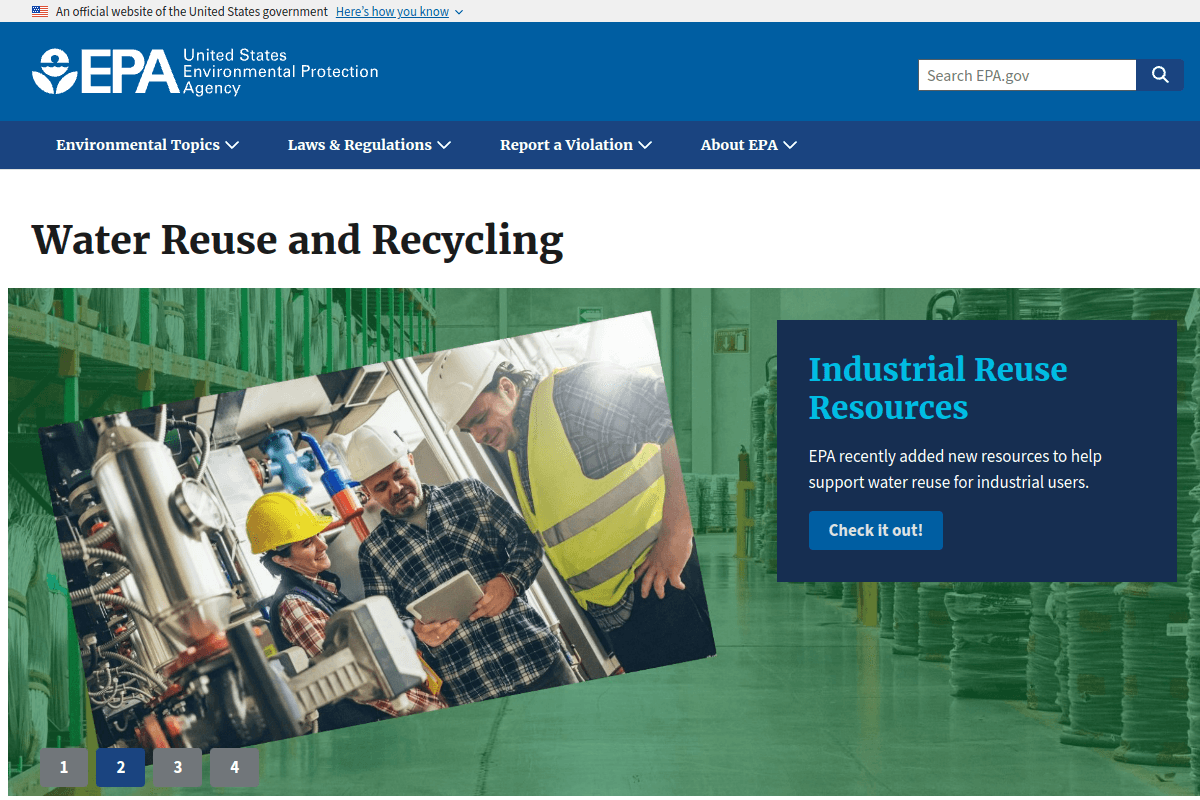
For manufacturing plants, food-processing facilities, data centers, and other high-volume water users, recycling process water can reduce both intake water costs and sewer-discharge fees by 30-90%. Process-water recycling captures wastewater from industrial processes -- rinse water, cooling blowdown, CIP (clean-in-place) water -- treats it on-site, and returns it to the process loop. This reduces the volume of fresh water purchased from the utility and the volume of wastewater discharged to the sewer.
Treatment technologies range from simple filtration and UV disinfection for cooling-loop reuse to membrane bioreactors and reverse osmosis for food-grade recycling. The right system depends on the contaminant profile, required quality, and volume. Modular, containerized treatment systems have made process-water recycling accessible to mid-sized facilities that previously could not justify custom treatment plants.
Key Features
Benefits
High-volume users can see 30-90% reductions in water and sewer costs depending on the recyclable fraction. Reduced sewer discharge may also lower surcharges for high-strength wastewater (BOD/TSS). Process-water recycling strengthens supply resilience in drought-prone or water-stressed regions. It supports ESG and sustainability reporting, which is increasingly material for commercial and industrial tenants.
Honest Limitation
Capital costs are significant -- a basic recycling system starts at $50,000 and advanced treatment can reach $500,000+. Ongoing operational costs include energy, chemicals, membrane replacement, and monitoring. The economics only work at scale, typically for facilities consuming more than 50,000 gallons per day. Regulatory permitting for on-site reuse varies by jurisdiction.
Best For
Manufacturing plants, food and beverage processors, breweries, data centers, laundries, and other industrial facilities with high-volume water consumption and discharge. Most effective where municipal water rates are high, sewer surcharges apply for high-strength wastewater, or water supply reliability is a concern.
Frequently Asked Questions
What is the fastest way to reduce commercial water and sewer bills?
The fastest method is installing a Flow Conditioning Device (FCD) such as the one from Water Flow Innovations. It addresses water meter over-registration -- where turbulence and air entrainment cause the meter to record more water than is actually consumed -- delivering 5-30% savings on both water and sewer bills. It installs in about an hour, requires no change in water use, and approximately 90% of installations achieve ROI in under 12 months.
A utility-bill audit is the second-fastest option, as it can identify billing errors and misclassified rates that result in immediate retroactive credits.
What is water meter over-registration and how does it affect my bills?
Water meter over-registration occurs when a meter records more water than actually passes through it. This is caused by turbulent flow, air entrainment, cavitation, and pressure surges in the supply line -- all of which cause the meter's measuring element to spin faster than the true flow rate warrants. Over-registration inflates both water and sewer bills, since sewer charges are typically calculated as a percentage of metered water consumption.
Studies and field installations show that commercial meters commonly over-register by 5-30%. A Flow Conditioning Device installed upstream of the meter corrects these conditions and brings meter readings closer to actual consumption.
What is a sewer deduct meter and when should I install one?
A sewer deduct meter is a secondary water meter installed on supply lines that serve uses where the water never enters the municipal sewer system -- cooling towers, landscape irrigation, boiler make-up water, and process evaporation. Since sewer charges are based on total metered water consumption, buildings with significant non-sewer water use overpay unless the utility deducts those volumes.
Install a deduct meter if your building has cooling towers, extensive irrigation, or industrial processes that consume water through evaporation. The utility reads both meters and charges sewer fees only on the difference.
How much can sub-metering reduce water consumption in commercial buildings?
Sub-metering typically reduces water consumption by 15-30% in multi-tenant commercial buildings. The reduction comes from behavioral change: when tenants pay for their own water consumption rather than splitting a master-meter bill by square footage, they self-correct wasteful practices. Sub-metering also gives property managers granular data to identify leaks, benchmark tenant usage, and allocate costs accurately.
The savings are most pronounced in the first 6-12 months after installation and tend to stabilize at a lower consumption baseline thereafter.
Should I replace fixtures or fix meter accuracy first?
Fix meter accuracy first. If your water meter is over-registering by 10-20%, every efficiency measurement you take after a fixture upgrade will be distorted by the same inaccuracy. Installing a Flow Conditioning Device and repairing leaks first establishes an accurate consumption baseline. Then a utility-bill audit confirms you are on the correct rate schedule. Only after measurement and billing are accurate should you invest in fixture replacements, sub-metering, or process-water recycling.
This layered approach ensures each subsequent investment is measured against a true baseline, and prevents you from underestimating (or overestimating) the ROI of fixture upgrades.
About Geeky Expert
Geeky Expert is a leading provider of research and insights, dedicated to helping businesses make informed decisions through comprehensive analysis.