Direct answer: The most effective answer-engine ranking strategy centers on AI confidence and extractability—clear structure, E-E-A-T signals, and schema—so AI systems cite your content.
Key Takeaways:
• Prioritize AI confidence through E-E-A-T signals and factual consistency over traditional link building.
• Structure content in an inverted pyramid with direct answers and clear schema for easy AI parsing.
• Measure success with AI-specific metrics like brand mentions in answers and assisted conversions.
The most effective answer-engine ranking strategy now centers on AI confidence, not backlinks alone. Organic click-through rates are declining—studies and industry reports show significant CTR declines, in some cases exceeding 20%—as AI overviews and zero-click searches deliver instant answers on the results page. To compete, content must be optimized for extractability and trust, so models like Gemini and Perplexity can easily cite it. That means clear structure, verifiable facts, and authoritative signals that make your site the safest source to quote. Visibility shifts from ranking positions to being referenced inside synthesized answers. This frontier demands a change in content thinking. Keep reading to learn what works.
An answer engine ranking strategy—often called answer engine optimization or AEO—is the practice of optimizing your web content for AI-driven platforms.
These platforms (Google AI Overviews, ChatGPT, Perplexity) generate direct answers by pulling information from websites. The goal of AEO is to make your content the preferred source for those answers. For a deeper dive into how this works in practice, see our answer engine optimization guide.
What Is AEO?
AEO focuses on directness, factual accuracy, and a structure that AI models can easily parse and cite. It is different from traditional SEO.
SEO aims to get a user to click a link on the search results page. AEO aims to have the information itself extracted and displayed in the AI's answer—often without a click.
Zero-click searches are rising: users get their answer directly from the AI summary. We have seen organic traffic from certain high-intent queries drop significantly because of this shift.
The strategy is not just about being found. It is about being chosen as the trustworthy source the AI engine uses to build its response.
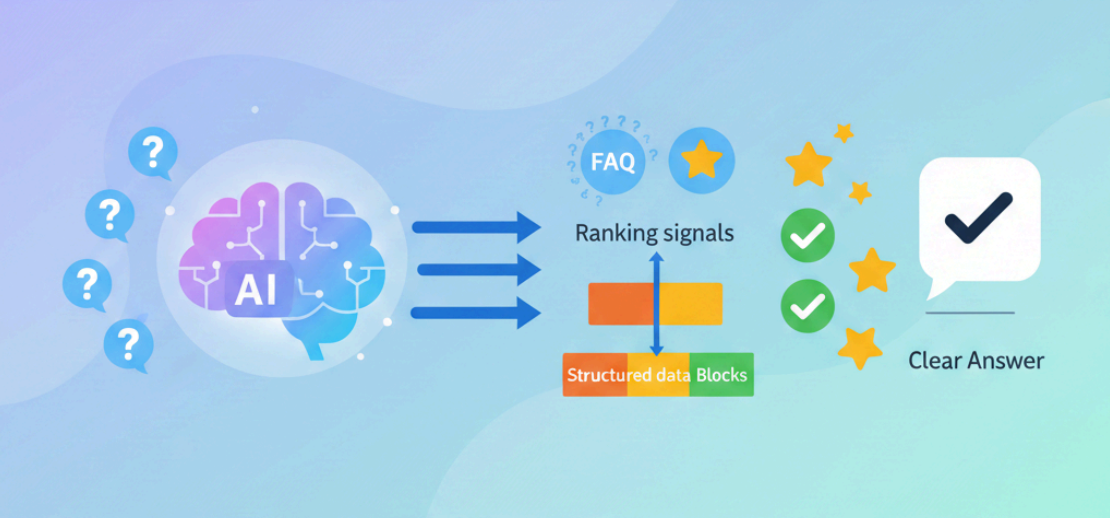
A simplified diagram of an answer engine: an AI brain icon processes questions on one side and produces clear answers on the other.
Why AI Confidence Matters More Than Classic Backlinks
AI-first search does not just count links. It evaluates how confident it feels about your content.
Backlinks still help, but they are now one signal inside a wider trust system. The core question: can the AI trust your facts enough to use or cite them?
E-E-A-T and Trust Signals
E-E-A-T becomes essential: Experience, Expertise, Authoritativeness, and Trustworthiness. AI models are trained to scan for these markers:
Clear author bios that show real expertise
Inline citations to reputable, verifiable sources
Recent updates with current data—not stale information
NLP (Natural Language Processing) lets AI understand intent, not just keywords. Your content needs direct, concise answers; clear, conversational language; and structure that matches what users actually want to know.
Pages that satisfy E-E-A-T and match NLP-understood intent often earn more AI citations than older, link-heavy pages. Fresh content, formatted for a strong AEO optimization strategy, can dramatically increase AI citation likelihood.
Content Structure That Maximizes AI Extractability
When AI pulls answers from your page, structure matters as much as the message. The goal: make every key point easy to find and extract.
Inverted Pyramid and Direct Answers
Start with an inverted pyramid format. Open with a 40–60 word paragraph that gives a clear, complete answer to the main query.
Then add supporting details, proof, and examples below it. This gives AI a clean, self-contained answer block it can reuse.
Question-Based Headings
Use headings that mirror real searches. Examples:
"How Does Answer Engine Optimization Improve Visibility?"
"What Is AI Extractable Content?"
Format the body with bulleted or numbered lists for steps and features; tables for comparisons; short definition blocks for key terms; and brief paragraphs (usually under three sentences).
This chunking—often called passage optimization—helps AI isolate specific facts. Add schema markup (FAQPage, Article schema) so the code clearly labels questions, answers, and main content. That makes extraction more consistent.
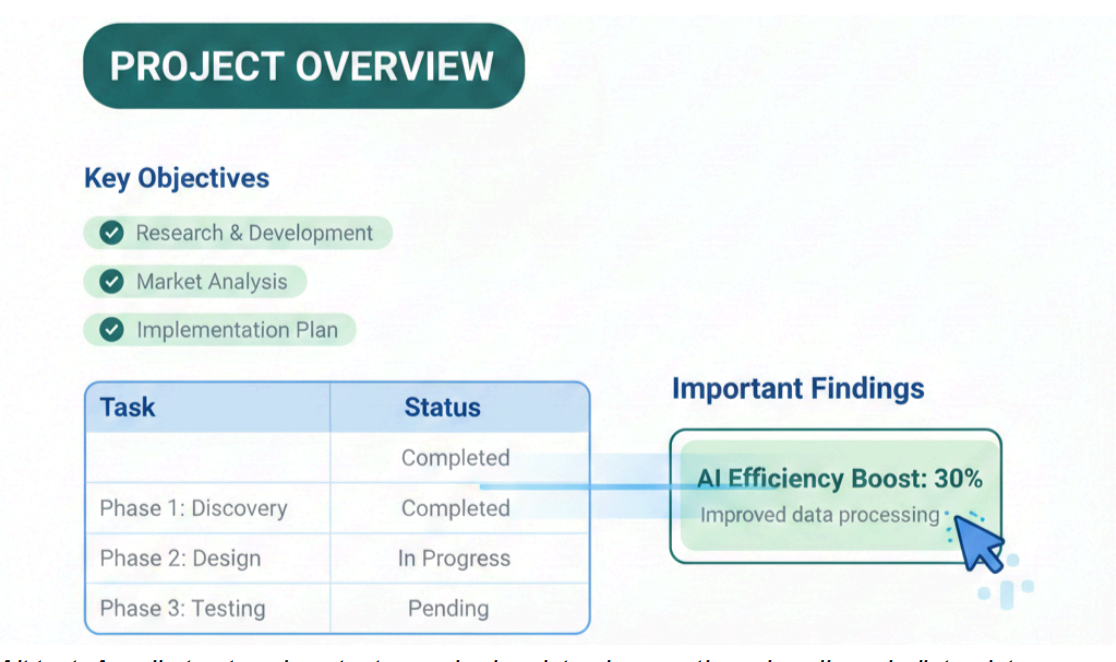
A well-structured content page broken into clear sections: headings, bullet points, tables, and highlighted answer snippets.
Traditional SEO vs. Answer Engine Optimization
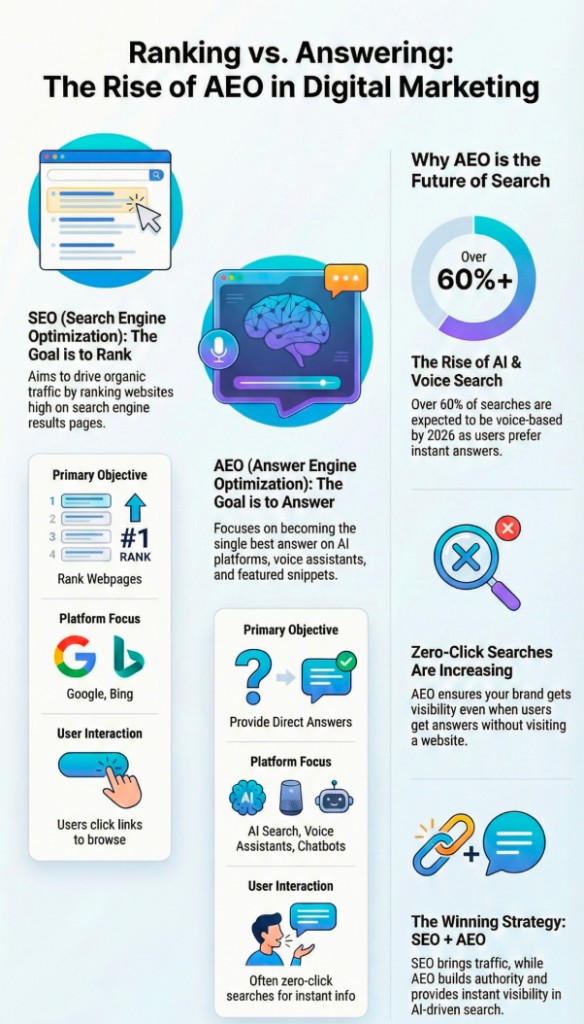
These approaches are not opposites, but they have different primary objectives. Think of SEO as the strategy to get someone to your storefront. AEO is the strategy to get your product quoted in a news report about the best products.
Visual guide exploring the key differences between ranking and answering in the context of search engine marketing trends.
SEO vs. AEO at a Glance
The table below breaks down the core differences.
Feature
Traditional SEO
Answer Engine Optimization (AEO)
Primary Goal
Rank on the Search Engine Results Page (SERP)
Secure an AI Citation & Brand Mention
Key Metric
Organic Click Through Rate (CTR)
Visibility Share & Assisted Conversion
Content Format
Long form Articles and Guides
Modular, Extractable Snippets
Authority Signal
Backlink Quantity & Quality
E-E-A-T & Entity Consistency
The Hybrid Approach
The trend moving into 2026 is the unification of these strategies. The most successful teams blend them. They create content that is both click-worthy for humans and perfectly extractable for AI.
This hybrid approach is reported to drive up to 27% higher lead conversion from AI-directed traffic. Even if a user does not click initially, the brand mention builds top-of-mind awareness—leading to a direct visit or branded search later.
"AEO optimizes content for immediate answers," whereas traditional SEO is about "ranking websites higher in search results pages." (Exabytes: AEO vs Traditional SEO)
Technical Signals That Help AI Trust Your Content
When AI decides what to cite, it looks first for clarity and structure. The cleaner the signal, the higher the trust.
Structured Data and Schema
Structured data is the main anchor. Do not use only basic Article schema. Extend your markup to cover:
Products and services
Local business information
People (authors, founders, experts)
Ratings, reviews, and prices where relevant
This tells AI what each element represents—not just what words appear on the page. That strengthens entity recognition and reduces ambiguity.
NAP Consistency for Local Queries
For local queries, NAP consistency (Name, Address, Phone) is especially important. Your NAP should be identical across:
Your website contact and footer
Google Business Profile
Leading directories and map services
Social profiles where contact details appear
Small differences in formatting, abbreviations, or phone styles can weaken trust over time.
Clean, Fast HTML
Combine this with a clean, fast site: simple HTML, compressed images, and minimal JavaScript that delays or hides core content. When AI can read your main facts directly in the source code, it is much more likely to treat them as reliable and citable.
External Validation and Core Technical Checklist
AI does not just trust what you say about yourself. It checks whether the rest of the web agrees. That is where external validation becomes useful.
When your statistics, descriptions, and positioning match high-authority sources, AI confidence increases.
Third-Party Alignment
Example: you share a market size figure and the same number appears on a respected .gov, .edu, or long-established industry site. That alignment supports your data instead of leaving it unverified.
Third-party profiles extend this effect. Build and maintain accurate, up-to-date listings on:
Industry review platforms (e.g., G2, Capterra, niche tools)
Trade associations and professional bodies
Local and sector-specific directories
These pages confirm your NAP, services, and brand details—which AI can cross-reference against your site.
Repeatable Checklist
To turn this into a repeatable process, use a focused checklist:
Audit and implement complete schema for core entities and content types.
Run a NAP consistency check and fix mismatches everywhere.
Ensure main content loads directly in HTML—not blocked or delayed by scripts.
Build and optimize profiles on relevant, trusted review and industry platforms.
Measuring Success in an AI-First Search Environment
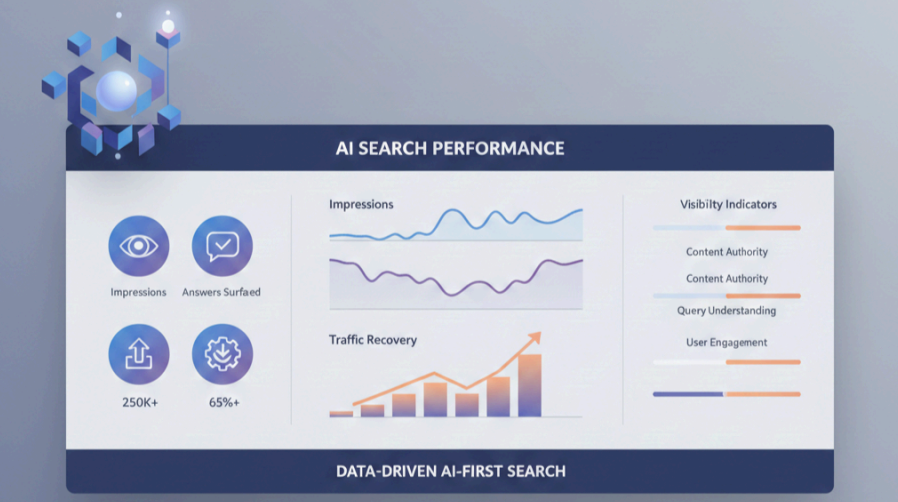
An analytics dashboard with charts, engagement metrics, and visibility indicators related to AI search performance.
Traditional SEO metrics (rankings, organic traffic) are no longer enough. In an AI-first environment, users often get answers without clicking. Success shifts to how often and how clearly your brand appears inside AI-generated responses.
Brand Mentions and Citations
The first core metric is brand mentions or citations in AI answers. Are you being quoted as a source? AI search grader tools can show which queries trigger an AI overview and when your content is used as a cited source.
Share of Voice in AI Answers
Next: share of voice within AI answers. For your main topics, how often are you cited compared to competitors? Are you a recurring source across related queries?
Assisted Conversions
Connect this to outcomes through assisted conversions. Users see your brand in an AI answer; they later search your brand or visit directly; they convert on your site.
Track this by tying analytics to branded search trends and direct traffic after AI exposure. A steady rise in branded search volume is a strong signal your SEO efforts are working.
The Path Forward for Your Answer Engine Strategy
Search has changed. Falling click-through rates reflect a new reality shaped by generative AI.
An answer engine strategy is now part of core SEO. Focus on trust and clarity. Start with high-traffic informational pages.
Lead with direct answers. Strengthen E-E-A-T using clear author bios and updated sources. Apply schema to improve understanding for both users and AI systems.
The goal is to be the most reliable source in your niche. When trust is clear, visibility follows.
For data-backed insights on adapting to AI-driven search, explore the strategic research at Geeky Expert.
What is answer engine optimization and why does it matter for AI search today?
Answer engine optimization helps content rank in generative AI search and zero-click searches. It supports AI overviews ranking by using answer-first content, direct answers, concise summaries, and extractable content. Strong AEO strategies rely on semantic SEO, natural language processing, NLP optimization, user intent matching, and conversational queries to improve visibility share and SERP climbing.
How do I structure content so AI systems can easily extract answers?
Use question-based headers, an inverted pyramid structure, and clear header placement. Add list formats, definition blocks, table markup, micro-answers, passage optimization, and chunk content. This improves content parsability, semantic relevance, and contextual relevance. Avoid keyword stuffing. Focus on semantic keywords, subheading LSI, latent semantic indexing, and strong topic coverage.
Which trust and quality signals help content appear in AI-generated answers?
AI search graders look for E-E-A-T signals, including experience, expertise and authoritative trustworthiness. Use author bios, source citations, recent updates, factual alignment, and AI citations. Third-party authority, review sites, G2 profiles, brand mentions, and assisted conversions also support credibility and improve generative AI search confidence.
How does structured data and schema markup support AI visibility?
Structured data helps entity recognition and answer accuracy. Use schema markup like FAQ schema, Article schema, and local schema. Keep NAP consistency with Google Business Profile. Add video transcripts and timestamp optimization for multimedia content. Structured data supports Google AI mode, Gemini answers, Perplexity ranking, and ChatGPT optimization across AI overviews.
How can AEO strategies recover traffic loss from AI-driven search changes?
AEO strategies address CTR decline and organic traffic drop by improving answer engine optimization. Focus on high-traffic pages, topic clusters, predictive topics, and content freshness. Use keyword research tools, autocomplete suggestions, LSIGraph generator, and GEO benchmarks. Combine AI SEO tactics, niche strategies, traffic maximization, lead conversion, and bounce rate reduction.
About Geeky Expert
Geeky Expert is a leading provider of research and insights, dedicated to helping businesses make informed decisions through comprehensive analysis.