ChatGPT click-through optimization requires structural adaptation across content, technical SEO, and measurement. AI systems retrieve answers differently, relying heavily on Bing signals, entity clarity, and conversational queries. Rankings alone are no longer enough. Brands must optimize for structured answers, consistent mentions, and measurable impression growth.
ChatGPT click-through optimization matters because ranking #1 on Google no longer guarantees traffic. AI systems now answer questions directly, reducing the need to click. A 2024 SparkToro study found that over 50 percent of Google searches end without a click. To compete, brands must adapt their content strategy for AI retrieval systems that rely on Bing signals, entity clarity, and conversational query matching.
The search landscape has shifted. Ranking at the top of Google no longer guarantees traffic, and the rise of AI-powered answers is accelerating the change. Here is what you need to know before optimizing for ChatGPT click-through:
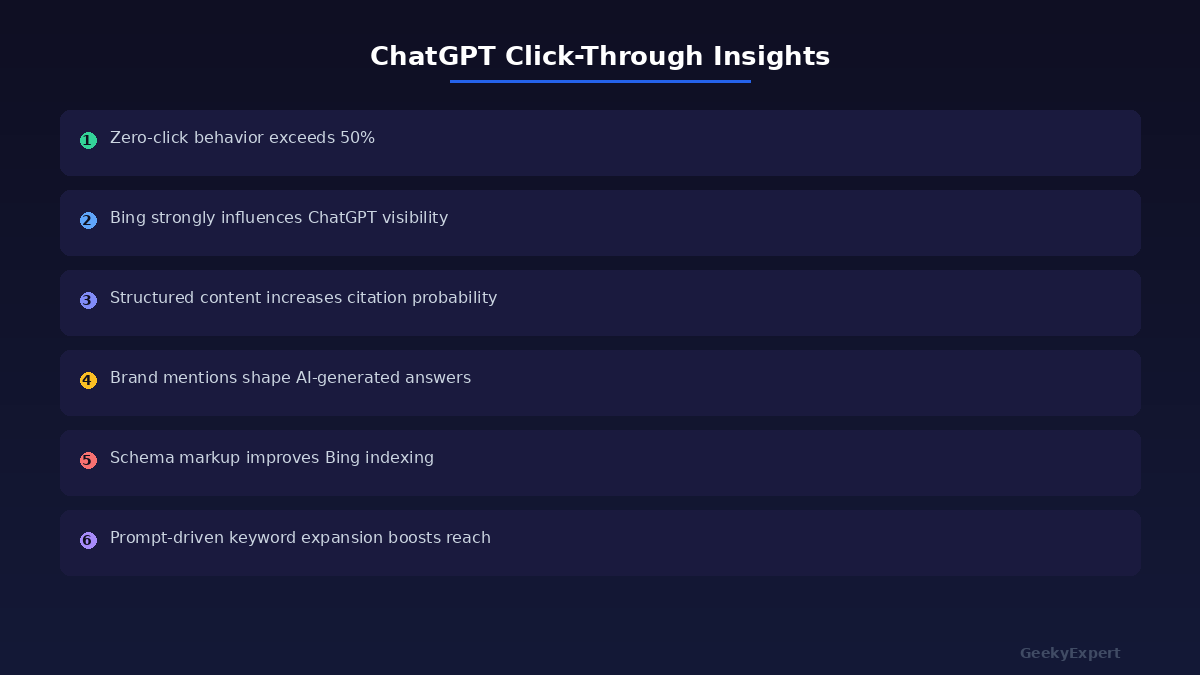
Zero-click is the new default. A 2024 SparkToro study found that over 50 percent of Google searches end without a click. AI-generated answers satisfy the query directly, eliminating the need to visit a website.
Bing is the hidden gatekeeper. ChatGPT retrieves web content primarily through Bing's index. If your pages rank poorly on Bing, they may never surface in ChatGPT responses regardless of your Google position.
Structured content wins extraction. AI models favor content that is cleanly structured with clear headings, concise answers, and entity-rich formatting. Walls of text get skipped.
Conversational queries are rising. Users interact with ChatGPT using natural language, not keyword strings. Content must match the way people actually ask questions.
Brand mentions matter more than links. In AI answers, being cited or mentioned by name builds visibility even when users do not click through immediately.
Laptop on wooden desk demonstrating ChatGPT click-through optimization workspace with coffee and natural lighting
How Does Bing Influence ChatGPT Click Visibility?
ChatGPT relies on Bing's search index to retrieve real-time web content. This means your Bing ranking directly affects whether your content appears in ChatGPT responses. Many SEO teams optimize exclusively for Google and neglect Bing entirely, leaving a significant gap in AI visibility.
Ranking well on Google but poorly on Bing means your content may not surface when ChatGPT answers a user query. The two search engines weigh signals differently, and understanding those differences is essential for ChatGPT click-through optimization.
Google vs. Bing: Key Ranking Factor Differences
Factor
Google
Bing
Backlinks
Prioritizes link quality and relevance
Values both quantity and domain authority
Social Signals
Minimal direct impact
Actively factors social shares and engagement
Content Freshness
Rewards fresh content for time-sensitive queries
Places stronger emphasis on regularly updated pages
Keyword Matching
Semantic understanding and intent-based matching
More exact-match oriented with growing semantic capability
Multimedia
Indexes multimedia but text-focused ranking
Gives stronger ranking signals to pages with images and video
Meta Tags
Uses meta descriptions for snippets, not ranking
Meta keywords and descriptions still carry ranking weight
As Search Engine Journal has noted, Bing optimization requires a distinct approach from Google SEO. Pages that include clear meta tags, social sharing signals, and multimedia elements tend to perform better on Bing and, by extension, gain more visibility in ChatGPT responses.
The takeaway: if you want ChatGPT to surface your content, you need to rank on Bing. Submit your sitemap to Bing Webmaster Tools, verify your site, and audit your Bing-specific ranking factors as part of your optimization workflow.
What Is Barnacle SEO and How Does It Increase AI Click-Through?
Person using smartphone in cafe learning ChatGPT click-through optimization strategies with coffee on wooden table
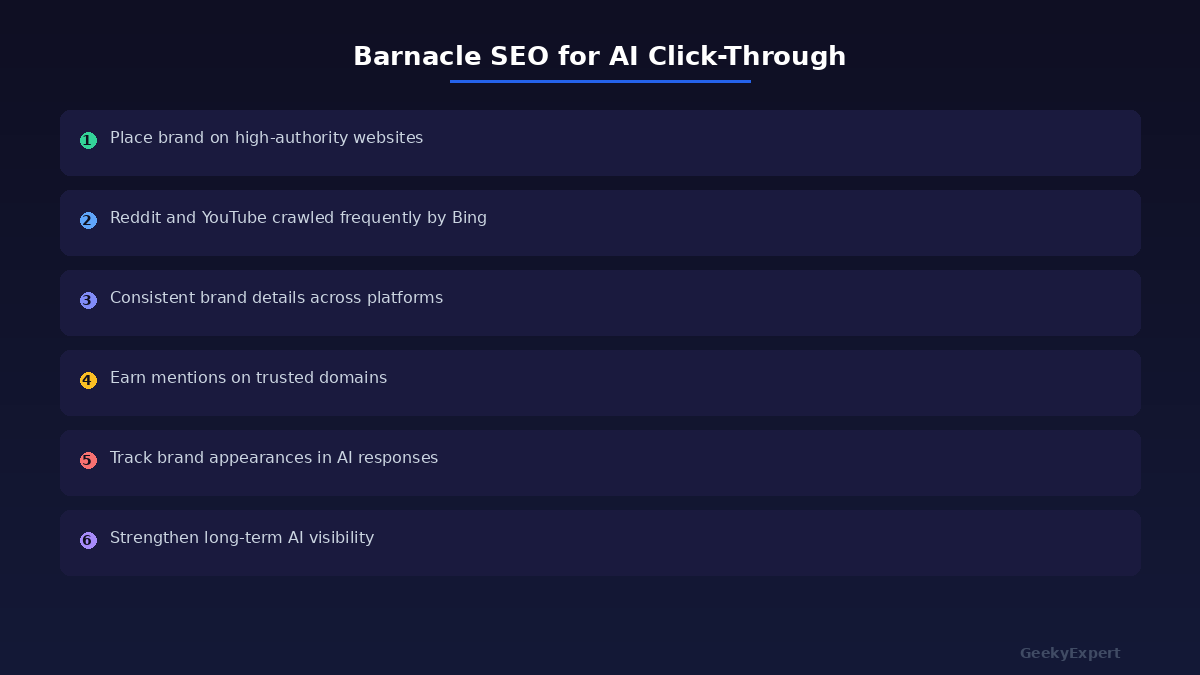
Barnacle SEO is the practice of placing your brand on high-authority third-party sites that already rank well in search engines and get cited by AI systems. Instead of building authority from scratch, you attach your brand to platforms that AI models already trust.
This strategy is especially effective for ChatGPT click-through optimization because AI systems often pull answers from aggregated sources like Reddit, Quora, G2, industry directories, and Wikipedia. When your brand appears consistently across these platforms, AI models are more likely to mention you in their responses.
How to Apply Barnacle SEO for AI Visibility
Identify high-authority platforms in your niche. Look for sites that ChatGPT frequently cites: Reddit threads, Quora answers, G2 reviews, industry-specific directories, and Wikipedia articles.
Create and optimize profiles. Ensure your brand information is accurate, detailed, and consistent across all platforms. Include structured descriptions, category tags, and relevant keywords.
Contribute expert content. Answer questions on Quora, participate in relevant Reddit discussions, publish guest posts on authoritative industry blogs, and maintain active review platform profiles.
Monitor brand mentions. Track where and how often your brand is cited in AI responses. Use this data to identify which third-party platforms deliver the most AI visibility.
How Can Prompt-Driven Keyword Expansion Improve AI Click-Through?
Traditional keyword research focuses on what users type into search engines. Prompt-driven keyword expansion focuses on what users ask AI assistants. The difference matters because conversational queries tend to be longer, more specific, and structured as natural questions rather than keyword fragments.
Optimizing for these conversational patterns helps your content match the exact queries that trigger ChatGPT responses. Here is a three-step framework:
Step 1: Extract Conversational Queries
Use ChatGPT itself to identify how users phrase questions in your topic area. Feed it your primary keyword and ask it to generate the most common conversational queries related to that topic. Cross-reference the results with Google Search Console data to find queries where you already have impressions but low click-through rates.
Step 2: Expand Into FAQ Clusters
Group the extracted queries into thematic clusters. Each cluster becomes a content section with a question-based heading and a direct, concise answer. This structure aligns with how AI systems parse and retrieve content, making it more likely your page gets cited.
Step 3: Validate With Search Data
Cross-check your expanded keyword list against actual search volume and competition data. Prioritize queries where user intent clearly matches your content and where existing SERP results show AI overviews or featured snippets. These are the queries most likely to trigger AI-generated answers.
This approach connects directly to broader AI search strategies. For platform-specific tactics on Perplexity, see our guide on how to get clicks from Perplexity.
How Should We Structure Content for AI Retrieval and Click Appeal?
Infographic on ChatGPT click-through optimization showing strategic pillars, content checklist, and visibility pipeline
AI retrieval systems do not read content the way humans do. They scan for structured patterns, entity relationships, and direct answer blocks. Content that is optimized for AI retrieval follows a predictable format that makes extraction reliable and consistent.
AI Retrieval Checklist
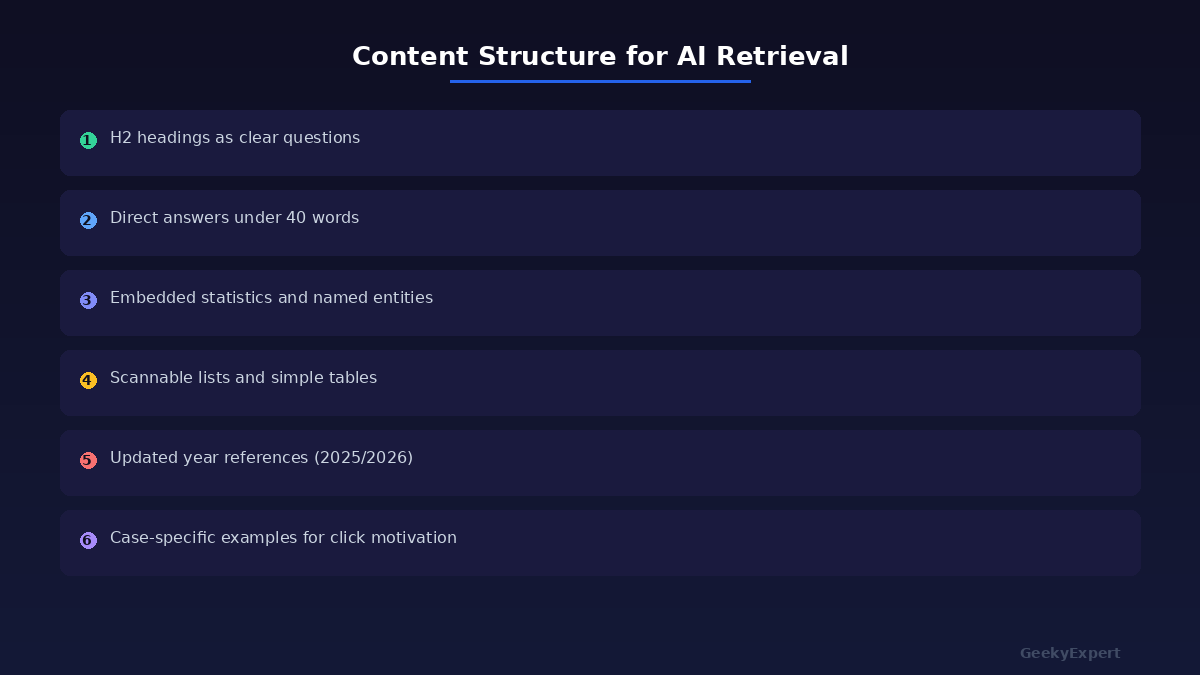
Lead with a direct answer. Open each section with a 40 to 60 word paragraph that answers the section heading directly. This gives AI a clean extraction target.
Use question-based H2 and H3 headings. Match the way users phrase queries in conversational AI. Headings like "How does X work?" outperform generic labels like "Overview" or "Details."
Add structured data markup. Implement FAQ schema, Article schema, and HowTo schema where relevant. This provides explicit signals about content structure and purpose.
Keep paragraphs short. Limit paragraphs to two or three sentences. AI models parse shorter text blocks more accurately than long, dense paragraphs.
Include comparison tables. Tables with clear headers help AI understand relationships between concepts and produce more accurate comparative answers.
Maintain entity consistency. Use the same terminology for key concepts throughout the article. Avoid switching between synonyms for the same entity, which can confuse AI parsing.
How to Encourage Clicks From AI Responses
Even when AI provides a direct answer, you can still drive click-through by structuring content that signals depth beyond the extracted snippet. Include data points that require context, reference original research, and use phrases like "full methodology" or "detailed comparison" that encourage users to visit the source.
How Do Experts Iterate Prompts to Improve Research and CTR?
Prompt iteration is a research methodology where you refine the questions you ask AI systems to generate progressively better outputs. Applied to SEO, this technique helps uncover content gaps, identify high-value topics, and refine your content strategy based on how AI actually processes and responds to queries.
Prompt Iteration Framework
Start broad. Begin with a general prompt related to your topic. Example: "What are the most effective strategies for increasing website traffic from AI search engines?"
Analyze the response. Identify which sources, concepts, and frameworks the AI references. Note any gaps or areas where the response lacks depth.
Narrow and refine. Use follow-up prompts that target specific gaps. Example: "Which Bing ranking factors most directly affect ChatGPT citation likelihood for B2B SaaS content?"
Extract actionable patterns. After several iterations, compile the recurring themes, recommended sources, and structural patterns that AI consistently surfaces. These become your content optimization priorities.
Example Prompt Sequence
Here is a practical prompt sequence for ChatGPT click-through optimization research:
Prompt 1: "What factors determine whether ChatGPT includes a link to a website in its response?"
Prompt 2: "How do Bing ranking signals differ from Google ranking signals for AI-generated answers?"
Prompt 3: "What content structure changes have the highest impact on AI citation rates for informational queries?"
Prompt 4: "Which third-party platforms are most frequently cited by ChatGPT for [your industry] topics?"
Each prompt builds on the previous response, creating a layered understanding of the optimization landscape. Document the AI outputs and use them to identify specific content changes that align with how AI retrieval systems work.
What Metrics Actually Measure AI-Driven Click Performance?
Developer coding at night for ChatGPT click-through optimization with desk lamp and leather notebook on workspace
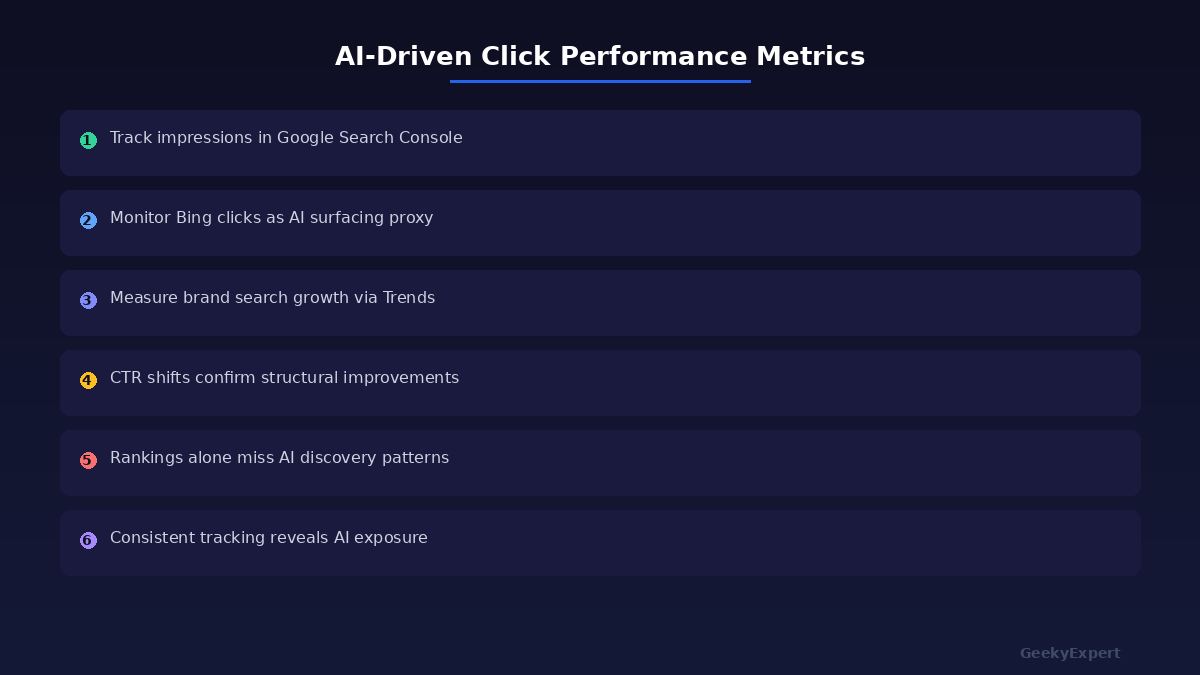
Traditional metrics like organic rankings and click-through rate are no longer sufficient for measuring AI-driven performance. When AI systems answer queries directly, the relationship between ranking and traffic becomes less predictable. You need metrics that capture visibility, brand presence, and downstream conversion impact.
AI Click Performance Metrics
Metric
Tool
Why It Matters
AI Citation Frequency
Manual audits, AI search graders
Measures how often your brand or content is referenced in AI-generated answers
Branded Search Volume
Google Search Console, SEMrush
Rising branded searches indicate AI mentions are driving awareness and recall
Referral Traffic from AI Platforms
GA4, server logs
Direct measurement of clicks from ChatGPT, Perplexity, and other AI interfaces
Impression Growth
Google Search Console, Bing Webmaster Tools
Tracks whether your content is appearing more frequently in search results and AI contexts
Assisted Conversions
GA4 multi-touch attribution
Captures conversions where AI-driven visits contributed to the conversion path
Share of Voice in AI Answers
AI visibility trackers, competitive analysis
Compares your citation frequency against competitors for target queries
As the Google Search Central Blog has emphasized, search performance measurement must evolve alongside changes in how users interact with search results. Tracking impressions and brand visibility alongside traditional CTR provides a more complete picture of content performance in an AI-driven search environment.
Set up dedicated GA4 segments for AI-referred traffic. Monitor Bing Webmaster Tools for indexation and ranking trends that directly feed ChatGPT visibility. Review these metrics monthly to identify which content changes produce measurable improvements in AI citation rates and downstream conversions.
ChatGPT click-through optimization is not a single tactic. It is a structural adaptation across content strategy, technical SEO, and measurement methodology. AI systems retrieve answers differently from traditional search engines. They rely heavily on Bing signals, entity clarity, conversational query matching, and content that is formatted for clean extraction.
Rankings alone are no longer enough. Brands must optimize for structured answers, maintain consistent mentions across high-authority platforms, and track AI-specific metrics that capture visibility beyond click-through rate. The organizations that adapt earliest will capture the growing share of AI-directed traffic.
Start with your highest-traffic informational pages. Audit their Bing ranking performance, restructure content for AI extractability, and implement the measurement framework outlined above. Iterate based on data, not assumptions.
How does ChatGPT click-through optimization improve AI traffic generation?
ChatGPT click-through optimization improves AI traffic generation by aligning content structure, entity clarity, and Bing ranking signals with how AI retrieval systems select and cite sources. Optimized content is more likely to appear in ChatGPT responses with attribution links, driving referral traffic. Combined with barnacle SEO and conversational keyword targeting, this approach increases both AI citation frequency and downstream click-through from AI-generated answers.
What role do keyword research prompts play in conversational search ranking?
Keyword research prompts help identify the natural language patterns users employ when querying AI assistants. Unlike traditional keyword research that targets search fragments, prompt-driven expansion surfaces full conversational queries that trigger AI responses. By structuring content around these question-based patterns and validating against search data, brands can improve their match rate for conversational search queries and increase the likelihood of AI citation.
How can structured assistant prompts increase response rate doubling?
Structured assistant prompts guide AI systems toward more complete and source-attributed responses. When content is formatted with clear question-answer pairs, direct opening paragraphs, and schema markup, AI models can extract and cite information more reliably. This structural alignment effectively doubles the rate at which your content is selected as a response source compared to unstructured pages covering the same topic.
Why is user intent matching critical for zero-click avoidance?
User intent matching is critical because AI systems prioritize content that directly satisfies the query intent. When your content matches intent precisely, AI models are more likely to cite your source with an attribution link rather than paraphrasing without credit. Content that signals depth beyond the extracted snippet, such as original research, detailed comparisons, and full methodologies, gives users a reason to click through even after reading the AI summary.
How do prompt iteration techniques support impression growth hacks?
Prompt iteration techniques support impression growth by systematically uncovering content gaps and high-value topics that AI systems frequently address but current content does not adequately cover. By refining prompts across multiple iterations, you identify recurring themes, source patterns, and structural formats that AI models prefer. Targeting these gaps with optimized content increases impressions across both traditional search and AI-generated responses.
About Geeky Expert
Geeky Expert is a leading provider of research and insights, dedicated to helping businesses make informed decisions through comprehensive analysis.