Getting clicks from Perplexity requires structured answers, semantic alignment, fresh data, and consistent authority building. Pages with citation-worthy content, tables, and data-backed insights earn more AI referrals. Refresh content every 90 days and focus on topical clusters rather than single keywords.
To learn how to get clicks from Perplexity, focus on building structured, relevant, and up-to-date content that aligns with user intent. Perplexity AI drives traffic by citing pages directly in its answers, giving users links for deeper context.
Laptop displaying content outline for how to get clicks from Perplexity with notebooks and books on desk
Getting clicks from Perplexity starts with understanding how the platform selects and surfaces sources. Perplexity is not a search engine in the traditional sense — it synthesizes answers from multiple pages and cites its sources inline. The click happens when a user wants to go deeper than the summary.
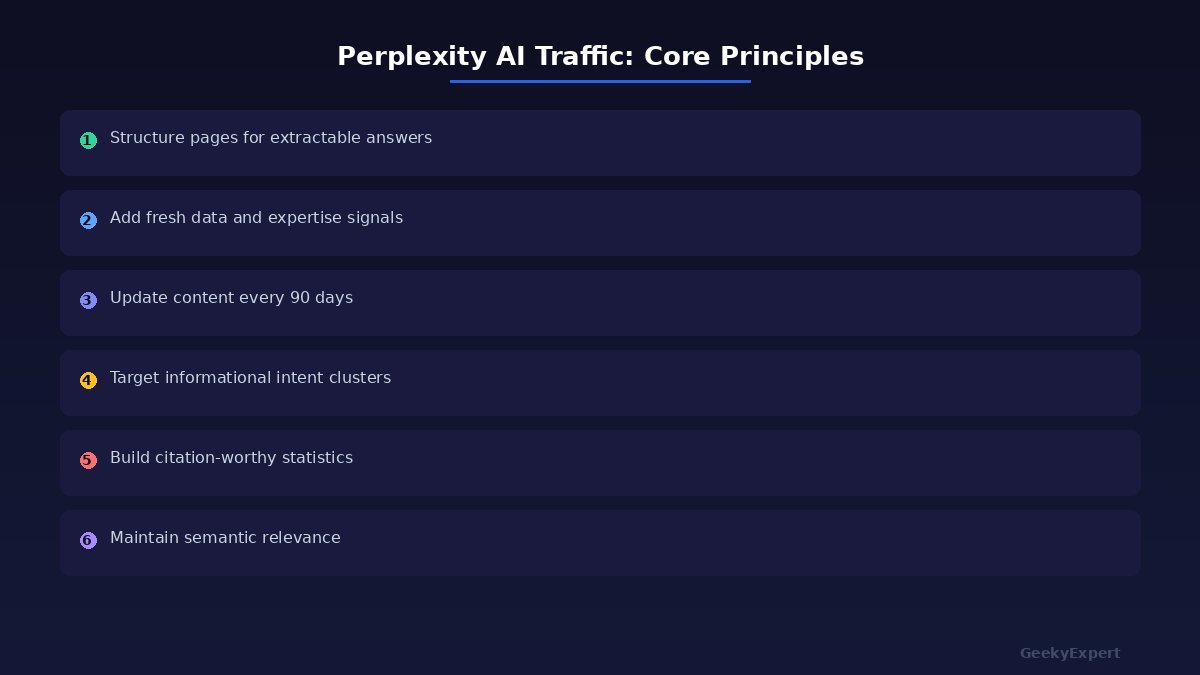
Three core principles drive consistent Perplexity referral traffic:
Structured pages earn citations. Pages with clear headings, direct answers, and organized data blocks are easier for the model to extract from. Structure is the baseline requirement — without it, your content is unlikely to be selected as a source.
Fresh data outperforms stale content. Perplexity favors pages with current statistics, recent examples, and up-to-date references. Pages with outdated information are deprioritized when newer alternatives exist on the same topic.
Refresh content every 90 days. A 90-day content refresh cycle keeps your pages competitive in AI citation pools. Update statistics, add new examples, and expand sections where the topic has evolved. This cadence matches how frequently AI models re-evaluate source quality.
These principles apply whether you are working on a single blog post or managing a full content library. The goal is to become a reliable, structured, and current source that Perplexity consistently reaches for when building answers.
How Does Perplexity Decide Which Websites to Cite?
Person analyzing data on laptop for how to get clicks from Perplexity with sticky notes in dark workspace
Perplexity selects sources based on a combination of semantic relevance, structural clarity, and content originality. It does not simply rank pages by backlink count or domain authority the way traditional search engines do. Instead, it evaluates whether a page provides a clear, extractable answer to the user's specific question.
"AI citation systems prioritize content that demonstrates expertise through structured evidence rather than keyword density alone." — Texas State University [1]
The key factors that influence whether Perplexity cites your page include:
Semantic relevance: Your content must closely match the intent behind the user's query. Pages that directly address the question — not tangentially related content — earn citations.
Structured formatting: Headings, bullet lists, tables, and clearly labeled sections make it easier for the model to parse and extract information. Unstructured walls of text are harder to cite.
Original analysis: Pages that provide unique data, proprietary research, or original frameworks are preferred over pages that simply aggregate existing information. Primary sources outperform secondary summaries.
Entity recognition: Perplexity identifies entities — brands, people, concepts — and associates them with topic authority. Consistent publishing on a topic cluster builds entity-level trust over time.
Content freshness: Recently updated pages with current data signals are more likely to be selected, especially for queries where timeliness matters.
Understanding these factors is the foundation of answer engine optimization. The same principles that drive Perplexity citations apply across ChatGPT, Gemini, and other AI search platforms — making this a transferable skill set.
How Can We Engineer Content for AI Citation?
Content engineering for AI citation is about designing pages that are easy for language models to extract, attribute, and reference. This goes beyond traditional SEO — it requires thinking about how a model reads and selects source material.
"Structured content with clear attribution signals improves discoverability in AI-generated answer environments." — Texas A&M University-Corpus Christi [2]
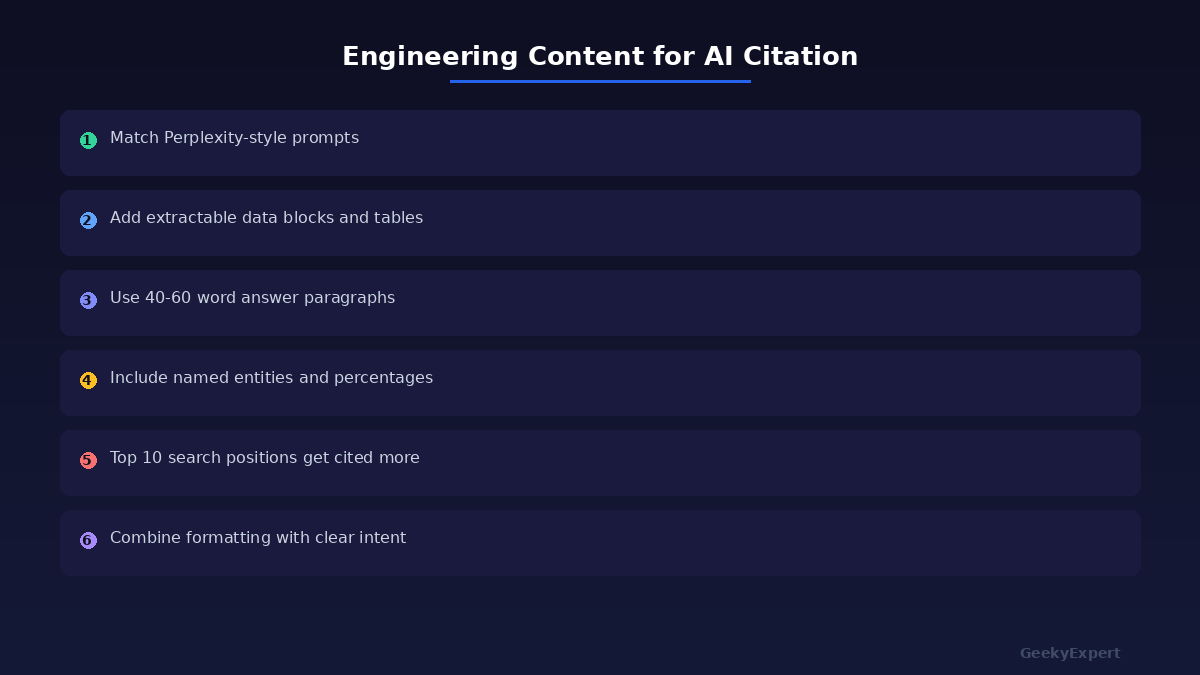
Three engineering approaches produce consistent results:
Prompt matching: Write content that directly mirrors how users phrase questions to AI. Use question-based headings (H2s) that match common prompts. If users ask "how to get clicks from Perplexity," your H2 should reflect that exact phrasing.
Extractable data blocks: Create self-contained data sections — comparison tables, numbered lists, step-by-step frameworks — that a model can lift and cite without needing surrounding context. Each block should make sense on its own.
Answer paragraphs: Open each section with a direct, concise answer in the first 1-2 sentences. Follow with supporting evidence and detail. This front-loaded structure lets the model grab the core answer and cite your page as the source.
The combination of prompt-aligned headings, extractable data, and front-loaded answers creates pages that are citation-ready. This approach aligns with the broader discipline of answer engine optimization (AEO) — structuring content so AI systems can reliably find, extract, and attribute it.
What Types of Content Get the Most Clicks from Perplexity?
Workspace with documents, pen, and tablet for how to get clicks from Perplexity content planning strategy
Not all content types perform equally in AI citation environments. Perplexity tends to cite pages that provide structured, data-rich, and verifiable information — content that adds depth beyond what the model can generate on its own.
Content Type
Citation Probability
Why
Original research with data
High
Primary data that cannot be generated by the model itself
Comparison tables
High
Structured, extractable format ideal for side-by-side answers
Step-by-step frameworks
High
Actionable sequences that models cite as procedural sources
Expert roundups with attribution
Medium-High
Named expert quotes add credibility signals the model values
Long-form guides
Medium
Comprehensive coverage, but only if well-structured with clear sections
Opinion articles
Low
Subjective content lacks the verifiable evidence AI models prefer
Thin listicles without data
Low
Surface-level content that adds no unique value beyond what the model already knows
The pattern is clear: content that provides unique, structured, verifiable information earns the most citations. Pages that simply restate commonly available knowledge offer no citation incentive — the model can generate that information itself.
Focus your content strategy on formats in the high-citation tier. These are the pages that drive generative engine optimization results and convert AI visibility into actual referral clicks.
How Should We Format Pages for Maximum Extractability?
Page formatting directly affects whether Perplexity can extract and cite your content. The model needs to parse your page, identify relevant sections, and pull out information that answers the user's query. Poor formatting creates friction at every step.
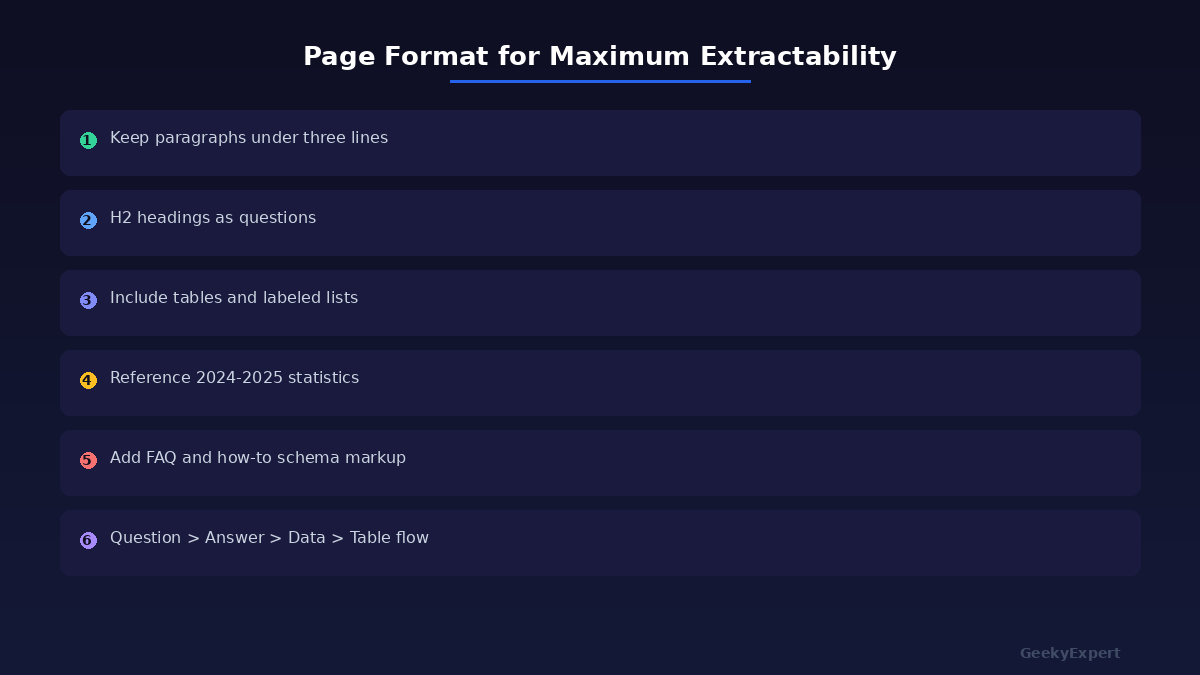
Follow these formatting principles to maximize extractability:
Use descriptive H2 headings: Each H2 should clearly state what the section answers. Question-based headings work best because they match how users prompt AI systems.
Front-load answers: Start every section with a direct answer in the first sentence. Supporting detail, examples, and evidence follow after the core answer is stated.
Break up long paragraphs: Keep paragraphs to 2-4 sentences. Dense text blocks are harder for models to parse and reduce the likelihood of citation.
Use tables for comparisons: Any time you compare options, features, or approaches, use an HTML table. Tables are highly extractable and frequently cited.
Add schema markup: Implement JSON-LD structured data — Article, FAQ, and HowTo schemas signal content type and improve discoverability for AI crawlers.
A recommended page structure for maximum AI extractability:
Title (H1) — clearly states the topic
TL;DR paragraph — 2-3 sentence summary with key takeaway
Table of contents — linked to section anchors
Question-based H2 sections — each with front-loaded answers
Data blocks — tables, numbered lists, comparison grids
FAQ section — structured Q&A with schema markup
Sources and references — linked citations that build trust
This structure aligns with how ranking in answer engines works — pages that are easy to parse, extract from, and attribute consistently outperform pages optimized only for traditional search.
Can Referral Programs Drive Additional Traffic?
Referral programs offer an indirect but effective channel for driving additional traffic from Perplexity users. When people share Perplexity referral links, they introduce new users to the platform — and those new users run queries that can surface your content as a cited source.
How referral programs connect to Perplexity traffic:
Growing the user base: Each new Perplexity user referred through a program increases the total pool of queries being asked. More queries mean more opportunities for your content to be cited.
Community sharing: Referral links shared in relevant communities — developer forums, marketing groups, research communities — bring in users who are likely to ask questions in your topic area.
Perplexity Pro adoption: Pro users tend to run more complex, in-depth queries that require longer answers with more citations. This increases the chance of your content being selected as a source.
Where to share referral links for maximum impact:
Professional communities where AI search tools are discussed
Industry-specific forums and groups
Content about AI productivity tools and workflows
Newsletter audiences interested in AI-powered research
Considerations: Referral programs are a supplementary strategy, not a primary traffic driver. The foundation must always be citation-worthy content. Without strong, structured content that Perplexity wants to cite, growing the user base will not benefit your visibility. Use referrals as an amplifier on top of a solid content engineering strategy.
What Is a Repeatable Strategy to Get Consistent Clicks?
Infographic on how to get clicks from Perplexity showing 5-step optimization framework and citation checklist
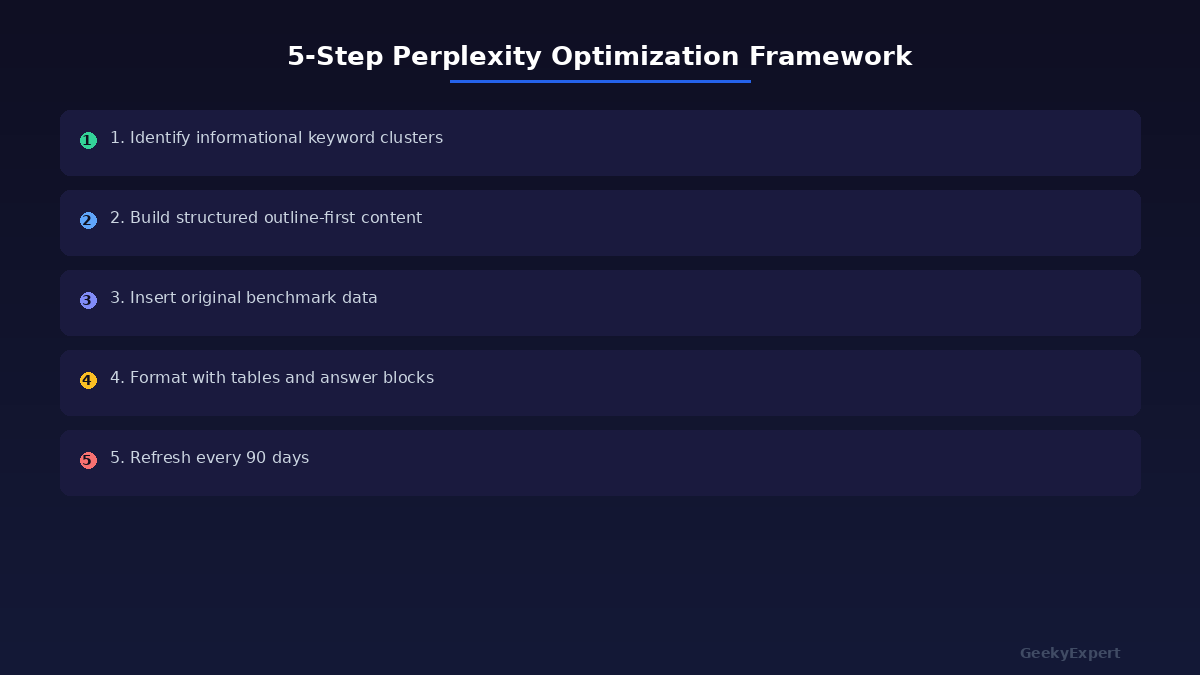
Consistent clicks from Perplexity require a repeatable system, not one-off optimizations. The following five-step framework creates a sustainable cycle of content creation, optimization, and monitoring.
Step 1: Build topical clusters. Instead of targeting individual keywords, build clusters of content around a core topic. Publish a pillar page with a comprehensive overview and supporting pages that address specific subtopics and questions. This establishes entity-level authority that AI models recognize.
Step 2: Structure every page for extraction. Apply the formatting principles from the extractability section above. Every page should have question-based H2s, front-loaded answers, data blocks, and schema markup. Make it easy for Perplexity to cite you.
Step 3: Refresh on a 90-day cycle. Set calendar reminders to review and update each page every 90 days. Add new data, update statistics, expand sections with recent developments, and remove outdated information. Fresh content earns more citations.
Step 4: Monitor citation performance. Use AI visibility tools to track which pages are being cited, which prompts trigger your content, and where competitors are winning. Platforms like AnswerManiac track citation presence across Perplexity, ChatGPT, Gemini, and Claude from a single dashboard.
Step 5: Iterate based on data. Use monitoring insights to prioritize updates. Pages losing citations need immediate attention. Pages gaining citations should be expanded and strengthened. Let the data drive your content calendar.
A helpful walkthrough of this optimization approach is available in the YouTube video: "How to Get Clicks from Perplexity — 5-Step Framework" — search for it on YouTube to see the full visual breakdown of each step in action.
Performance indicators to track weekly:
Citation presence rate: Percentage of target prompts where your content appears as a source
Citation share: Your share of total citations versus competitors for target topics
Click-through from citations: Referral traffic from Perplexity measured in analytics
Content freshness score: Days since last update for each page in your cluster
Topical coverage: Percentage of subtopic questions in your cluster that have dedicated pages
This system turns Perplexity traffic from an unpredictable side effect into a measurable, repeatable channel. The key is consistency — regular publishing, regular updates, and regular monitoring create a compounding visibility advantage over time.
How to Get Clicks from Perplexity with a Long-Term System
Getting clicks from Perplexity is not about gaming an algorithm — it is about becoming the source that AI models trust and cite consistently. The combination of structured content, fresh data, semantic alignment, and systematic monitoring creates a defensible position in AI search results.
Start with topical clusters. Structure every page for extraction. Refresh on a 90-day cycle. Monitor citation performance. Iterate based on data. This is how you turn Perplexity from a black box into a reliable traffic channel.
To learn more about AI visibility and content optimization strategies, explore GeekyExpert. And if you want to track your Perplexity citation performance immediately, AnswerManiac monitors your brand across Perplexity, ChatGPT, Gemini, and Claude — run a free visibility report to see exactly where you stand today.
How can I increase Perplexity AI traffic without relying on luck?
Increasing Perplexity AI traffic requires a systematic approach: build topical clusters around your core subjects, structure every page with question-based H2 headings and front-loaded answers, include extractable data blocks like tables and numbered frameworks, and refresh content every 90 days with updated statistics and examples. Use AI visibility monitoring tools to track which prompts cite your content and where competitors are winning.
This data-driven cycle replaces guesswork with measurable optimization that compounds over time.
What content format earns more Perplexity citations and AI search clicks?
Original research with proprietary data, comparison tables, and step-by-step frameworks earn the highest citation rates from Perplexity. These formats provide structured, verifiable information that the model cannot generate on its own — giving it a reason to cite your page. Expert roundups with named attribution also perform well. Opinion articles and thin listicles without data earn the fewest citations because they add no unique value beyond what the model already knows.
Which Perplexity ranking factors matter most for consistent clicks?
The most important Perplexity ranking factors are semantic relevance to the user query, structured formatting with clear headings and data blocks, original analysis with primary data, entity-level authority built through topical clustering, and content freshness.
Pages that directly match user prompt phrasing, provide extractable answer paragraphs in the first 1-2 sentences of each section, and include current statistics consistently outperform pages optimized only for traditional SEO signals like backlinks and keyword density.
How do I turn citations into referral traffic from Perplexity?
Citations become referral traffic when your cited page offers depth that the AI summary cannot fully replicate. Include detailed data tables, interactive tools, downloadable resources, or extended analysis that incentivizes users to click through for the full picture. Ensure your page title and meta description are compelling since they appear in the citation list.
Track referral traffic from Perplexity in your analytics to identify which pages convert citations into clicks and double down on those content formats.
What off-page strategies help drive more clicks from Perplexity?
Off-page strategies that improve Perplexity citation rates include building topical authority through consistent publishing on related subtopics, earning backlinks from authoritative sources that strengthen entity signals, maintaining active brand presence on platforms Perplexity crawls frequently, and growing the Perplexity user base through referral programs in relevant professional communities.
Internal linking between your topical cluster pages also strengthens the authority signals that AI models use when selecting citation sources.
About Geeky Expert
Geeky Expert is a leading provider of research and insights, dedicated to helping businesses make informed decisions through comprehensive analysis.