Direct answer: A Perplexity ranking monitor tracks whether your brand and web pages are cited inside Perplexity AI's generated answers — measuring citation presence, share of voice, volatility, and replacement events that no traditional SEO tool captures.
Key Takeaways:
• Perplexity monitors track brand mentions and citations inside AI answers, not traditional search rankings.
• These tools help spot when your content gets replaced and identify the exact competitor that took your citation slot.
• The insights guide practical content updates to structure, evidence quality, and sources to maintain AI search visibility.
A Perplexity ranking monitor checks whether your brand or web pages show up inside Perplexity AI's answers. Since Perplexity does not provide its own built-in tracking tool, we rely on external systems to measure visibility. This matters because AI-generated answers are increasingly appearing above traditional links for informational queries — if your content is not cited, you may become effectively invisible for that search moment.
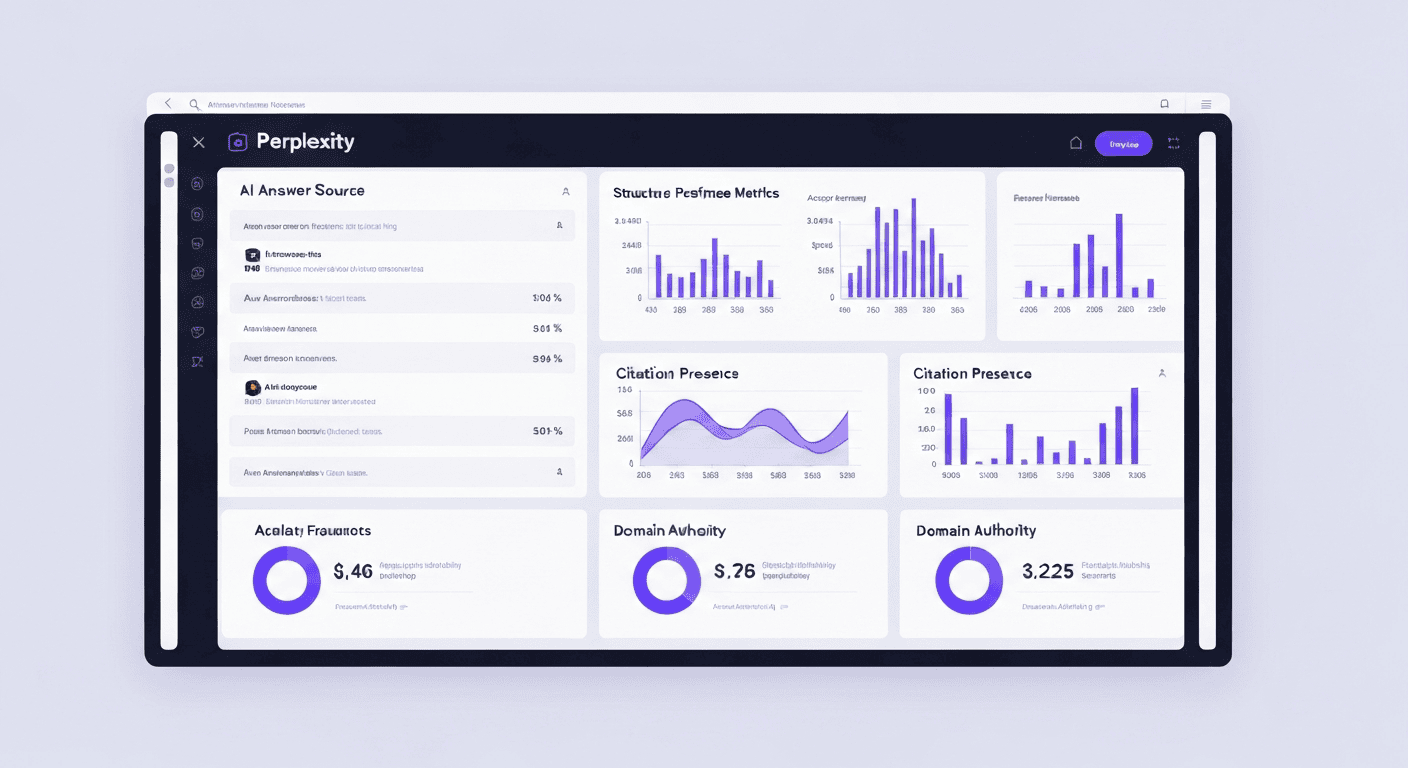
Perplexity ranking monitor illustration focused on AI answer source tracking and structured performance metrics
A Perplexity ranking monitor is a tool that tracks whether your brand or your web pages appear inside Perplexity AI's generated answers and its list of citations. Perplexity does not currently provide brand-level analytics dashboards — there is no native tool for brands to see how often they are cited.
"AI search doesn't use traditional rankings, impressions, or Search Console data, so you need an AI visibility tracker to see when Perplexity cites your brand." — Keyword.com [1]
This introduced a visibility gap for many marketers when Perplexity launched. You could be a primary source for a topic, but have no idea if the AI was using you. Third-party tools stepped in to fill this gap. They act like a persistent, automated user — constantly asking Perplexity questions and recording what it says back.
What these monitors capture is crucial. They log direct mentions of your brand name in the answer text itself. More importantly, they record if your website is in the list of citations Perplexity provides as sources. If your brand is missing, your visibility may be significantly reduced for that query — and a user who never scrolls past the AI answer will never find you. That is the new reality of search for a growing number of queries, and a monitor is your window into it.
This connects directly to the broader practice of LLM citation monitoring — tracking how AI systems reference your brand across multiple platforms to build a defensible visibility strategy.
How Do Perplexity Ranking Monitors Work?
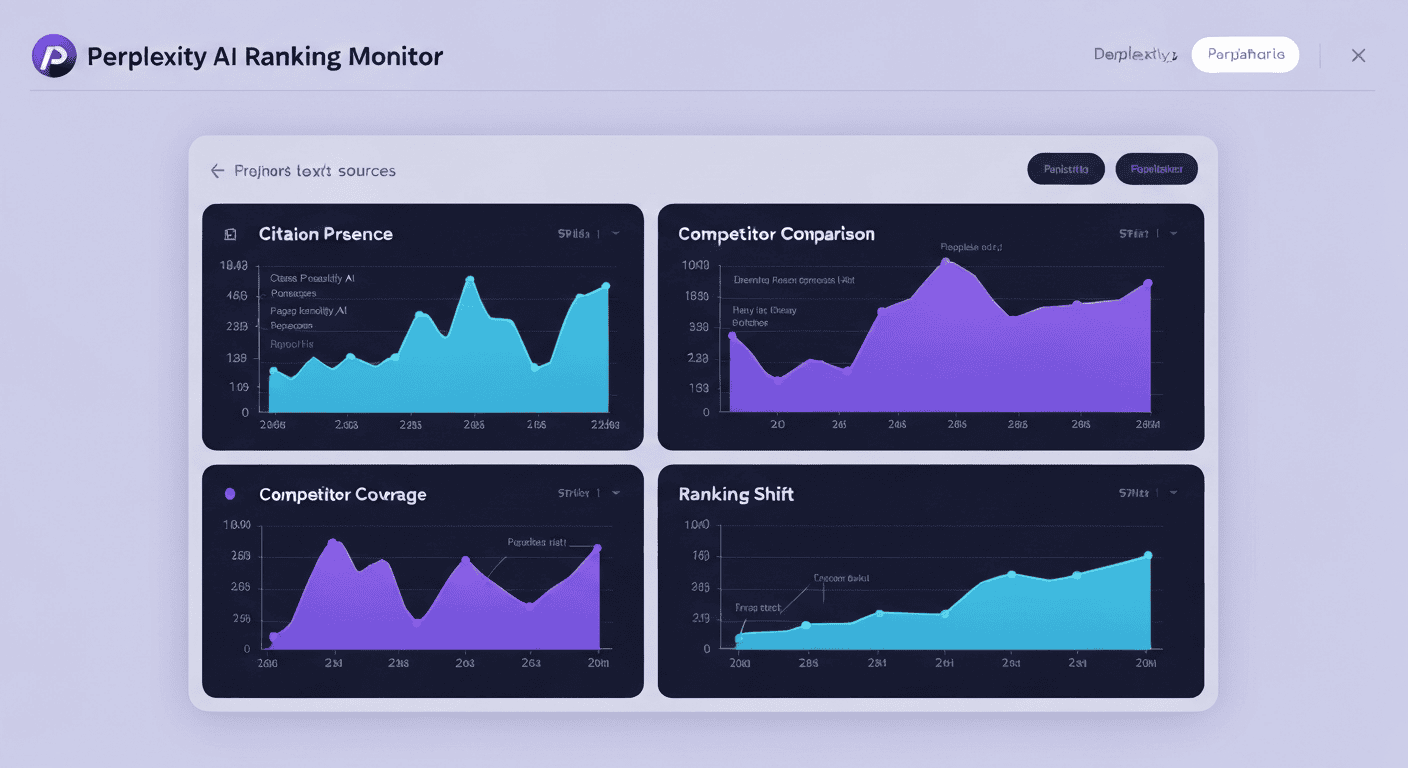
Perplexity ranking monitor analytics display showing citation presence, competitor coverage, and ranking shifts over time
Perplexity ranking monitors automate the process of asking Perplexity questions and saving the answers. This is not about tracking one fixed rank number — it is about mapping how prompts, citations, and competitors shift over time.
"A prompt-based workflow shows you which prompts trigger your brand, which competitors dominate, and which sources Perplexity trusts for your category." — Rankability [2]
Here is the basic workflow:
Prompt Simulation: The system automatically runs a list of your important search queries through Perplexity.
Answer Capture: It grabs the full AI-generated response, including every source link it cites.
Data Parsing: The tool scans the answer text for your brand name and logs the position of your website in the citation list.
Historical Tracking: All this data is saved so you can see how your visibility changes from day to day or week to week.
This need for constant checking is what makes it different from traditional rank tracking. Perplexity's answers are not static like a cached web page — they can be re-generated at any time based on new information it finds.
What Metrics Do Perplexity Ranking Monitors Track?
Instead of tracking a numbered rank like "position 3," these tools measure whether we are included inside the AI's answer and how strong that inclusion is. The focus is on visibility metrics, not traditional SERP rankings. The main metrics a Perplexity ranking monitor tracks include:
Brand mentions: Your company name appears directly in the AI answer text, creating instant exposure.
Citation presence: Your domain appears in the answer citations — the clearest signal of authority.
Citation share: If Perplexity lists 10 sources and you own 2 of them, your citation share is 20%.
Citation order: Higher placements in the citation list usually bring more prominence and trust.
Visibility score: Some systems combine inclusion signals into one score across prompts.
Volatility score: This measures how often citations shift — a high score means you appear one day but disappear the next.
A high volatility score often means you are in a competitive topic where new content is published constantly. Stable inclusion usually means your content is seen as a reliable, authoritative source — the kind of signal that tracking AI search rankings broadly helps you build and defend.
How Is Perplexity Tracking Different From Google Rank Tracking?
The old rules do not fully apply. Tracking visibility in Perplexity is a fundamentally different game than tracking rankings on Google, and understanding the difference is critical.
The biggest practical difference is volatility. A Google SERP might shift around a bit, but a page that ranks #3 today probably will not vanish entirely tomorrow. In Perplexity, an answer can be completely re-generated, and a source cited yesterday can be absent today. The volatility is inherently higher because the system is designed to synthesize the best answer from available data at that moment.
Aspect
Perplexity Tracking
Google Rank Tracking
What it tracks
Mentions and citations in an AI answer
Page position in a list of links
Volatility
High — answers can regenerate anytime
Moderate — SERPs change, but less frequently
Focus for optimization
Evidence, structure, and source quality
Keywords, backlinks, and page authority
Because the AI can create a new answer at any moment, in fast-moving categories more frequent monitoring is necessary. You need automated, consistent monitoring — not occasional manual checks.
Which Tools Offer Perplexity Ranking Monitoring?
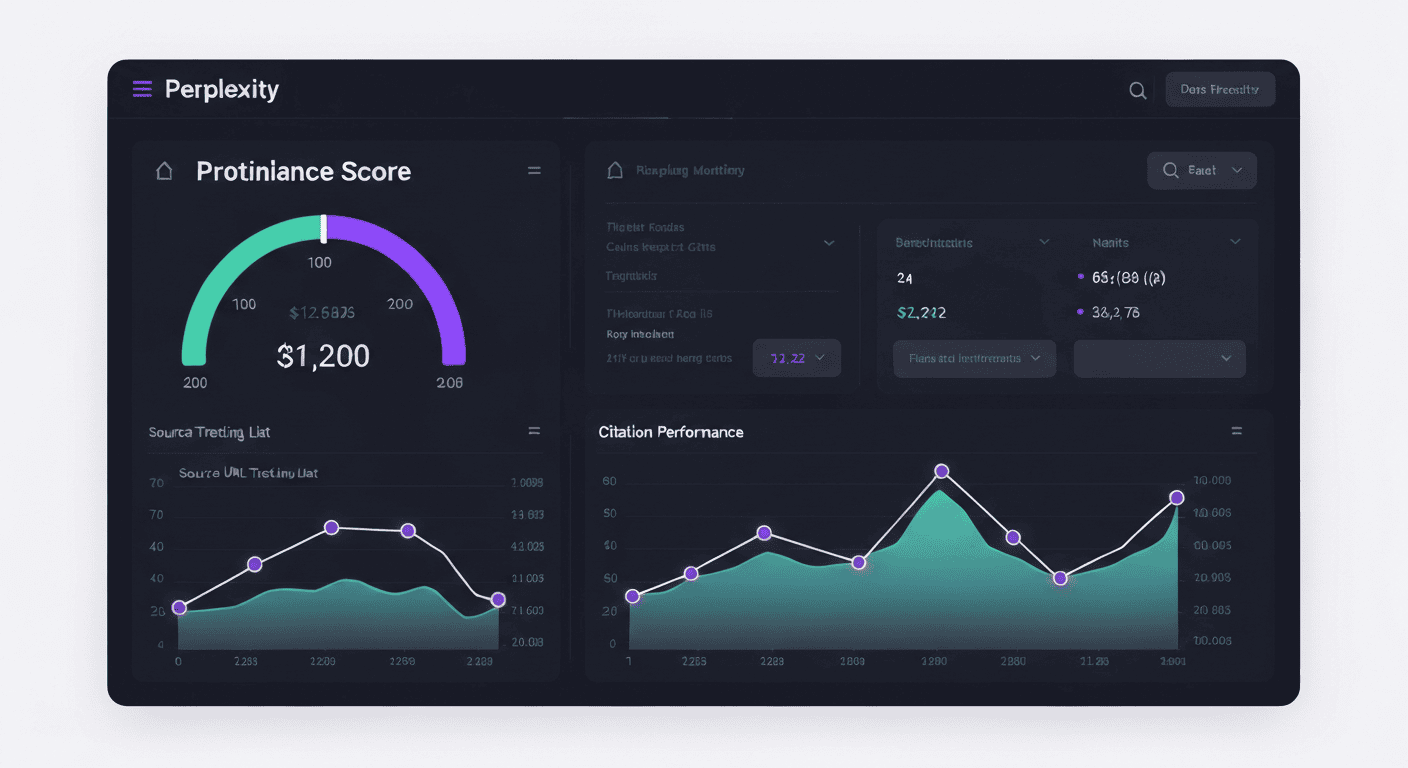
Perplexity ranking monitor screen with prominence score, source tracking, and citation performance metrics
Cross-engine monitoring matters because AI answers are not consistent across platforms. A source that appears in one AI engine may be missing entirely in another, even for the same query. By tracking citation presence, visibility metrics, and rank shifts across multiple AI-driven results, we can see whether a drop is specific to Perplexity or part of a wider visibility issue.
This broader view reduces blind spots and supports more reliable AI search optimization over time. Good Perplexity monitoring tools generally offer a mix of these core capabilities:
Capability
What It Does
Common Use
Source Tracking
Logs every website cited in an answer
Analyzing which sources Perplexity trusts for a topic
Replacement Analysis
Shows exactly which competitor source took your spot
Understanding why you lost visibility
Cross-Engine Checks
Monitors your visibility on other AI platforms too
Getting a broader view of AI search presence
Reporting
Creates dashboards and reports you can share
Aligning your marketing or content team around the data
Platforms like GeekyExpert cover Perplexity alongside ChatGPT, Gemini, and Claude — giving you a unified view of citation presence and share of voice across AI platforms from one dashboard. Run a our research reports to see how Perplexity currently treats your brand.
Why Does Monitoring Perplexity Rankings Matter?
In traditional search, you might be on page two or three — a determined user could still find you. In AI search, the entire interaction often begins and ends with that single generated answer at the top of the page. Many users accept it as complete and never scroll down to traditional links.
This makes inclusion non-negotiable for awareness and, more importantly, for trust. Being cited serves as a credibility indicator for users — the implicit message is: "The AI trusted this source." Without monitoring, you are flying blind. You have no idea if you are visible to potential customers, and you might be optimizing for the wrong thing entirely.
You could pour resources into a piece of content, rank it highly on Google, and still get zero traction from the growing segment of users who start their search with Perplexity. Monitoring highlights exactly where you are failing to appear and turns optimization from guesswork into a targeted, evidence-based process — the same principle behind ChatGPT ranking tracking and multi-platform AI visibility work.
What Causes Ranking Volatility in Perplexity?
Volatility in Perplexity stems from how it builds its answers. Unlike a static database, Perplexity synthesizes answers on the fly from the most current and relevant information it can access — constantly re-evaluating sources. Perplexity citations may shift more frequently than traditional rankings because answers regenerate dynamically every time the model builds a new response.
Ranking volatility usually comes from:
Content freshness changes: Updated competitor pages can replace stale sources.
New evidence signals: Pages with clearer primary sources often earn citation priority.
Prompt variants: Small wording changes produce different citation sets.
Entity reranking: The model may recognize your brand but still choose another source.
High volatility is not always bad — it often means you are in a popular, fast-moving field where lots of people are publishing. The key is to understand why the changes are happening so you can respond with the right content updates, not random rewrites.
How Do Replacement Maps Explain Lost Visibility?
Knowing you lost visibility is one thing. Understanding exactly why is another. Some AI visibility platforms provide replacement mapping — a powerful feature that lets you compare two versions of an answer: the version from a previous check where you were included, and the new version where you are not.
The map does not just show you that you are gone. It highlights exactly which competitor source or sources now occupy the citation slot you used to have — a side-by-side visual comparison. Instead of dealing with a vague "we dropped out," you have a specific target: "Our guide to cloud storage was replaced by TechRadar's 2024 roundup," or "Our citation was replaced by a direct link to the IRS website."
This level of detail turns reaction into strategy. You can analyze the winning source, understand what it has that yours does not, and make a precise change based on what actually displaced you. It reduces wasted effort and focuses your optimization where it will make a real difference — exactly the kind of insight that AI citation tracking tools are built to deliver.
What Content Formats Perform Best in Perplexity Answers?
If you want to be cited, you need to think about how the AI reads and uses your content. Perplexity prioritizes clarity, scannability, and easy information extraction. Dense, long-form prose might be great for human storytelling, but it is harder for the model to confidently pull a concise fact from. Structure matters as much as writing quality.
Commonly cited formats include:
Clear bulleted lists that summarize steps or features
Comparison tables with specific attributes and differences
Short answer-first intros that define the topic immediately
Primary source support, such as research papers or official datasets
Structured data markup, which improves domain attribution and clarity
The logic is about confidence. When the model encounters a long article where key points are buried in paragraphs, it may be less confident about extracting the correct information — making it less likely to use your page as a source. These same principles power effective generative engine optimization across all AI platforms.
How Can We Optimize Using a Perplexity Ranking Monitor?
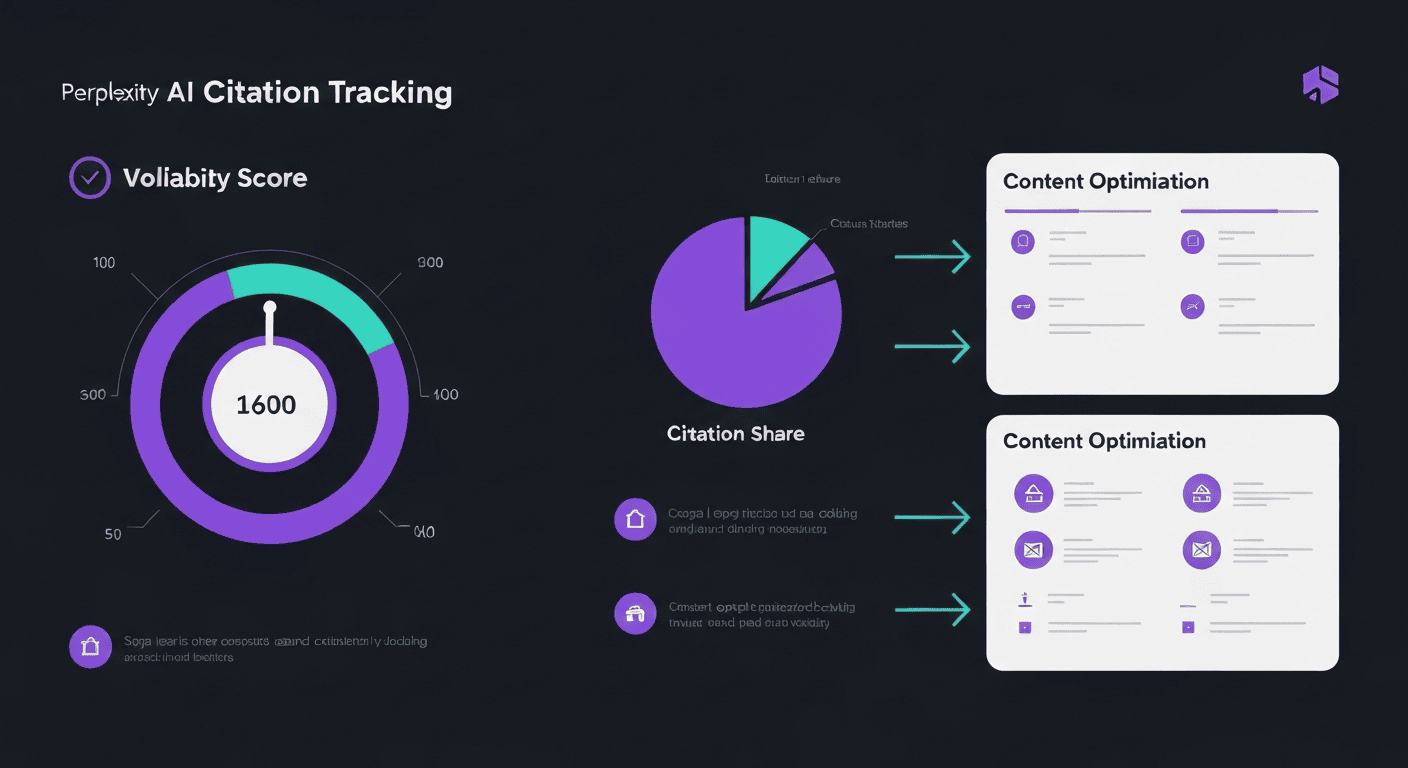
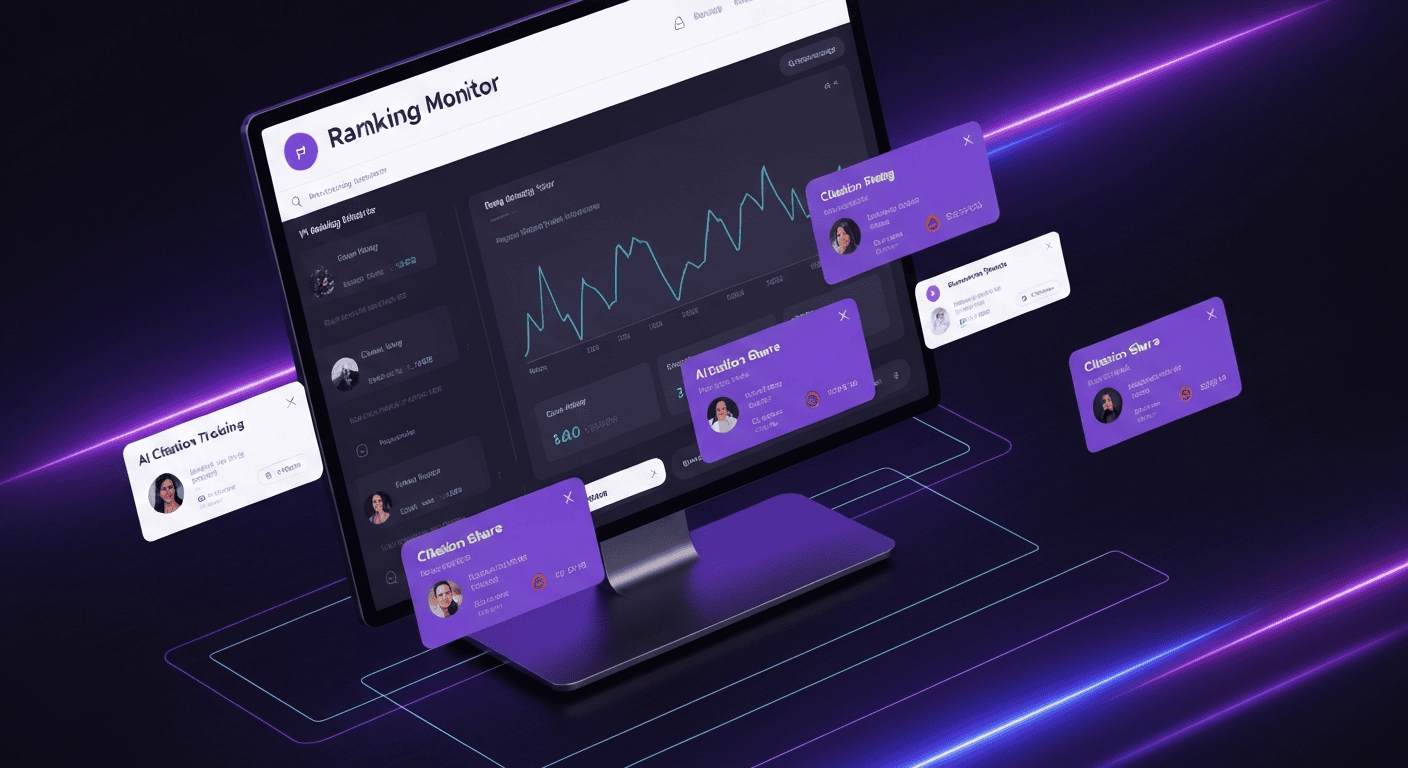
Perplexity ranking monitor interface surrounded by prompt cards and AI citation tracking widgets
Data is only useful if you act on it. A Perplexity ranking monitor matters most when its insights lead to clear updates you can execute. A practical optimization workflow looks like this:
Identify unstable prompts: Focus on prompts where citation presence is missing or volatility is high.
Run competitor benchmarking: Review which domains dominate the source coverage in those answers.
Improve evidence and attribution: Add clearer proof elements, stronger citations, and updated references.
Upgrade structure: Convert dense blocks into scannable summaries, lists, and comparison sections.
Track stabilization: Over the next two weeks, monitor whether volatility scores decline and citation presence becomes steady.
Optimization is not guesswork when the monitor shows exactly where you drop out. At a strategic level, use the monitor to identify stale content sections that are no longer performing. A piece that was cited six months ago but has dropped off might just need a refresh with new examples or updated statistics — a small investment with a measurable visibility return.
Who Should Use Perplexity Ranking Monitors?
These tools are most immediately valuable for a few specific groups:
SEO teams and specialists: If your job is organic visibility, AI search is now part of your domain. Perplexity monitor data gives you a metric to report on and optimize against.
Content strategists and managers: Monitor data provides direct feedback on what formats are effective, which topics have AI search demand, and where your existing content library has gaps.
Agencies managing client visibility: Offering AI search visibility tracking and reporting is becoming a competitive differentiator. It demonstrates comprehensive coverage beyond classic SEO metrics.
The businesses that benefit most are those where AI-assisted research is common — B2B sectors, complex product comparisons, and any field where users start with research queries. If your audience is likely to use an AI tool to learn, compare, or evaluate, you need to understand your visibility in those tools.
Perplexity Ranking Monitor: Visibility Takeaways and Next Steps
A Perplexity ranking monitor gives you structured visibility into how AI answers reference your content and authority. It replaces assumptions with measurable citation presence, visibility metrics, and source coverage data — turning what used to be a black box into an actionable reporting layer.
We use these insights to guide content updates, evidence improvements, and stronger formatting so our pages stay citable over time. Use monitoring to prioritize updates where citation loss is measurable, not where you are guessing.
To learn more about how we approach AI visibility and SEO content strategy, explore GeekyExpert. And if you want to put Perplexity monitoring into practice immediately, GeekyExpert tracks your brand's citation presence across Perplexity, ChatGPT, Gemini, and Claude — run a our research reports to see exactly where you stand today.
What does a Perplexity Ranking Monitor measure beyond simple rankings?
A Perplexity Ranking Monitor measures brand mentions, citation presence, citation share, citation order, visibility score, and volatility score inside AI-generated answers. It tracks domain attribution and source coverage across prompts over time — metrics that are completely absent from traditional rank trackers. These insights explain why your content appears, moves, or disappears in Perplexity results, giving you an evidence-based foundation for content updates.
How can we tell if brand mentions help or hurt our visibility?
Some Perplexity monitoring tools apply sentiment scoring to brand mentions, showing whether references are positive, neutral, or negative. By reviewing citation presence, citation share, and competitor share together, you can measure whether your authority signals are strengthening or weakening over time. A rising citation share combined with stable prominence scores indicates improving authority.
Declining citation presence alongside competitor gains signals a content or evidence gap that needs to be addressed.
Why do citations change so often in Perplexity AI answers?
Citations change frequently in Perplexity because it regenerates answers dynamically rather than serving cached results. The model re-evaluates sources every time it builds a new response, influenced by content freshness, new evidence signals, prompt variant wording, and entity reranking. Replacement maps in monitoring tools show exactly which competitor sources displaced yours, making it possible to understand the specific reason for a citation drop and respond with a targeted content update.
How do prompt clusters improve Perplexity optimization efforts?
Prompt clusters organize your monitored queries into groups by topic, intent, and buyer stage — such as informational questions, comparison queries, and how-to terms. This structure allows you to run prompt auditing at scale and improve GEO monitoring across your full content library. Tracking citation share and visibility score within each cluster reveals which topic areas are performing well and which need content investment, making optimization decisions systematic rather than ad hoc.
What should we do when our content stops appearing in answer citations?
When citations drop, first check for stale content, weak evidence, or poor source attribution using replacement map data to identify the specific competitor that displaced you. Update the page with fresher statistics, stronger primary sources, and clearer structured formatting like bullet lists and comparison tables. Improve internal linking and structured data markup to strengthen authority signals.
Then monitor volatility scores over the next two weeks to confirm whether citation presence stabilizes after the update.
About Geeky Expert
Geeky Expert is a leading provider of research and insights, dedicated to helping businesses make informed decisions through comprehensive analysis.