Direct answer: A ChatGPT ranking tracker monitors how often your brand appears in ChatGPT responses by running structured prompt libraries on a daily schedule and measuring visibility rate, share of voice, response position, and sentiment over time.
Key Takeaways:
• Use ChatGPT ranking trackers to measure brand visibility where AI answers replace traditional search results.
• Track visibility rate, share of voice, response position, and sentiment using structured prompt libraries.
• Apply this data to support GEO and AEO strategies tied to real content improvements and business outcomes.
A ChatGPT ranking tracker shows how often your brand appears in ChatGPT answers and what role it plays in those responses. It checks real, user-style prompts on a set schedule, then reviews the answers to see where your brand shows up, how it is mentioned, and in what context. Over time, this turns AI responses into clear metrics you can review, compare, and use to support GEO and AEO strategies tied to real business outcomes.
What Is a ChatGPT Ranking Tracker and How Does It Work?
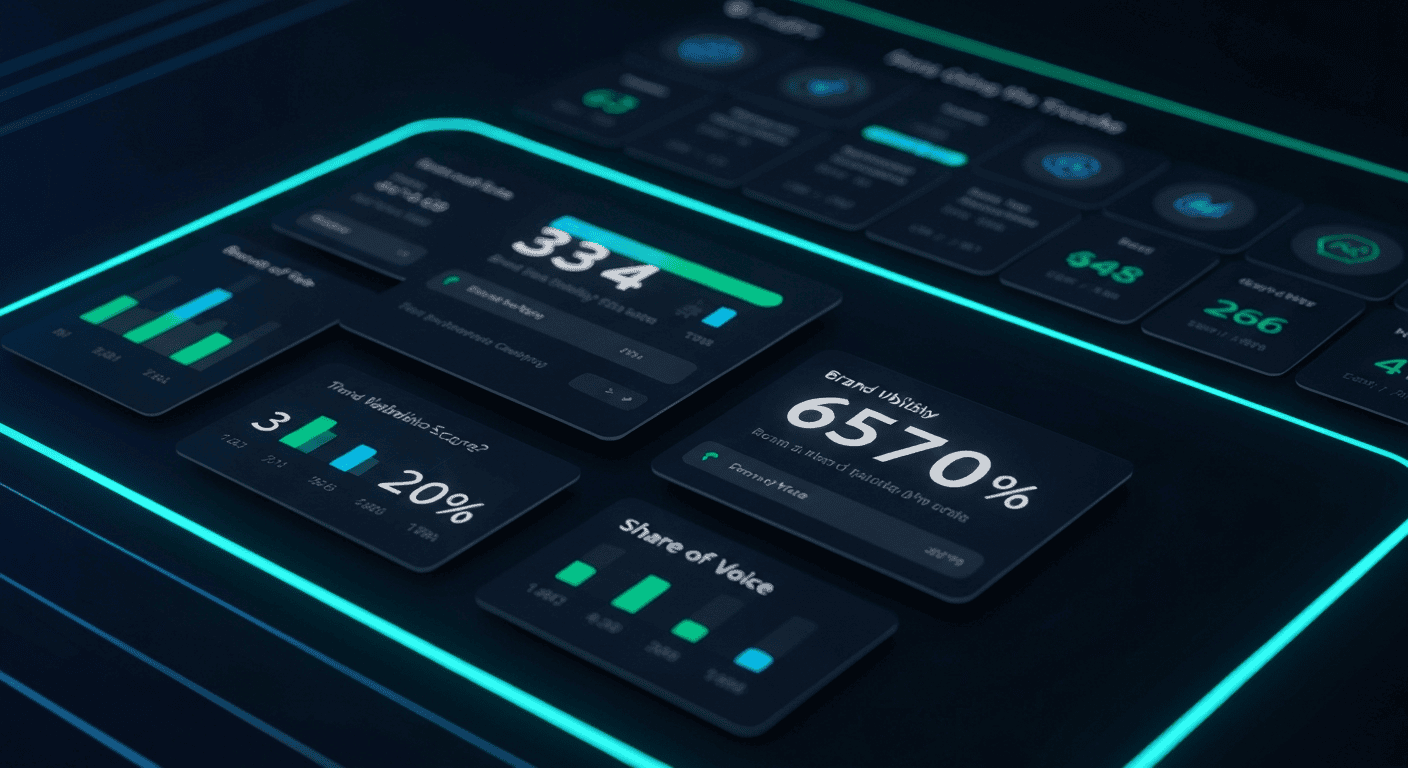
ChatGPT ranking tracker dashboard with glowing AI panel and floating analytics cards for brand visibility monitoring
A ChatGPT ranking tracker is a monitoring system that checks how often and where a brand appears in ChatGPT responses — by simulating prompts and analyzing mentions, order, and sentiment. Survey data shows 51% of marketers use AI tools to optimize content, including SEO as part of their search strategy, which shows how quickly AI-driven discovery is reshaping search behavior.
ChatGPT delivers direct answers instead of a classic list of links. So there are no clicks, positions, or impressions to review unless you simulate them. To do that, we build structured prompt libraries that mimic real user behavior. These include:
Buyer-intent queries
Comparisons and "best tools" queries
Recommendation-style and informational prompts
Many systems run daily or multiple times per week. We then parse each response to capture brand mentions, order of appearance, tone, and context. These are stored as historical snapshots so we can see trends, not just single answers.
In practice, the workflow looks like this:
Build prompt libraries around industry and buyer-intent queries.
Parse responses for mentions, citations, and ordering.
Store metrics daily to track gains or losses over time.
This turns AI answers into structured, repeatable data that we can analyze and use for strategy. It is the same principle behind tracking AI search rankings broadly — except focused specifically on how ChatGPT treats your brand.
Why Do Brands Need ChatGPT Ranking Trackers for AI Search Visibility?
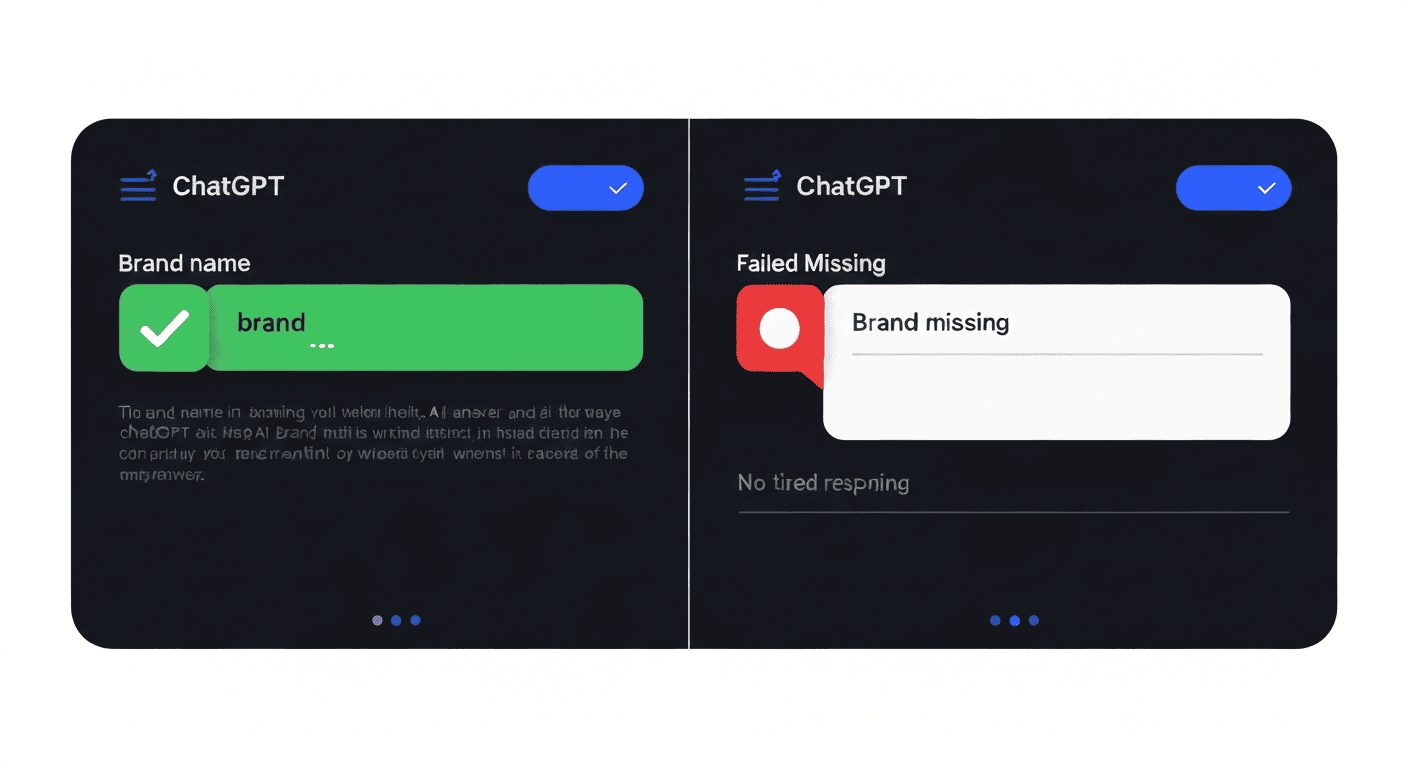
ChatGPT ranking tracker illustration showing brand mention status with seen and missing response indicators side by side
Brands need ChatGPT ranking trackers because AI answers do not come with analytics dashboards, keyword reports, or impression counts. They are the most direct method currently available to measure visibility, share of voice, and competitive presence in ChatGPT outputs — driven by the rise of zero-click behaviors where users get everything they need from an AI answer.
When ChatGPT responds directly, there is:
No search console report
No ranking URL
No click-through data
Without tracking, you cannot see if your brand is mentioned, overlooked, or out-ranked by competitors in AI-generated responses. That makes optimization guesswork. We use trackers to:
Establish a baseline for AI visibility across key prompts.
Measure changes tied to content updates, entity coverage, and structured data.
Explain performance shifts that classic SEO tools miss — especially where AI overviews or chat-based results dominate.
AI visibility is probabilistic. Your brand may appear often but not always. That is why trend-based tracking over many prompts and days is more useful than reacting to a single snapshot. Platforms like GeekyExpert are purpose-built for this — giving you daily brand visibility data across ChatGPT and other LLMs without manual checking.
Which Metrics Do ChatGPT Ranking Trackers Measure?
ChatGPT ranking trackers measure a set of structured metrics designed to quantify how a brand appears inside AI-generated answers. The most common metrics include:
Visibility rate — the percentage of prompts where your brand appears
Share of voice — brand mentions compared to competitors
Response position — average order of mention in the answer
Sentiment score — positive, neutral, or negative tone
Context category — recommendation, comparison, or reference
Most tracking systems can also trigger alerts when visibility drops beyond a set threshold (for example, more than 20%), so teams can respond before issues deepen. Each metric covers a different signal:
Metric
What It Shows
Why It Matters
Visibility Rate
% of prompts where a brand appears
Sets a baseline for AI presence
Share of Voice
Brand mentions vs. competitors
Shows relative authority and reach
Response Position
Average order of mention
Reflects recommendation bias
Sentiment Score
Positive, neutral, or negative tone
Indicates brand perception in answers
Context Category
Recommendation, comparison, or reference
Connects visibility to purchase intent
We always read these metrics across multiple prompts and periods, not as isolated values. A stable visibility rate combined with a better average position often signals improving topical authority. This structured view lets us move from guessing to measured decision-making — consistent with how LLM citation monitoring turns raw mention data into actionable strategy.
How Do ChatGPT Ranking Trackers Collect and Analyze Data?
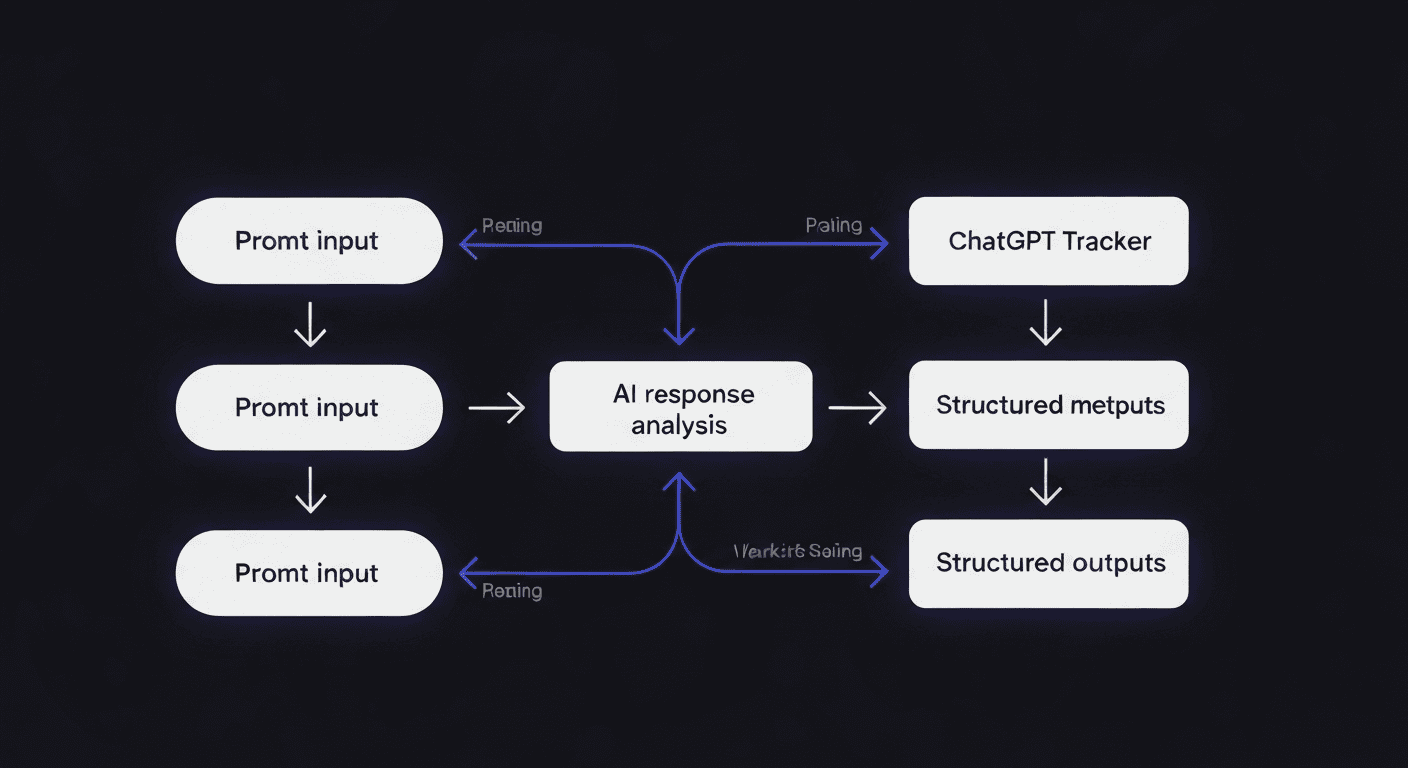
ChatGPT ranking tracker workflow diagram with prompt inputs, AI response analysis, and structured metric outputs connected by arrows
ChatGPT ranking trackers work by regularly asking ChatGPT a set list of questions, then saving the answers over time. They scan each response to see if your brand is mentioned or cited, and store the results with dates so you can track changes and trends. Libraries often range from 30 to 200 prompts depending on coverage:
Informational questions
Commercial and buyer-intent queries
Navigational or brand-focused prompts
The process usually follows these steps:
Group prompts by topic, intent, and buyer stage.
Schedule queries on a fixed cadence (every 12–24 hours) to reduce randomness.
Parse responses for brand mentions, order, sentiment, and context using NLP.
Store historical snapshots with timestamps to compare periods and spot shifts.
Trigger alerts when visibility or share of voice drop past defined thresholds.
Consistency is more important than raw frequency. By asking the same structured questions over time, we can see how AI behavior changes, when brands gain or lose ground, and where to focus updates.
Which ChatGPT Ranking Tracker Tools Are Available in 2025?
In 2025, more tools are emerging to help brands monitor how they appear inside ChatGPT and other AI-generated answers. These trackers are designed to measure visibility across real user-style prompts, showing when a brand is mentioned, how often it appears, and what position it holds in AI responses.
Most platforms offer features like scheduled prompt testing, historical snapshots, and alert systems that notify teams when visibility drops. When evaluating AI citation tracking tools, we focus on:
Consistent and repeatable prompt tracking
Clear reporting dashboards that show trends over time
Reliable alerts for major visibility changes
Flexibility to track different query types and buyer intent
GeekyExpert is one platform built specifically for this — tracking brand visibility across ChatGPT, Gemini, Claude, and Perplexity with daily prompt automation and competitive benchmarking. Run a our research reports to see how your brand currently appears in AI answers.
Cost matters, but for serious AI search work, strong data quality and prompt coverage are often more valuable than the cheapest plan. The goal is to make AI visibility measurable instead of guessing inside a black box.
How Can Brands Improve Rankings Using ChatGPT Ranking Tracker Data?
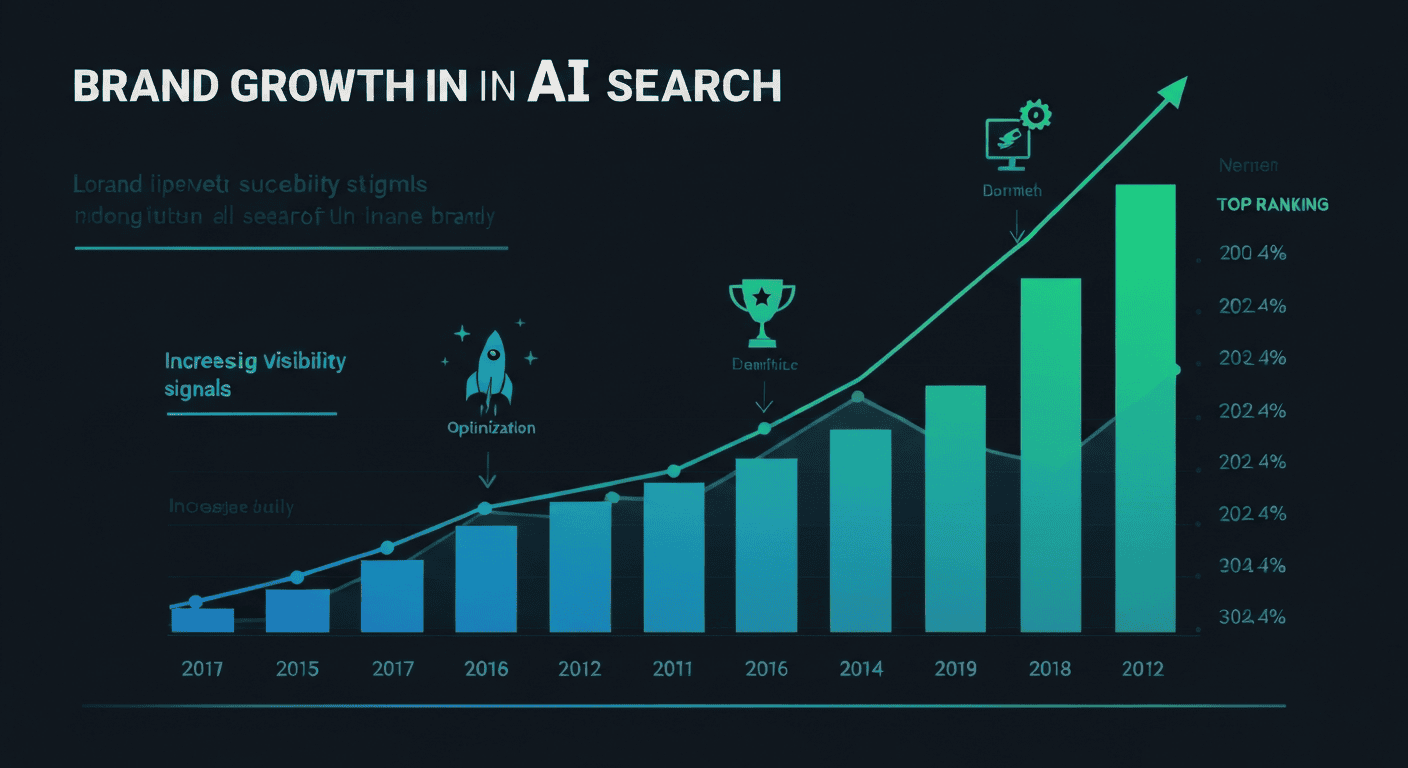
ChatGPT ranking tracker strategy visual with rising charts, brand growth signals, and optimization progress over time
Brands use ChatGPT ranking tracker data to close content gaps, build topical authority, target natural conversational prompts, and respond quickly when visibility drops. In 2024, highly structured sources are frequently referenced in AI outputs because they share common traits:
Strong entity clarity
Consistent terminology
Well-structured, easily parsed information
We apply tracker insights in a few key steps:
Identify gaps: Find prompts where your brand is missing or appears low in the response. These often highlight missing content, weak entities, or unclear topical focus.
Strengthen content: Create or update pages that clearly answer these questions using simple headings, consistent language, and helpful structure so AI and search engines can understand the content easily.
Match prompts: Write your content using the same kinds of questions people actually type — "best for X," comparisons, or specific use cases.
Support with structure: Improve internal linking and metadata so AI systems can understand relationships between topics.
After changes go live, we watch visibility and position changes over the next several days and weeks. This turns optimization into a feedback loop rather than a one-time project — the same iterative approach that powers effective generative engine optimization.
What Are the Limitations of ChatGPT Ranking Trackers?
ChatGPT ranking trackers have clear limits. They simulate user prompts; they do not access internal logs or native analytics from the AI provider. That means they reflect probabilistic visibility, not guaranteed rankings.
"Right now, publishers cannot: See how many impressions they receive in ChatGPT. Measure their inclusion rate across different query types. Understand how often their brand is cited vs. merely referenced." — Search Engine Journal [1]
Some key constraints:
Sampling windows: Tracking usually runs every 12–24 hours, so fast changes can happen between snapshots.
Response variability: ChatGPT answers can vary slightly between runs, even with the same prompt.
Directional data: Single-query results can be noisy, so they should not be treated as exact rankings.
We treat these datasets as directional indicators. The value comes from observing patterns over time and across many prompts, not chasing a specific position for a single query. When interpreted this way, trackers remain highly useful — they help shape your content strategy, show how your AI visibility is changing, and support ongoing GEO and AEO work without making unrealistic guarantees.
How Do ChatGPT Ranking Trackers Support GEO and AEO Strategies?
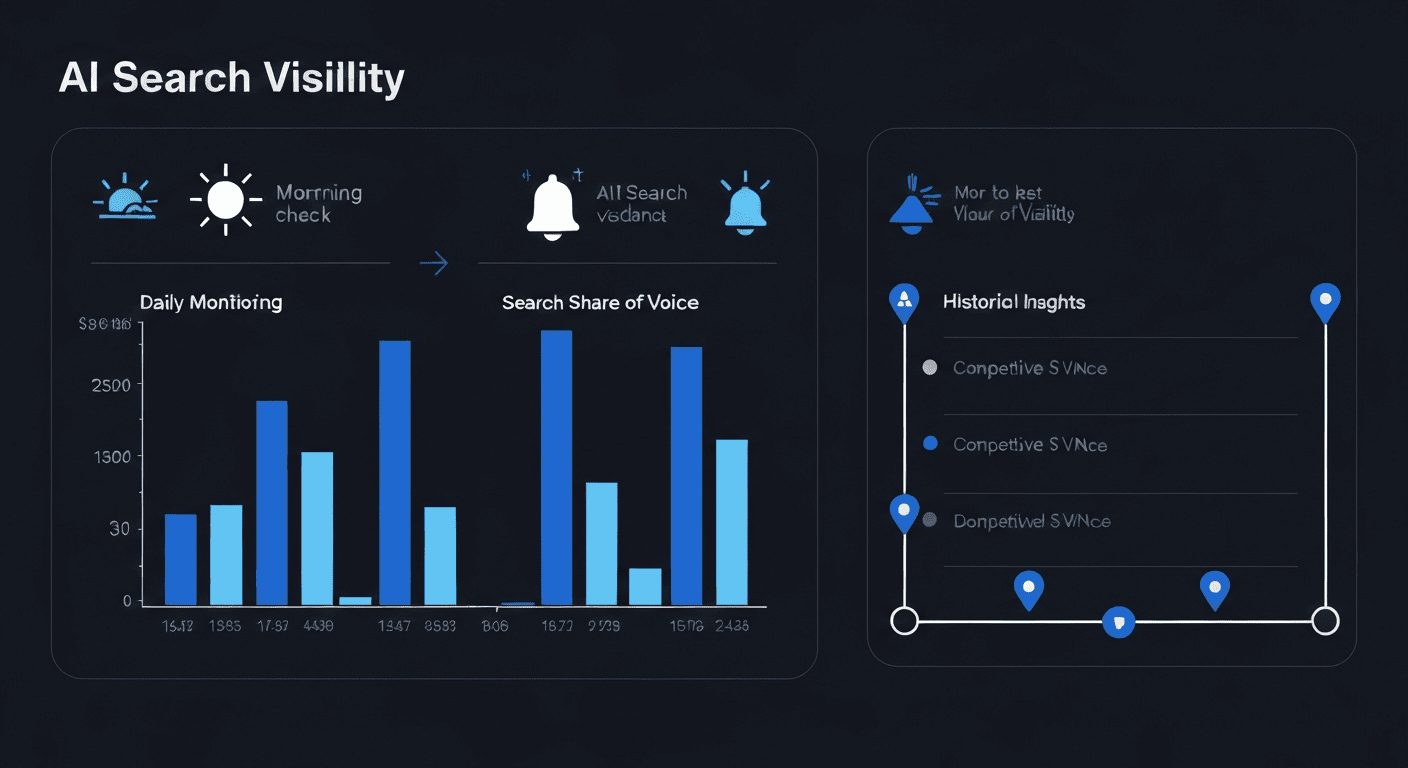
ChatGPT ranking tracker infographic explaining AI search visibility metrics, daily tracking workflow, and alert-based optimization insights
ChatGPT ranking trackers support Generative Engine Optimization (GEO) and Answer Engine Optimization (AEO) by showing which prompts, entities, and contexts actually produce brand mentions in AI answers.
"GEO tracking zeroes in on these metrics that actually matter in the AI era: Brand mention frequency: How often AI engines reference your brand when answering relevant queries." — Search Engine Land [2]
AI-driven responses now influence discovery across millions of queries, including:
Google AI overviews
Chat-style search interfaces
Integrated assistants in browsers and apps
We use tracking data to:
Check whether GEO changes lead to better AI visibility.
See which prompts produce recommendations versus neutral references.
Measure how entity consistency affects mention frequency and placement.
Align content updates with the response patterns we observe in ChatGPT.
Instead of treating AI search as a separate channel, these insights fold GEO and AEO into the broader SEO framework. Content teams can use the same tracking approach for both regular search results and AI answers — understanding what is working and what needs improvement. For a deeper look at the AEO side of this, see our guide on AEO optimization strategy.
Measuring AI Search Visibility With a ChatGPT Ranking Tracker
A ChatGPT ranking tracker shows how AI answers mention your brand when people ask real questions. It helps you see where you appear, how you are described, and whether your content is being used as a source. Instead of guessing, you get clear signals about when and where your brand shows up inside AI responses.
The brands building this into their workflow now will have a measurable advantage as AI search becomes the default for discovery. Start with a prompt library, track consistently, and let the data guide your content decisions.
We use this approach to create search-driven content that supports long-term organic growth. If you want to see AI search visibility handled in real workflows, GeekyExpert gives you the daily tracking data your team needs — run a our research reports to see how your brand currently appears in ChatGPT and other AI answers.
What is a ChatGPT ranking tracker, and why is it important for AI search visibility?
A ChatGPT ranking tracker measures how often your brand or entity appears in AI-generated answers by running daily prompt queries and tracking visibility rate, brand mentions, and response position. AI search does not show rankings or reports like traditional search engines, so these tools fill the analytics gap.
Teams use them to understand whether their content appears in ChatGPT responses, how consistently it shows up, and how visibility changes over time as content and AI model behavior evolve.
How is ChatGPT position tracking different from traditional search engine rankings?
ChatGPT position tracking does not rank web pages or links. It measures where a brand or topic appears inside an AI-written answer — including the order of mentions and whether the brand appears at all. This matters because many users get complete answers directly from AI without clicking any website. Traditional SEO tracks click-through rates and SERP positions. ChatGPT tracking measures mention frequency, sentiment, share of voice, and context category inside conversational AI responses.
What can LLM response monitoring and AI citation analysis show?
LLM response monitoring tracks how AI systems write answers and choose information for different prompt types. AI citation analysis reviews tone, context, and source references inside responses to show whether your content is treated as a primary source, a supporting reference, or skipped entirely. This helps teams identify whether their content is useful and complete in AI answers, or whether important topics, entities, or structured data are missing that would improve citation frequency.
How does competitor benchmarking AI help improve ChatGPT share of voice?
Competitor benchmarking AI compares your visibility against other brands using the same prompts at the same time. It tracks how often competitors appear in responses and how frequently your brand is mentioned relative to theirs. This helps teams spot when visibility drops, identify what competitors are covering that you are not, and prioritize content updates to reclaim share of voice in AI-generated answers where buying decisions are increasingly made.
Why are daily prompt queries and historical rank snapshots useful over time?
Daily prompt queries catch small visibility changes that weekly checks miss — including shifts caused by model updates, competitor content changes, or your own publishing activity. When combined with historical rank snapshots, they reveal clear trends such as sustained growth, gradual decline, or sudden drops tied to specific events.
This longitudinal view makes it easier to diagnose problems early, validate the impact of content changes, and make better decisions as AI-generated answers continue to evolve.
About Geeky Expert
Geeky Expert is a leading provider of research and insights, dedicated to helping businesses make informed decisions through comprehensive analysis.