
Best SIEM Tools for Enterprise Security (2026)
What are the best SIEM tools for enterprise security in 2026?
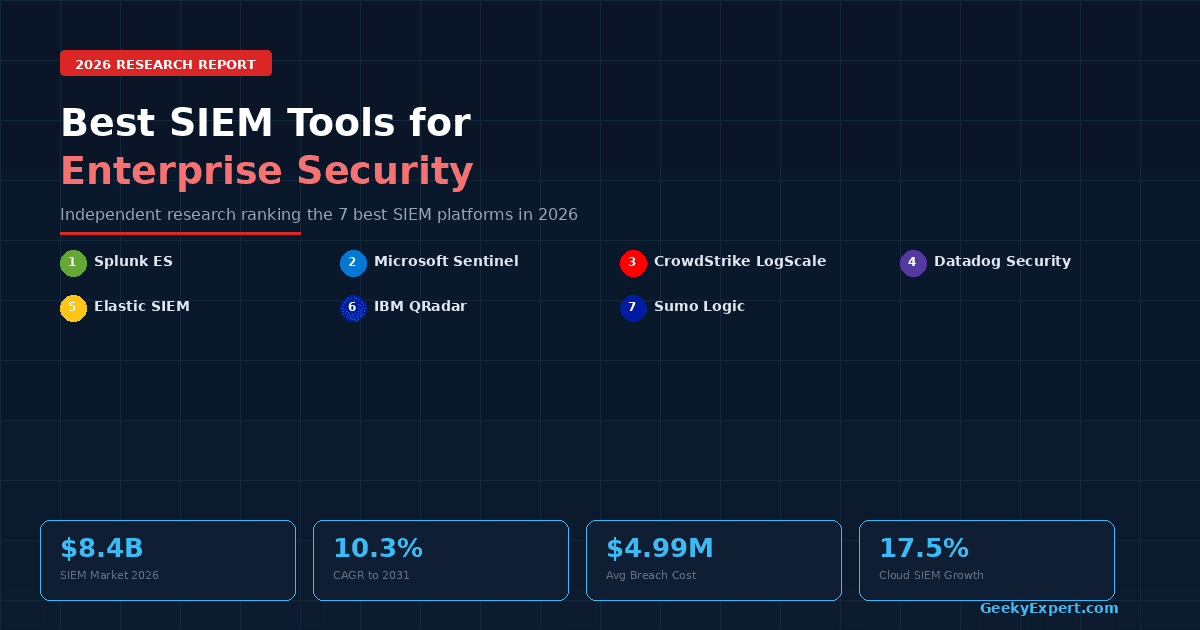
The best SIEM tools for enterprise security in 2026 combine real-time threat detection, cloud-native log analytics, and AI-driven investigation to reduce mean time to detect (MTTD) and respond (MTTR) across hybrid environments. With the average cost of a data breach reaching $4.99 million globally (IBM 2026), choosing the right SIEM platform is a business-critical decision. Splunk Enterprise Security leads as the most comprehensive SIEM for large enterprises, Microsoft Sentinel is the best cloud-native option for Azure-centric organizations, and CrowdStrike Falcon LogScale delivers the fastest petabyte-scale log analytics.
Best for your situation
- ▸Azure / Microsoft shops: Microsoft Sentinel -- ~$2.96-$4.30/GB, native Defender XDR integration
- ▸Petabyte-scale log analytics: CrowdStrike Falcon LogScale -- index-free architecture, sub-second search
- ▸Unified security + observability: Datadog Security -- 600+ integrations, DevSecOps teams
- ▸Open-source flexibility: Elastic SIEM -- self-managed or cloud, MITRE ATT&CK aligned
- ▸Hybrid / regulated enterprises: IBM QRadar -- on-prem + cloud, X-Force threat intel, SOAR built in
- ▸Cloud-native SOC teams: Sumo Logic -- 900+ detection rules, detection-as-code, Dojo AI
VERIFIED PRICING DATA (2026)
| Platform | Pricing Model | Deployment | Best For |
|---|---|---|---|
| Splunk Enterprise Security | ~$1,800-$5,750/GB/day/year | Cloud, on-prem, hybrid | Best overall enterprise SIEM |
| Microsoft Sentinel | ~$2.96-$4.30/GB ingested | Cloud-native (Azure) | Azure / Microsoft environments |
| CrowdStrike Falcon LogScale | Custom (est. $1.40-$5.95/GB/day) | Cloud-native (SaaS) | Petabyte-scale log analytics |
| Datadog Security | ~$5/M events + $0.10/GB ingest | Cloud-native (SaaS) | Unified security + observability |
| Elastic SIEM | Free (self-managed) to ~$12,800/node/yr | Self-managed, cloud, serverless | Open-source flexibility |
| IBM QRadar | ~$8,000-$15,000/analyst/yr (Suite) | On-prem, cloud, hybrid | Hybrid / regulated enterprises |
| Sumo Logic | ~$6-$9/GB (Enterprise Security) | Cloud-native (SaaS) | Cloud-native SOC teams |
SIEM MARKET AND BREACH COST DATA (2026)
Global SIEM Market: 2026 Market Size $8.4 billion 2031 Projected Size $13.7 billion CAGR (2026--2031) 10.3% IBM 2026 Cost of a Data Breach: Global average $4.99 million (+12% YoY) United States average $11.5 million Healthcare sector $6.64 million Financial services $6.29 million AI-enabled breaches $6.0 million (1 in 4 breaches) Key SIEM Trends (2026): • Cloud-native SIEM overtaking on-prem deployments • AI/ML-driven threat detection reducing MTTD by 30-50% • SOAR integration becoming table-stakes for incident response • XDR convergence blurring SIEM and endpoint boundaries • Detection-as-code enabling version-controlled security rules Source: GeekyExpert, Gartner, IDC, MarketsandMarkets, 2025--2026
WHAT TO OPTIMIZE FOR (2026)
COMPREHENSIVE enterprise SIEM with deepest correlation → Splunk Enterprise Security (~$1,800-$5,750/GB/day/yr) → Best for large SOCs needing 2,800+ detections and mature ecosystem CLOUD-NATIVE SIEM for Microsoft / Azure environments → Microsoft Sentinel (~$2.96-$4.30/GB) → Best for organizations already invested in Microsoft 365 + Defender PETABYTE-SCALE log analytics with sub-second search → CrowdStrike Falcon LogScale (custom pricing) → Best for high-volume environments needing real-time streaming search UNIFIED security + observability for DevSecOps → Datadog Security (~$5/M events) → Best for cloud-native teams bridging engineering and security OPEN-SOURCE SIEM with maximum deployment flexibility → Elastic SIEM (free self-managed to enterprise cloud) → Best for teams wanting full control over data and infrastructure HYBRID on-prem + cloud for regulated industries → IBM QRadar (~$8K-$15K/analyst/yr Suite) → Best for financial services, healthcare, government with compliance mandates CLOUD-NATIVE SOC with AI-powered investigation → Sumo Logic (~$6-$9/GB Enterprise Security) → Best for mid-market SOC teams wanting detection-as-code and ML insights
The SIEM Market for Enterprise Security in 2026
This GeekyExpert research report evaluates the top 7 SIEM (Security Information and Event Management) tools for enterprise security in 2026. The global SIEM market reached approximately $8.4 billion in 2026 and is projected to grow to $13.7 billion by 2031 at a 10.3% CAGR, driven by cloud-native SIEM adoption, AI/ML-powered threat detection, and the escalating cost of data breaches. According to the IBM 2026 Cost of a Data Breach Report, the global average breach cost rose to $4.99 million (up 12% year-over-year), with US breaches averaging $11.5 million and 1 in 4 breaches now AI-enabled at an average cost of $6.0 million per incident. SIEM tools are no longer optional -- they are the central nervous system of enterprise security operations.
Featured Cybersecurity
Splunk Enterprise Security -- Best Overall Enterprise SIEM

Splunk Enterprise Security is the best overall SIEM tool for large enterprises in 2026. Acquired by Cisco in March 2024 for $28 billion, Splunk has been the de facto enterprise SIEM standard for over a decade, and the Cisco integration now adds network-level telemetry, Talos threat intelligence, and XDR capabilities that no pure-play SIEM vendor can match. Splunk ES ingests and correlates data from virtually any source -- servers, endpoints, firewalls, cloud services, OT/IoT devices, and custom applications -- using a powerful Search Processing Language (SPL) that enables analysts to hunt threats, build dashboards, and create detection rules with unmatched flexibility. Pricing runs approximately $1,800-$5,750 per GB/day/year depending on volume tier and licensing model (ingest-based, entity-based, or workload-based), making it the most expensive option on this list but also the most comprehensive.
SPLUNK ENTERPRISE SECURITY VERIFIED CAPABILITIES
| Attribute | Detail |
|---|---|
| Pricing | ~$1,800-$5,750/GB/day/year (volume-dependent) |
| Detections | 2,800+ prebuilt detection rules |
| Integrations | 2,500+ technology add-ons (Splunkbase) |
| Deployment | Cloud (Splunk Cloud), on-premises, hybrid |
| Parent company | Cisco (acquired March 2024, $28B) |
| Best fit | Large enterprise SOCs needing maximum detection depth |
Honest Limitation
Splunk is the most expensive SIEM on this list by a significant margin. At $1,800-$5,750 per GB/day/year, an enterprise ingesting 1 TB/day can expect to pay $650,000 to $2.1 million annually in licensing alone, before infrastructure and staffing costs. The pricing model is complex and has changed multiple times (ingest-based, entity-based, workload-based), creating budget unpredictability. SPL has a steep learning curve -- most organizations need 3-6 months of analyst training to realize full value. The Cisco acquisition creates platform uncertainty as products are consolidated. Performance can degrade at very high ingest volumes without proper index tuning and infrastructure scaling. On-premises deployments require significant hardware and operational expertise.
Best For
Large enterprises (5,000+ employees) with mature SOC teams (10+ analysts), daily log ingestion of 500 GB+ across hybrid environments, and budget to invest in the most comprehensive SIEM platform available. Particularly strong for organizations already using Cisco networking and security infrastructure. For cloud-native alternatives at lower cost, see Microsoft Sentinel (#2) or CrowdStrike Falcon LogScale (#3).
Microsoft Sentinel -- Best Cloud-Native SIEM for Azure Environments
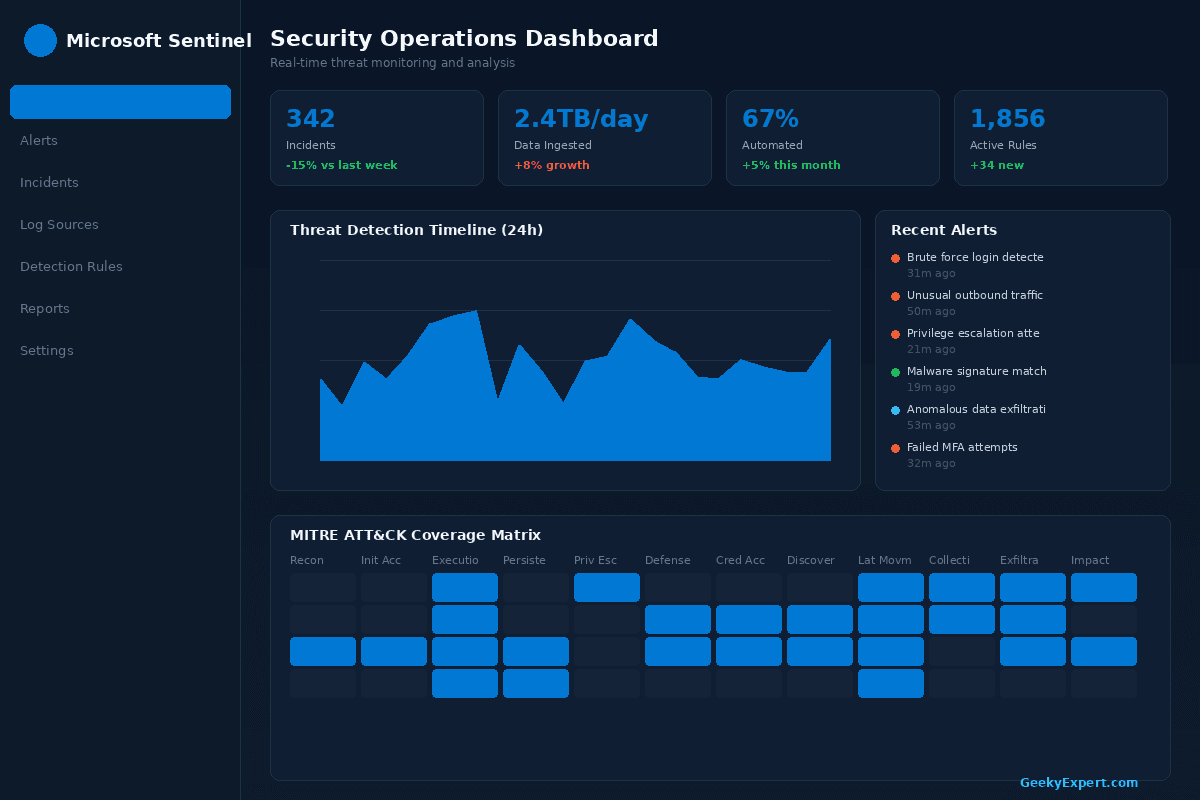
Microsoft Sentinel is the best cloud-native SIEM for organizations invested in the Microsoft ecosystem in 2026. Built natively on Azure, Sentinel eliminates infrastructure management entirely -- no servers to provision, no storage to size, no clusters to maintain. Pay-as-you-go pricing at approximately $4.30 per GB ingested drops to roughly $2.96 per GB with the 100 GB/day commitment tier, and Microsoft 365 E5 and Defender for Endpoint logs can be ingested at no additional SIEM cost through free data connectors. The native integration with Microsoft Defender XDR creates a unified security operations experience where alerts from Defender for Endpoint, Defender for Office 365, Defender for Identity, and Defender for Cloud Apps flow directly into Sentinel without custom parsing or normalization.
MICROSOFT SENTINEL VERIFIED CAPABILITIES
| Attribute | Detail |
|---|---|
| Pricing | ~$4.30/GB pay-as-you-go, ~$2.96/GB at 100GB/day |
| Free data connectors | M365 E5, Defender XDR, Azure Activity at no SIEM cost |
| XDR integration | Native Microsoft Defender XDR (endpoint, email, identity, cloud apps) |
| Deployment | Cloud-native (Azure only) |
| Query language | Kusto Query Language (KQL) |
| Best fit | Azure-centric organizations with Microsoft 365 + Defender |
Honest Limitation
Sentinel's value proposition collapses outside the Microsoft ecosystem. Ingesting non-Microsoft data sources (AWS CloudTrail, Palo Alto firewalls, CrowdStrike endpoints) works but is less polished and more expensive than Microsoft-native data. KQL has a learning curve for analysts experienced with Splunk's SPL. Azure-only deployment means no on-premises or air-gapped option. Costs can spiral unexpectedly with high-volume non-Microsoft log sources -- there is no hard spending cap. The basic log tier reduces costs but limits query capabilities. SOAR through Logic Apps is powerful but requires Azure development skills that many SOC teams lack. Advanced analytics rules and UEBA require Microsoft Sentinel's higher pricing tier.
Best For
Mid-size to large enterprises (1,000+ employees) running Azure, Microsoft 365, and Microsoft Defender that want a cloud-native SIEM with minimal infrastructure overhead and strong XDR integration. Particularly strong for organizations with existing Azure skills and Microsoft EA agreements that include security credits. For non-Microsoft environments, see Splunk (#1) or CrowdStrike Falcon LogScale (#3).
CrowdStrike Falcon LogScale -- Best for Petabyte-Scale Log Analytics

CrowdStrike Falcon LogScale is the best SIEM for organizations that need petabyte-scale log ingestion with sub-second search performance in 2026. Built on an index-free architecture (inherited from the Humio acquisition), LogScale can ingest, store, and search massive volumes of security telemetry without the index overhead that slows traditional SIEMs. Named a Leader in the IDC MarketScape Worldwide SIEM 2026, LogScale has seen 75% year-over-year growth as enterprises replace legacy SIEMs that cannot keep up with cloud-scale data volumes. Pricing is custom and quote-based, with estimates ranging from approximately $1.40-$5.95 per GB/day depending on volume tier, but the real value is in the architecture: LogScale achieves up to 10:1 compression ratios and supports 5 years of historical telemetry retention with federated search across external data sources.
CROWDSTRIKE FALCON LOGSCALE VERIFIED CAPABILITIES
| Attribute | Detail |
|---|---|
| Pricing | Custom (est. $1.40-$5.95/GB/day) |
| Architecture | Index-free, petabyte-scale, sub-second search |
| Compression | Up to 10:1 compression ratio |
| Retention | Up to 5 years historical telemetry |
| Recognition | IDC MarketScape SIEM Leader 2026, 75% YoY growth |
| Best fit | High-volume environments needing real-time streaming analytics |
Honest Limitation
LogScale is cloud-only with no on-premises deployment option, which disqualifies it for air-gapped or highly regulated environments requiring data sovereignty. Pricing is opaque -- there is no public price list, and quotes vary significantly by volume and negotiation. The ecosystem is narrower than Splunk's 2,500+ integrations; while growing, CrowdStrike's marketplace has fewer third-party data connectors. The query language (CQL) is different from SPL, requiring analyst retraining. LogScale is strongest when paired with other CrowdStrike Falcon modules -- as a standalone SIEM without CrowdStrike EDR, it loses the ecosystem advantage that justifies the platform commitment. The SOAR capability is less mature than Splunk SOAR or IBM QRadar SOAR.
Best For
Large enterprises and MSSPs ingesting 500 GB to 10+ TB/day of security telemetry that need real-time search performance at scale, particularly those already using CrowdStrike Falcon for endpoint protection. Strong fit for technology companies, cloud service providers, and financial institutions with massive log volumes. For organizations needing on-premises deployment, see Splunk (#1) or IBM QRadar (#6).
Datadog Security -- Best for Unified Security and Observability
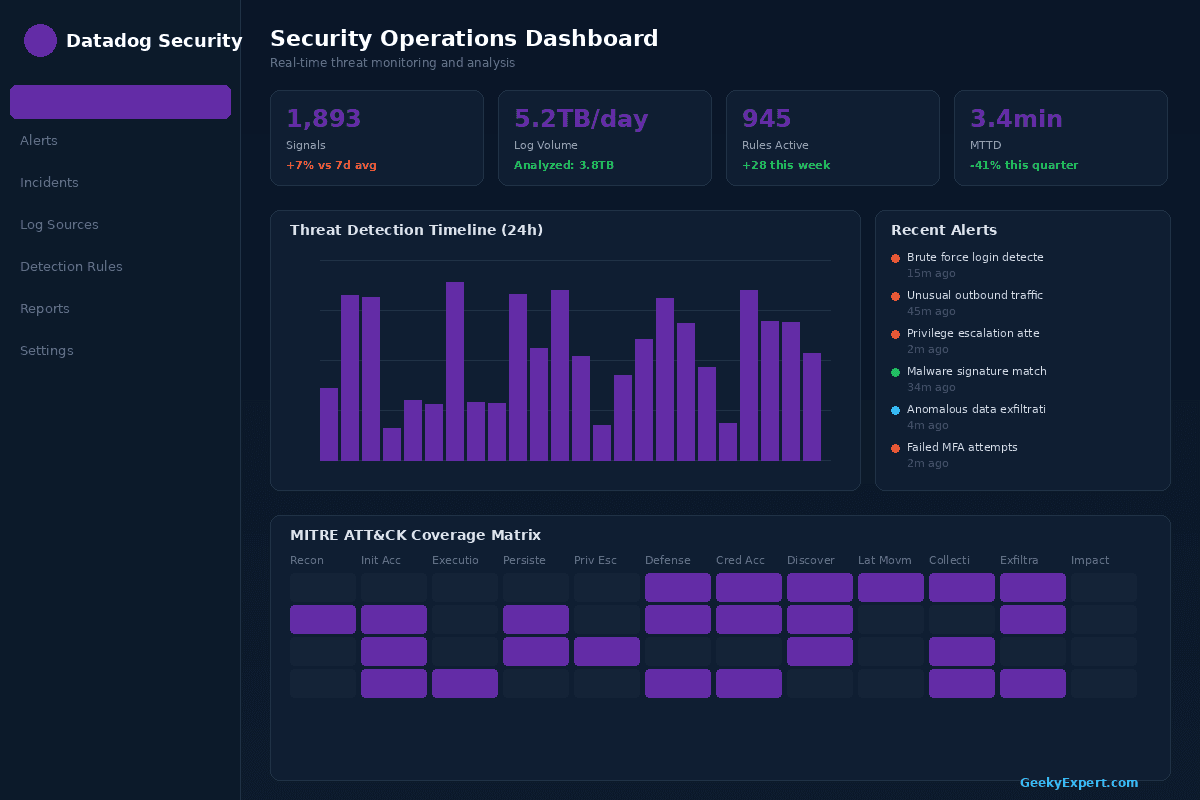
Datadog Security is the best SIEM for DevSecOps teams that need unified security and observability in a single platform in 2026. Unlike traditional SIEMs that operate in isolation from engineering tools, Datadog Cloud SIEM sits alongside Datadog's infrastructure monitoring, APM, log management, and cloud security posture management (CSPM) -- giving security teams the same real-time visibility into application performance, infrastructure health, and cloud configuration that engineering teams already use. Cloud SIEM pricing runs approximately $5 per million analyzed events (annual billing), with underlying log ingestion at $0.10 per GB, and the SIEM analysis charge applies only to logs specifically selected for security monitoring.
DATADOG SECURITY VERIFIED CAPABILITIES
| Attribute | Detail |
|---|---|
| SIEM pricing | ~$5/million analyzed events (annual) |
| Log ingestion | $0.10/GB ingested |
| Integrations | 600+ out-of-box integrations |
| Deployment | Cloud-native (SaaS), multi-cloud |
| Differentiator | Unified security + APM + infrastructure monitoring |
| Best fit | DevSecOps teams bridging engineering and security |
Honest Limitation
Datadog's SIEM capabilities are less mature than Splunk, Sentinel, or QRadar for traditional enterprise security use cases. The detection rule library is smaller, compliance reporting content is limited, and advanced correlation features lag behind dedicated SIEM vendors. The per-event pricing model can become expensive and unpredictable at high SIEM analysis volumes. Datadog is cloud-only with no on-premises deployment option. The platform can become very expensive when combining SIEM with APM, infrastructure, and other modules -- total Datadog spend often surprises enterprises at renewal time. Log forwarding at $0.25/GB adds cost for organizations that also need a dedicated SIEM for compliance. The security team experience is secondary to Datadog's engineering-first design.
Best For
Cloud-native technology companies and DevSecOps teams that already use (or plan to use) Datadog for infrastructure monitoring and APM, and want to add security monitoring without deploying a separate SIEM. Particularly strong for SaaS companies, startups, and mid-market enterprises where engineering and security teams collaborate closely. Not recommended as a standalone enterprise SIEM for organizations with dedicated SOCs and mature security operations. For traditional enterprise SIEM, see Splunk (#1) or IBM QRadar (#6).
Elastic SIEM -- Best Open-Source SIEM with Maximum Flexibility
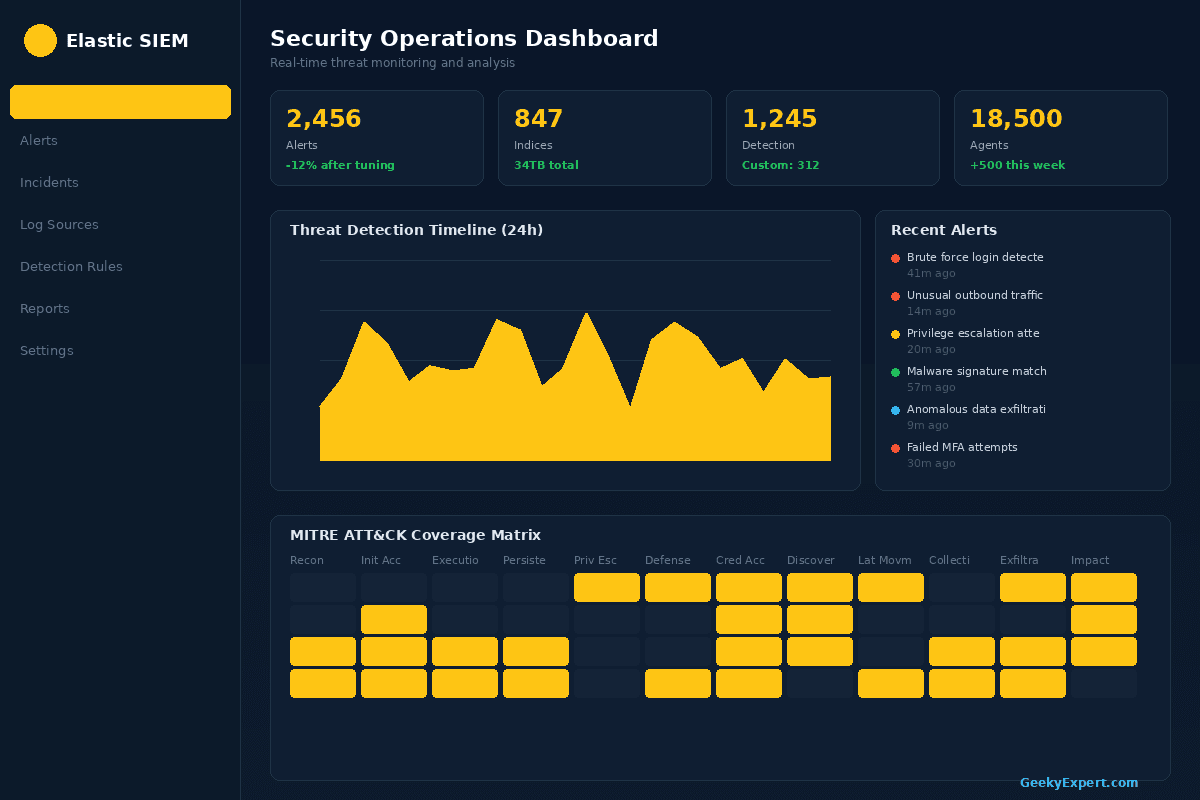
Elastic SIEM (Elastic Security) is the best SIEM for organizations that want open-source flexibility with the option to scale to enterprise cloud in 2026. Built on the Elasticsearch, Kibana, Beats, and Logstash (ELK) stack that powers search infrastructure at companies like Netflix, Uber, and Wikipedia, Elastic Security provides a genuinely free self-managed SIEM tier alongside paid Gold, Platinum, and Enterprise licenses. Cloud options include Elastic Cloud Hosted (starting at approximately $99-$131/month) and the recently GA Elastic Cloud Serverless (starting at $0.50-$0.60/GB, dropping to $0.09-$0.11 at scale). Enterprise self-managed licenses run approximately $7,200-$12,800 per node/year. This range of deployment options -- from free self-managed to fully managed serverless -- is unmatched in the SIEM market.
ELASTIC SIEM VERIFIED CAPABILITIES
| Attribute | Detail |
|---|---|
| Pricing | Free (self-managed) to ~$12,800/node/yr (Enterprise) |
| Cloud Serverless | ~$0.50-$0.60/GB (dropping to ~$0.09-$0.11 at scale) |
| Foundation | Open-source Elasticsearch + Kibana + Beats + Logstash |
| Deployment | Self-managed, Elastic Cloud, Cloud Serverless |
| Detection alignment | Prebuilt rules mapped to MITRE ATT&CK |
| Best fit | Teams wanting full control over data and infrastructure |
Honest Limitation
Self-managed Elastic SIEM requires significant operational expertise -- running Elasticsearch clusters at scale demands skilled engineers for capacity planning, index lifecycle management, shard tuning, and upgrade maintenance. The free tier lacks ML anomaly detection, cross-cluster search, and some advanced security features that are essential for mature SOCs. Infrastructure costs for self-managed deployments (servers, storage, network) can reach $15,000-$50,000/year for 50-200 GB/day of ingestion, negating the "free software" advantage. The detection rule library, while growing, is smaller than Splunk's 2,800+ detections. Elastic's SOAR capabilities are basic compared to Splunk SOAR or IBM QRadar SOAR. The learning curve for Elasticsearch administration is steep for security teams without prior ELK experience.
Best For
Security teams with Elasticsearch/ELK expertise that want maximum control over their SIEM deployment, cost-conscious mid-market enterprises, MSSPs building multi-tenant security platforms, and organizations that require on-premises data sovereignty with the option to migrate to cloud. Particularly strong for companies already using ELK for log management or search. For a fully managed enterprise SIEM without operational overhead, see Microsoft Sentinel (#2) or Sumo Logic (#7).
IBM QRadar -- Best for Hybrid and Regulated Enterprises
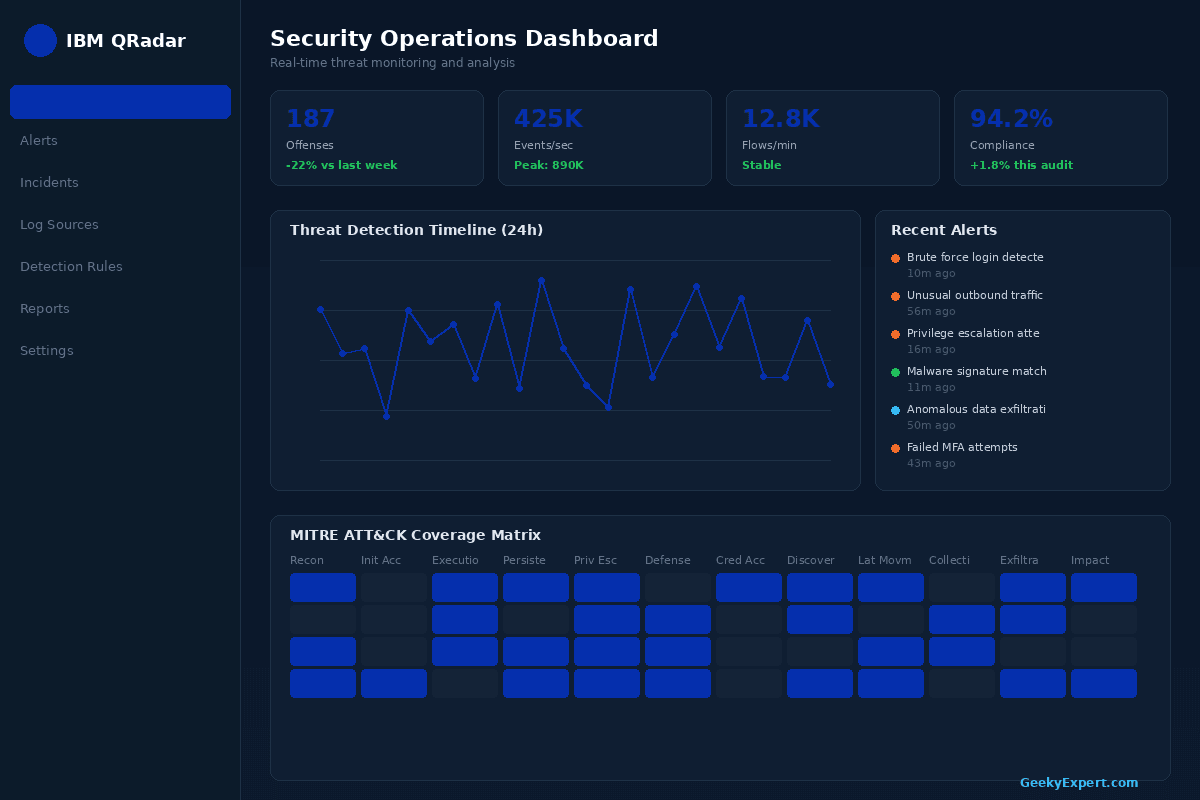
IBM QRadar is the best SIEM for regulated enterprises that need hybrid on-premises and cloud deployment with integrated SOAR capabilities in 2026. Now delivered as QRadar Suite, the platform bundles SIEM, EDR/XDR, SOAR, and cloud-native log management into a unified analyst experience with pricing per analyst seat at approximately $8,000-$15,000/year. The traditional on-premises QRadar SIEM remains available with EPS-based (events per second) licensing for organizations requiring air-gapped or fully on-prem deployments. IBM's X-Force threat intelligence, built from monitoring 150+ billion security events daily across 130+ countries, provides threat context that pure-play SIEM vendors cannot match. The June 2026 IBM-Cisco joint Threat Detection and Response (TDR) initiative further extends QRadar's network visibility.
IBM QRADAR VERIFIED CAPABILITIES
| Attribute | Detail |
|---|---|
| Pricing | ~$8,000-$15,000/analyst/yr (QRadar Suite) |
| On-prem SIEM | ~$180K-$280K/yr at 5,000 EPS (30-60% discounts typical) |
| Suite components | SIEM + EDR/XDR + SOAR + Log Insights |
| Deployment | On-premises, cloud (AWS), hybrid |
| Threat intelligence | X-Force (150B+ events/day, 130+ countries) |
| Best fit | Financial services, healthcare, government, regulated industries |
Honest Limitation
QRadar's product strategy has been in flux. IBM deprecated QRadar SaaS (standalone cloud) and is directing customers to QRadar Suite, creating migration complexity for existing cloud SIEM customers. The on-premises deployment requires significant hardware investment and operational expertise -- a typical QRadar deployment needs dedicated appliances or VMs for the console, event processors, flow processors, and data nodes. The user interface, while improved in QRadar Suite, still feels dated compared to Splunk, Sentinel, and CrowdStrike. QRadar's cloud-native capabilities lag behind Sentinel and CrowdStrike LogScale. The learning curve is steep, and IBM professional services engagements for deployment can add $100,000-$300,000 in implementation costs. The platform's future direction amid the IBM-Cisco TDR partnership adds strategic uncertainty.
Best For
Regulated enterprises in financial services, healthcare, government, and defense that require on-premises SIEM deployment with integrated SOAR and compliance reporting. Particularly strong for organizations with existing IBM security infrastructure and those needing air-gapped or highly controlled deployment environments. For cloud-native SIEM without on-prem overhead, see Microsoft Sentinel (#2) or Sumo Logic (#7).
Sumo Logic -- Best Cloud-Native SIEM for Mid-Market SOC Teams
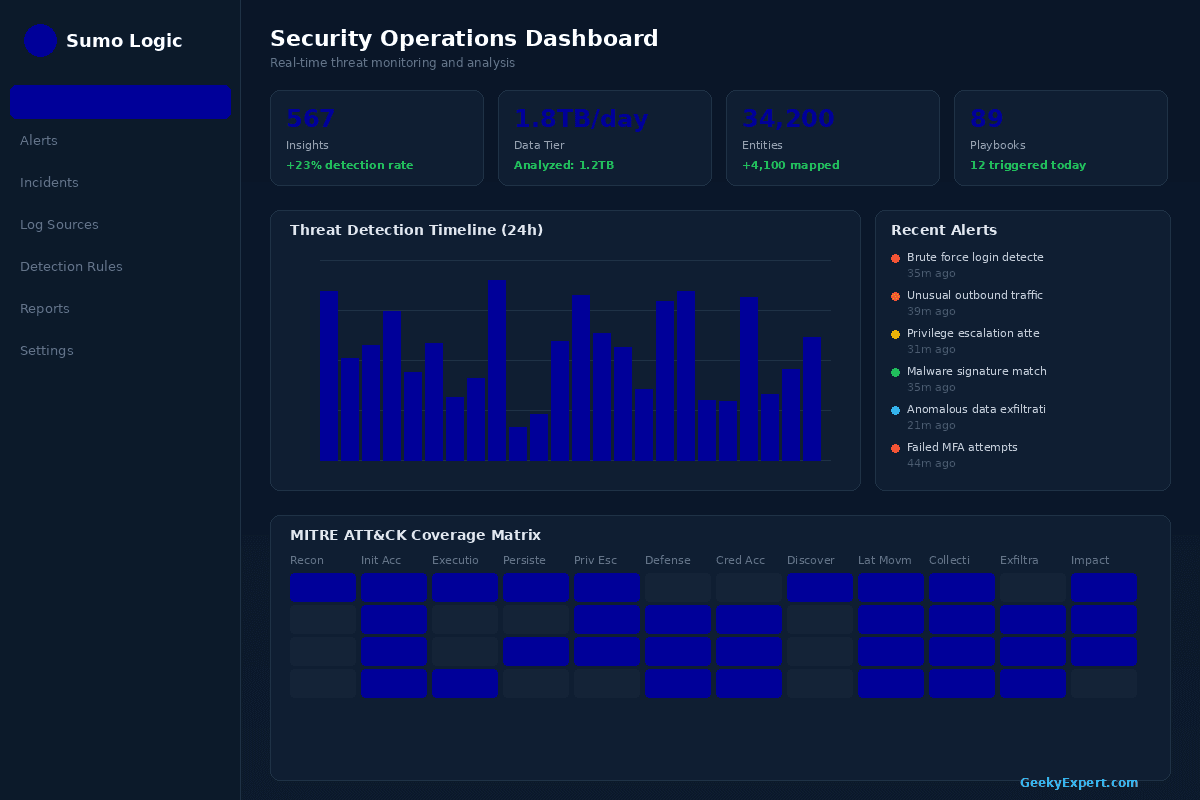
Sumo Logic Cloud SIEM is the best cloud-native SIEM for mid-market SOC teams that want AI-powered investigation and detection-as-code workflows in 2026. Built entirely in the cloud with no on-premises option, Sumo Logic eliminates infrastructure management and delivers 900+ customizable out-of-box detection rules with Global Intelligence ML models that provide confidence scores on security Insights. Pricing uses a credit-based model where Cloud SIEM ingestion costs 40 credits per GB, with effective costs of approximately $6-$9 per GB at Enterprise Security tier pricing. The Dojo AI platform provides explainable AI across the threat detection, investigation, and response lifecycle, and the SOC Analyst Agent automates remediation recommendations -- reducing the expertise gap that plagues understaffed security teams.
SUMO LOGIC VERIFIED CAPABILITIES
| Attribute | Detail |
|---|---|
| Pricing | ~$6-$9/GB (Enterprise Security, credit-based) |
| Detection rules | 900+ customizable out-of-box rules |
| AI/ML | Dojo AI + Global Intelligence ML + SOC Analyst Agent |
| Deployment | Cloud-native only (SaaS) |
| Detection-as-code | GitHub integration, version-controlled detection rules |
| Best fit | Mid-market SOC teams wanting AI-powered cloud SIEM |
Honest Limitation
Sumo Logic's market share and ecosystem are significantly smaller than Splunk, Microsoft, or CrowdStrike, which means fewer third-party integrations, less community content, and a smaller talent pool of experienced analysts. The credit-based pricing model is complex and can be difficult to budget accurately -- organizations often overpurchase credits initially or face unexpected overage charges. Cloud-only deployment eliminates Sumo Logic for air-gapped or strictly on-premises requirements. The SOAR capabilities are less mature than IBM QRadar SOAR or Splunk SOAR. At $6-$9/GB effective cost, Sumo Logic is more expensive per GB than Microsoft Sentinel or Elastic Cloud. The platform is less proven at Fortune 500 scale than Splunk or QRadar.
Best For
Mid-market enterprises (500-5,000 employees) with cloud-native infrastructure and SOC teams of 3-15 analysts that want AI-powered detection and investigation without the complexity and cost of Splunk or QRadar. Particularly strong for organizations adopting detection-as-code practices and those with limited SOC staffing that need AI-assisted investigation. For larger enterprise needs, see Splunk (#1). For Microsoft-centric environments, see Microsoft Sentinel (#2).
Frequently Asked Questions
What is a SIEM tool and why do enterprises need one?
A SIEM (Security Information and Event Management) tool is a security platform that collects, normalizes, correlates, and analyzes log data from across an organization's IT infrastructure -- servers, endpoints, firewalls, cloud services, applications, and network devices -- to detect security threats, investigate incidents, and support compliance reporting.
Enterprises need SIEM because the average cost of a data breach reached $4.99 million globally in 2026 according to IBM, with US breaches averaging $11.5 million, and 1 in 4 breaches are now AI-enabled at an average cost of $6.0 million per incident.
SIEM tools reduce mean time to detect (MTTD) and mean time to respond (MTTR) by correlating events across thousands of data sources in real time, enabling security teams to identify advanced persistent threats, insider threats, and zero-day attacks that would be invisible when examining individual log sources in isolation. The global SIEM market is valued at approximately $8.4 billion in 2026 and growing at 10.3% CAGR to a projected $13.7 billion by 2031.
How much do enterprise SIEM tools cost in 2026?
Enterprise SIEM pricing varies dramatically by vendor, deployment model, and data volume. Splunk Enterprise Security costs approximately $1,800-$5,750 per GB/day/year depending on volume tier and licensing model. Microsoft Sentinel charges $4.30 per GB pay-as-you-go or approximately $2.96 per GB with a 100 GB/day commitment tier, with free ingestion for Microsoft 365 E5 and Defender data. CrowdStrike Falcon LogScale uses custom pricing estimated at $1.40-$5.95 per GB/day.
Datadog Security bills approximately $5 per million analyzed events plus $0.10 per GB for log ingestion. Elastic SIEM offers a free self-managed tier with enterprise licenses at $7,200-$12,800 per node/year and cloud serverless starting at $0.50-$0.60 per GB. IBM QRadar Suite is priced per analyst seat at $8,000-$15,000 per year, with traditional on-premises SIEM at $180,000-$280,000 per year for 5,000 EPS. Sumo Logic costs approximately $6-$9 per GB for Enterprise Security.
For a mid-size enterprise ingesting 500 GB/day, annual SIEM costs typically range from $200,000 to $1.5 million depending on the platform chosen.
Should I choose a cloud-native SIEM or on-premises SIEM?
The choice between cloud-native and on-premises SIEM depends on regulatory requirements, existing infrastructure, and operational model. Cloud-native SIEMs like Microsoft Sentinel, CrowdStrike Falcon LogScale, Datadog Security, and Sumo Logic offer faster deployment (days to weeks vs. months), elastic scaling without hardware planning, no infrastructure management, and lower upfront costs.
On-premises SIEMs like Splunk (self-managed) and IBM QRadar provide full data sovereignty, air-gapped deployment for classified environments, and no dependency on third-party cloud infrastructure. Hybrid options from Splunk, IBM QRadar, and Elastic support both models simultaneously.
For most enterprises in 2026, cloud-native SIEM is the default choice unless you have specific regulatory requirements (ITAR, certain government or defense mandates) that prohibit cloud data processing, or you operate in air-gapped environments. Organizations in financial services and healthcare can typically satisfy compliance requirements with cloud-native SIEMs that offer data residency controls and certifications like SOC 2, HIPAA BAA, FedRAMP, and ISO 27001.
What is the difference between SIEM and XDR?
SIEM (Security Information and Event Management) and XDR (Extended Detection and Response) are converging technologies that serve different primary functions in 2026. SIEM focuses on broad log collection, event correlation, compliance reporting, and long-term data retention across all IT infrastructure -- it is the system of record for security data.
XDR focuses on integrated threat detection and automated response across specific security layers including endpoint, network, email, and cloud with faster time-to-action. In 2026 the distinction is blurring rapidly: Splunk Enterprise Security integrates with Cisco XDR, CrowdStrike Falcon LogScale is part of the Falcon XDR ecosystem, Microsoft Sentinel connects natively with Defender XDR, and IBM QRadar Suite bundles EDR/XDR with SIEM.
The practical guidance is: if you need broad compliance reporting, long-term log retention (1-7 years), and correlation across hundreds of data sources including custom applications, you need SIEM. If you need fast detection and automated response across endpoint, email, and network with fewer data sources, XDR may suffice. Most large enterprises deploy both: SIEM for breadth and compliance, XDR for detection speed and automated response.
How do SIEM tools help with compliance requirements?
SIEM tools are essential for meeting compliance requirements across frameworks including SOX, HIPAA, PCI DSS, GDPR, CCPA, NIST 800-53, ISO 27001, and FedRAMP.
They support compliance by providing centralized log collection and tamper-evident retention (most regulations require 1-7 years of audit logs), automated compliance reporting with prebuilt templates mapped to specific regulatory frameworks, real-time monitoring for policy violations and unauthorized access attempts, user activity monitoring and privileged access management tracking, incident detection and forensic investigation capabilities for breach notification requirements, and documented audit trails for regulatory examinations.
Splunk Enterprise Security and IBM QRadar have the most mature compliance reporting with prebuilt content packs for major frameworks. Microsoft Sentinel integrates with Microsoft Compliance Manager for unified governance across Microsoft 365 workloads. Elastic SIEM supports custom compliance dashboards via Kibana.
For PCI DSS specifically, all seven tools reviewed can satisfy the logging and monitoring requirements of Requirement 10, but Splunk and QRadar have the deepest out-of-box PCI compliance content.
How long does it take to deploy an enterprise SIEM?
Enterprise SIEM deployment timelines vary significantly by platform, scope, and organizational readiness. Cloud-native SIEMs deploy faster: Microsoft Sentinel can be operational within 1-2 weeks for organizations already on Azure, CrowdStrike Falcon LogScale and Datadog Security can begin ingesting logs in days, and Sumo Logic Cloud SIEM typically deploys in 2-4 weeks.
On-premises SIEMs take longer: Splunk Enterprise Security typically requires 4-12 weeks for initial deployment and 3-6 months for full optimization across all data sources, and IBM QRadar on-premises deployments average 6-16 weeks for infrastructure setup and initial configuration. Elastic SIEM self-managed varies from 2 weeks for a small deployment to 3+ months for a large multi-cluster environment. However, initial deployment is not full value realization.
Most enterprise SIEM deployments require 3-6 months of detection rule tuning, false positive reduction, data source onboarding, analyst workflow optimization, and SOC team training before reaching optimal effectiveness. Plan for a 6-12 month journey from purchase decision to a fully operational, tuned SOC.
What data sources should I connect to my SIEM first?
Prioritize SIEM data source onboarding by threat coverage impact using a phased approach.
Phase 1 (weeks 1-4): connect identity and access management logs (Active Directory, Azure AD/Entra ID, Okta, SSO providers) because compromised credentials drive approximately 80 percent of breaches; firewall and network security logs (Palo Alto, Fortinet, Cisco ASA) for perimeter visibility; endpoint detection and response telemetry (CrowdStrike, Microsoft Defender, SentinelOne) for workstation and server visibility; and cloud platform audit logs (AWS CloudTrail, Azure Activity Log, GCP Cloud Audit Logs).
Phase 2 (weeks 4-8): add email security logs (Microsoft 365, Google Workspace) for phishing detection; VPN and remote access logs; DNS query logs for command-and-control detection; and web proxy/gateway logs. Phase 3 (weeks 8-12): onboard application logs for business-critical systems; database audit logs for data access monitoring; container and Kubernetes logs for cloud-native workloads; and DLP (data loss prevention) events.
This phased approach ensures your SIEM delivers threat detection value from week one while building toward comprehensive coverage over 90 days.
About Geeky Expert
Geeky Expert is a leading provider of research and insights, dedicated to helping businesses make informed decisions through comprehensive analysis.