
Best AI Tools for HR (2026)
What are the best AI tools for HR in 2026?
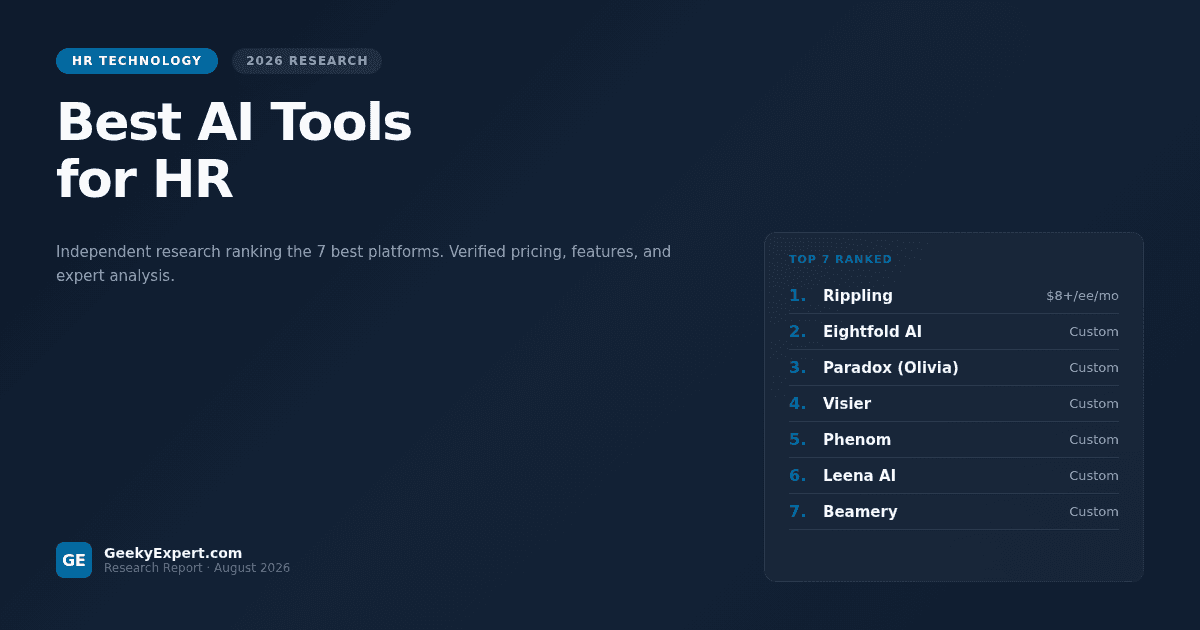
The best AI tools for HR in 2026 span recruitment, employee experience, people analytics, and workforce management. For the most comprehensive AI-powered HR platform unifying HR, IT, and Finance, Rippling leads with its Deep Agents multi-agent architecture starting at $8/employee/month. Eightfold AI is the top choice for talent intelligence, Paradox (Olivia) dominates conversational AI recruiting, and Visier leads in AI-powered people analytics.
Best for your situation
- ▸Talent intelligence: Eightfold AI -- skills-based matching, 80% faster time-to-hire
- ▸Conversational AI recruiting: Paradox (Olivia) -- chatbot for high-volume hourly hiring
- ▸People analytics: Visier -- AI-driven workforce planning and predictive insights
- ▸Talent experience: Phenom -- unified candidate, recruiter, and employee AI
- ▸Employee experience AI: Leena AI -- 70% support ticket deflection
VERIFIED PRICING DATA (2026)
| Platform | Starting Price | AI Focus | Best For |
|---|---|---|---|
| Rippling | $8/emp/mo (base platform) | Multi-agent AI (Deep Agents) | Best overall AI HR platform |
| Eightfold AI | ~$7-10/emp/mo (custom) | Talent intelligence | Skills-based talent matching |
| Paradox (Olivia) | ~$1,000/mo (mid-size) | Conversational AI | High-volume hourly hiring |
| Visier | Custom (headcount-based) | People analytics | Workforce planning + analytics |
| Phenom | Custom (enterprise only) | Talent experience | Unified candidate + employee AI |
| Leena AI | Custom (headcount-based) | Employee experience AI | HR service desk automation |
| Beamery | Custom ($150K-500K/yr) | Talent CRM + AI | Enterprise talent lifecycle |
AI IN HR MARKET (2026)
AI in Human Resources Market: 2025 Market Size $4.8 billion 2032 Projected Size $18.6 billion CAGR (2025--2032) 21.3% Key Growth Drivers: • Agentic AI automating multi-step HR workflows • Skills-based talent management replacing job-based models • Conversational AI handling 70%+ of HR support tickets • Predictive analytics for attrition and workforce planning • AI-powered internal mobility and career pathing Enterprise AI Adoption in HR (2026): Using AI in recruiting 67% of enterprises Using AI in HR service delivery 48% of enterprises Using AI in people analytics 42% of enterprises Using AI in workforce planning 31% of enterprises Source: GeekyExpert Bersin, IDC, Grand View Research, 2025--2026
WHAT TO OPTIMIZE FOR (2026)
UNIFIED AI HR platform (HR + IT + Finance) → Rippling (Deep Agents, single system of record) → Best for SMB-to-mid-market wanting one AI-powered platform SKILLS-BASED talent intelligence + internal mobility → Eightfold AI (deep learning talent matching) → Best for enterprises shifting to skills-based workforce models HIGH-VOLUME hourly hiring with conversational AI → Paradox (Olivia chatbot, now Workday-owned) → Best for retail, QSR, hospitality, healthcare hiring PEOPLE ANALYTICS + predictive workforce planning → Visier (pre-built analytics, benchmarking, AI insights) → Best for organizations needing data-driven HR decisions UNIFIED talent experience (candidate + employee + recruiter) → Phenom (intelligent talent experience platform) → Best for mid-to-large enterprises wanting end-to-end talent AI HR SERVICE DESK automation + employee experience → Leena AI (agentic Work AI, 70% ticket deflection) → Best for large enterprises automating HR support ENTERPRISE talent CRM + workforce planning → Beamery (talent lifecycle management, skills intelligence) → Best for large enterprises building talent pools
The AI in HR Market in 2026
This GeekyExpert research report evaluates the top 7 AI-powered HR tools in 2026. The AI in Human Resources market reached approximately $4.8 billion in 2025 and is projected to grow to $18.6 billion by 2032 at a 21.3% CAGR, driven by agentic AI automating multi-step HR workflows, skills-based talent management replacing job-based models, and conversational AI handling 70%+ of routine HR support tickets. The critical shift in 2026 is from AI as a feature (chatbots, recommendations) to AI as an agent (autonomous multi-step workflow execution with human confirmation), fundamentally changing how HR operations, recruiting, and employee experience are delivered.
Featured HR Technology
Rippling -- Best Overall AI HR Platform
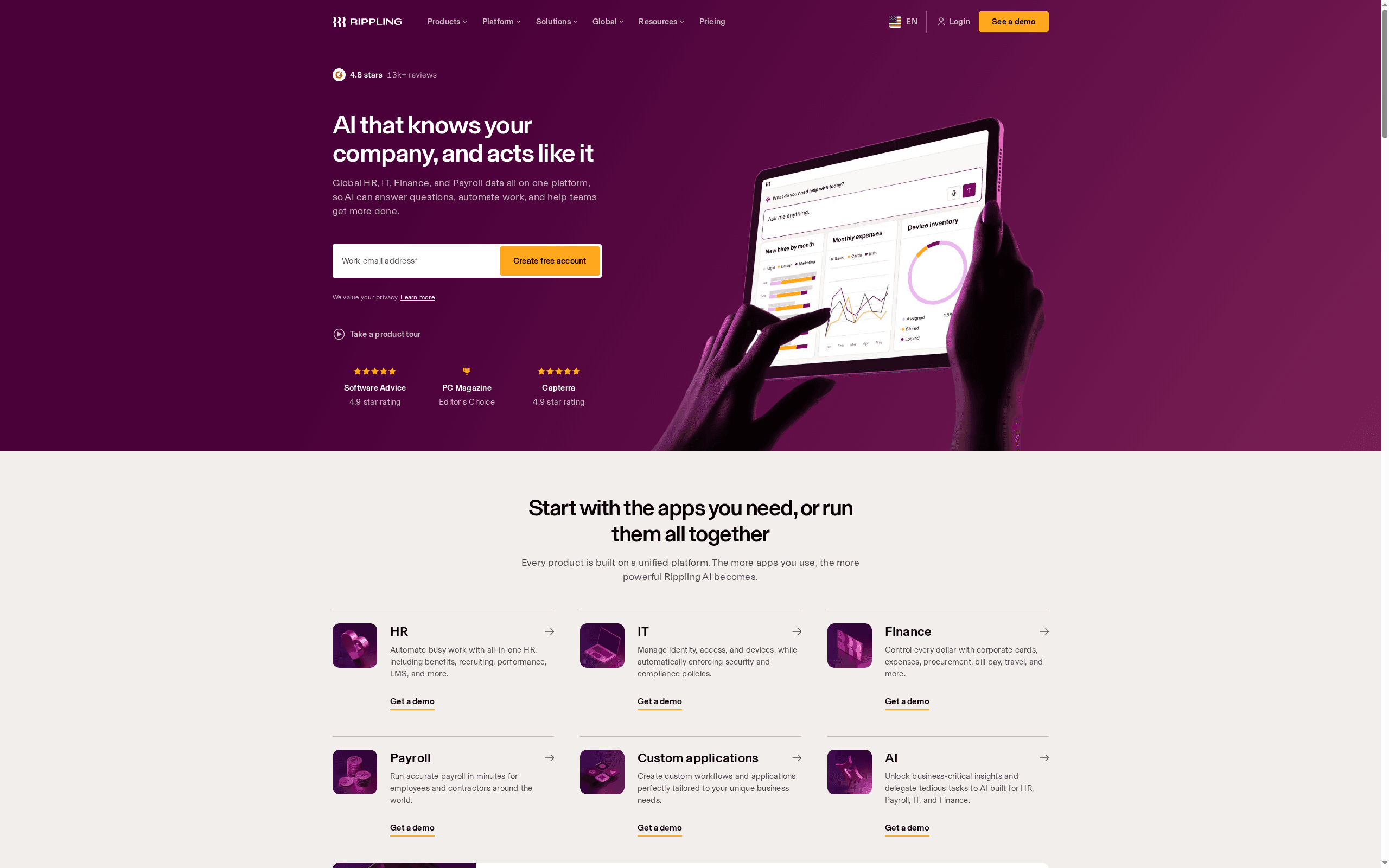
Rippling is the best overall AI-powered HR platform in 2026 for organizations that want a unified system covering HR, IT, and Finance with enterprise-grade AI capabilities at a mid-market price point. Serving 20,000+ customers and surpassing $1 billion in annual recurring revenue, Rippling has grown from a payroll and HR startup into the most comprehensive workforce management platform on the market. Its 2025-2026 Deep Agents launch introduced a multi-agent AI architecture where a supervisor agent orchestrates specialized read, RAG, and action agents to execute complex multi-step workflows across HR onboarding, IT provisioning, expense management, and compliance -- all with human confirmation before critical actions.
RIPPLING VERIFIED CAPABILITIES
| Attribute | Detail |
|---|---|
| Base platform | $8/employee/month |
| Blended cost | $25-50/emp/mo (HR + payroll); $60+/emp/mo with IT modules |
| AI architecture | Deep Agents: supervisor + read/RAG/action agent orchestration |
| Platform scope | HR + IT + Finance unified on one system |
| Market position | 20,000+ customers, $1B+ ARR (2026) |
| Best fit | SMB-to-mid-market orgs wanting unified AI-powered HR+IT+Finance |
Honest Limitation
Rippling's $8/employee base price is misleading -- realistic blended costs are $25-50/employee/month for HR and payroll, and $60+ with IT modules. The platform is optimized for US-based companies; international capabilities are expanding but not as mature as Workday or SAP SuccessFactors. Deep Agents are still rolling out across modules and require configuration for optimal performance. The platform's ambition to cover HR, IT, and Finance means some individual modules are not as deep as dedicated tools (e.g., its ATS is functional but less feature-rich than Greenhouse). Enterprise companies with 5,000+ employees may find the platform under-scaled. Customer support quality varies based on contract tier.
Best For
Eightfold AI -- Best for Talent Intelligence
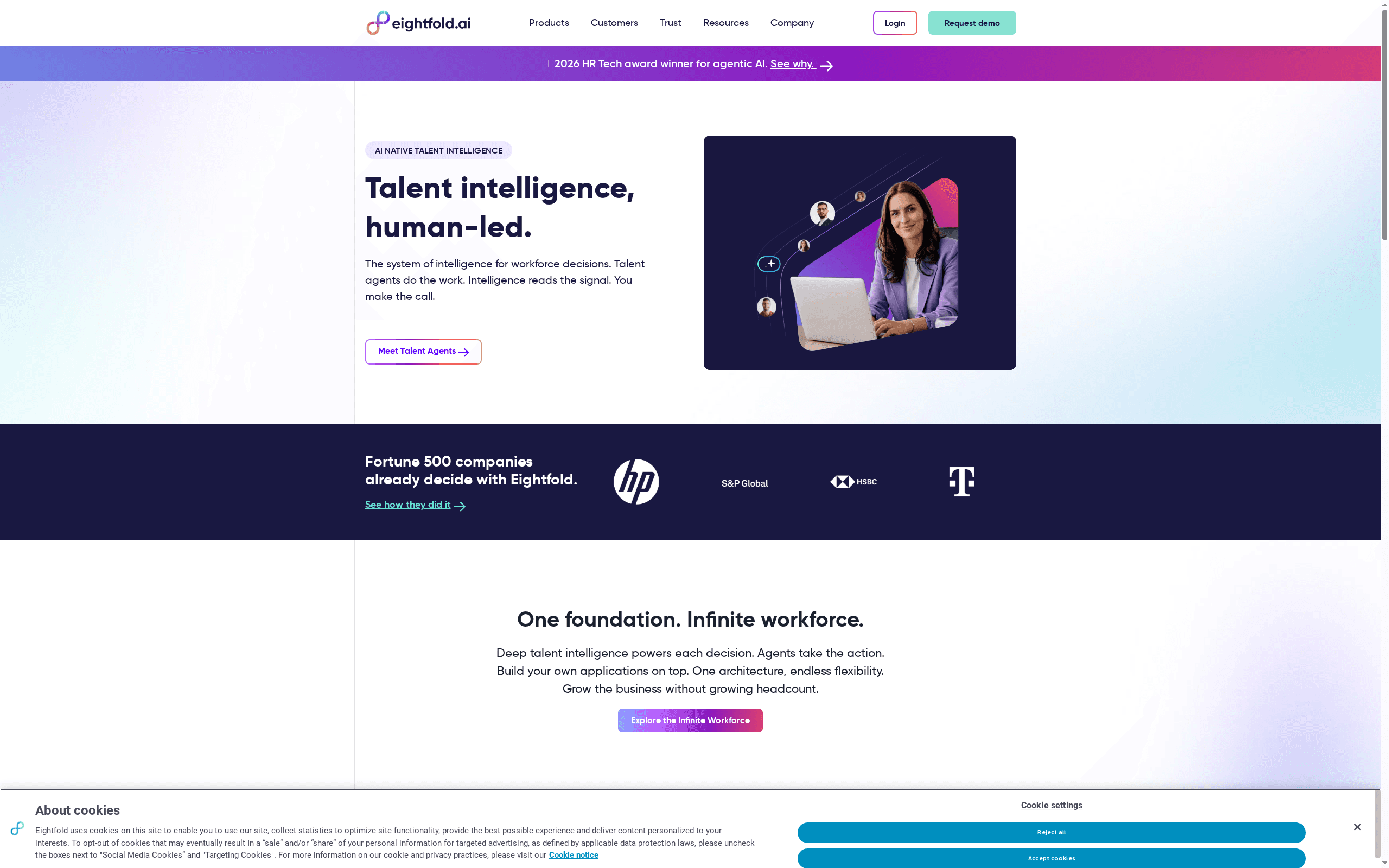
Eightfold AI is the best talent intelligence platform in 2026 for enterprises shifting from job-based to skills-based talent management. Its deep learning AI analyzes billions of data points to match candidates to roles based on skills, capabilities, and potential rather than traditional resume keywords and job titles. Serving approximately one-third of Fortune 500 companies including Vodafone, Bayer, Micron, and the US Air Force, Eightfold has documented outcomes including 80% faster time-to-hire and 50% lower cost-to-hire. The platform spans three modules: Talent Acquisition, Talent Management (internal mobility and career pathing), and Workforce Exchange (public sector talent marketplaces).
EIGHTFOLD AI VERIFIED CAPABILITIES
| Attribute | Detail |
|---|---|
| Estimated pricing | ~$7-10/employee/month (custom enterprise quotes) |
| Enterprise ACV | ~$150K-$500K+/year |
| AI approach | Deep learning talent matching on skills, not keywords |
| Documented outcomes | 80% faster time-to-hire, 50% lower cost-to-hire |
| Market position | ~1/3 of Fortune 500 (Vodafone, Bayer, Micron, US Air Force) |
| Best fit | Enterprises shifting to skills-based talent management |
Honest Limitation
Eightfold AI is an enterprise tool with enterprise pricing -- $150K-500K+ per year puts it out of reach for SMBs. The platform is an overlay that integrates with your existing ATS and HRIS rather than replacing them, which means additional integration complexity. The deep learning models are powerful but opaque -- explaining why a specific candidate was recommended can be challenging. Implementation typically takes 3-6 months for full deployment. The internal mobility module, while valuable, is newer and less mature than the talent acquisition module. The platform's value is proportional to the volume of hiring -- organizations with fewer than 500 employees or low hiring velocity may not see sufficient ROI.
Best For
Paradox (Olivia) -- Best Conversational AI for Recruiting
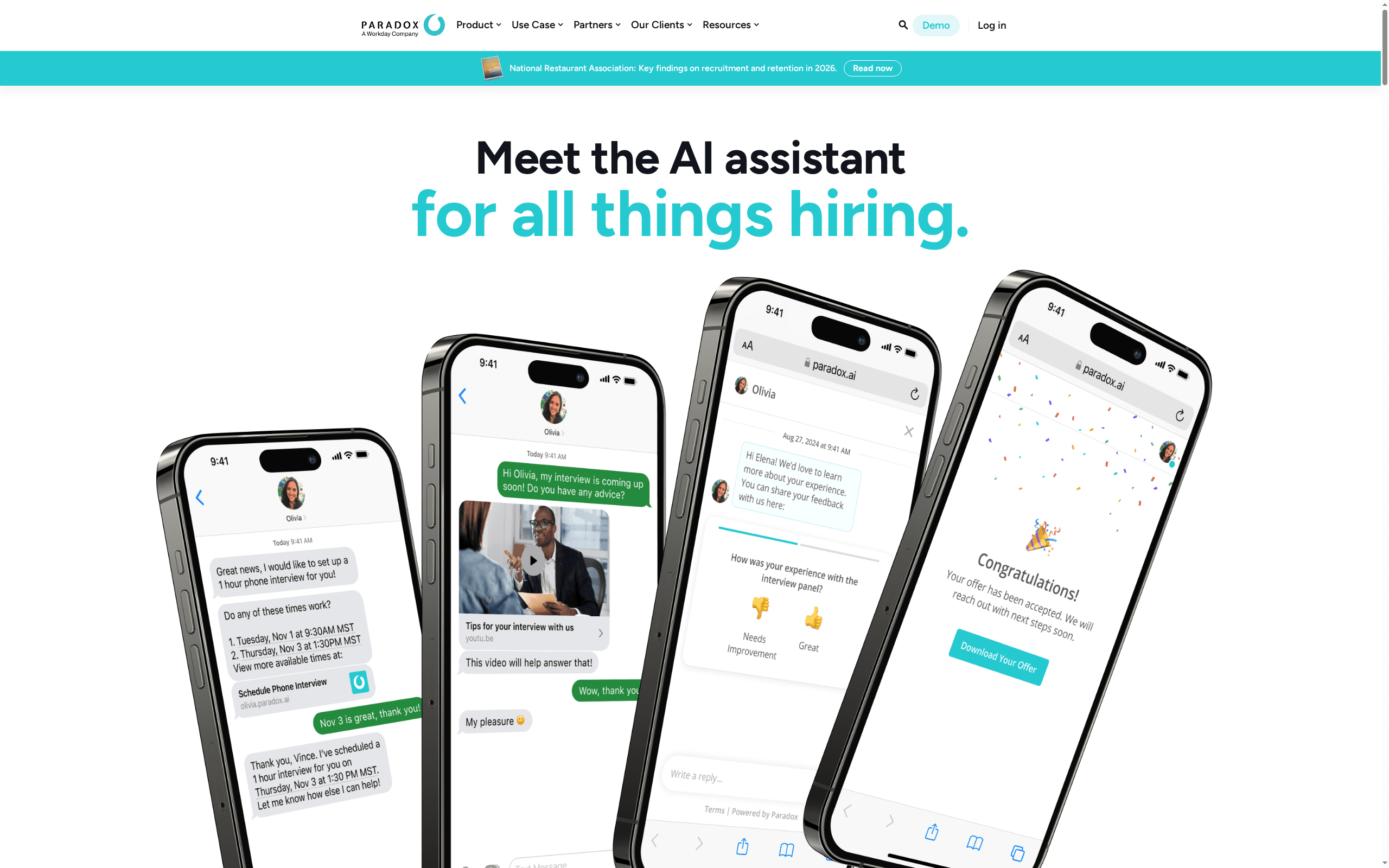
Paradox, creator of the Olivia AI assistant, is the best conversational AI platform for high-volume recruiting in 2026. Acquired by Workday in October 2025 for approximately $1 billion and rebranded as the Workday Paradox Candidate Experience Agent, Olivia handles the entire hourly hiring workflow through natural conversation: screening applicants, scheduling interviews, sending reminders, collecting documents, and extending offers -- all via text message, web chat, or WhatsApp without human intervention. Paradox serves some of the world's largest employers including McDonald's, Unilever, GM, CVS Health, Chipotle, and 7-Eleven, with documented ROI that makes it the most proven conversational AI in HR.
PARADOX (OLIVIA) VERIFIED CAPABILITIES
| Attribute | Detail |
|---|---|
| Starting price | ~$1,000/month (mid-size deployment) |
| Typical ACV | $30K-95K/yr + $15K-35K setup |
| AI capability | Conversational AI handling full hiring workflow via text/chat |
| Documented ROI | GM: $2M/yr saved; Chipotle: 12 to 4 day time-to-hire |
| Acquisition | Acquired by Workday (Oct 2025, ~$1B) |
| Best fit | High-volume hourly hiring (retail, QSR, healthcare, logistics) |
Honest Limitation
Paradox is purpose-built for high-volume, hourly hiring -- it is not designed for executive recruiting, specialized technical hiring, or low-volume professional roles. The setup cost ($15K-35K) and annual contract ($30K-95K) require sufficient hiring volume to justify ROI. The Workday acquisition may eventually limit integration with non-Workday ATS platforms. The conversational AI, while sophisticated, can frustrate candidates with complex questions that fall outside its training. No free trial or self-service option -- all sales are enterprise-grade. The platform addresses recruiting only and does not help with employee experience, talent management, or people analytics.
Best For
Visier -- Best AI-Powered People Analytics
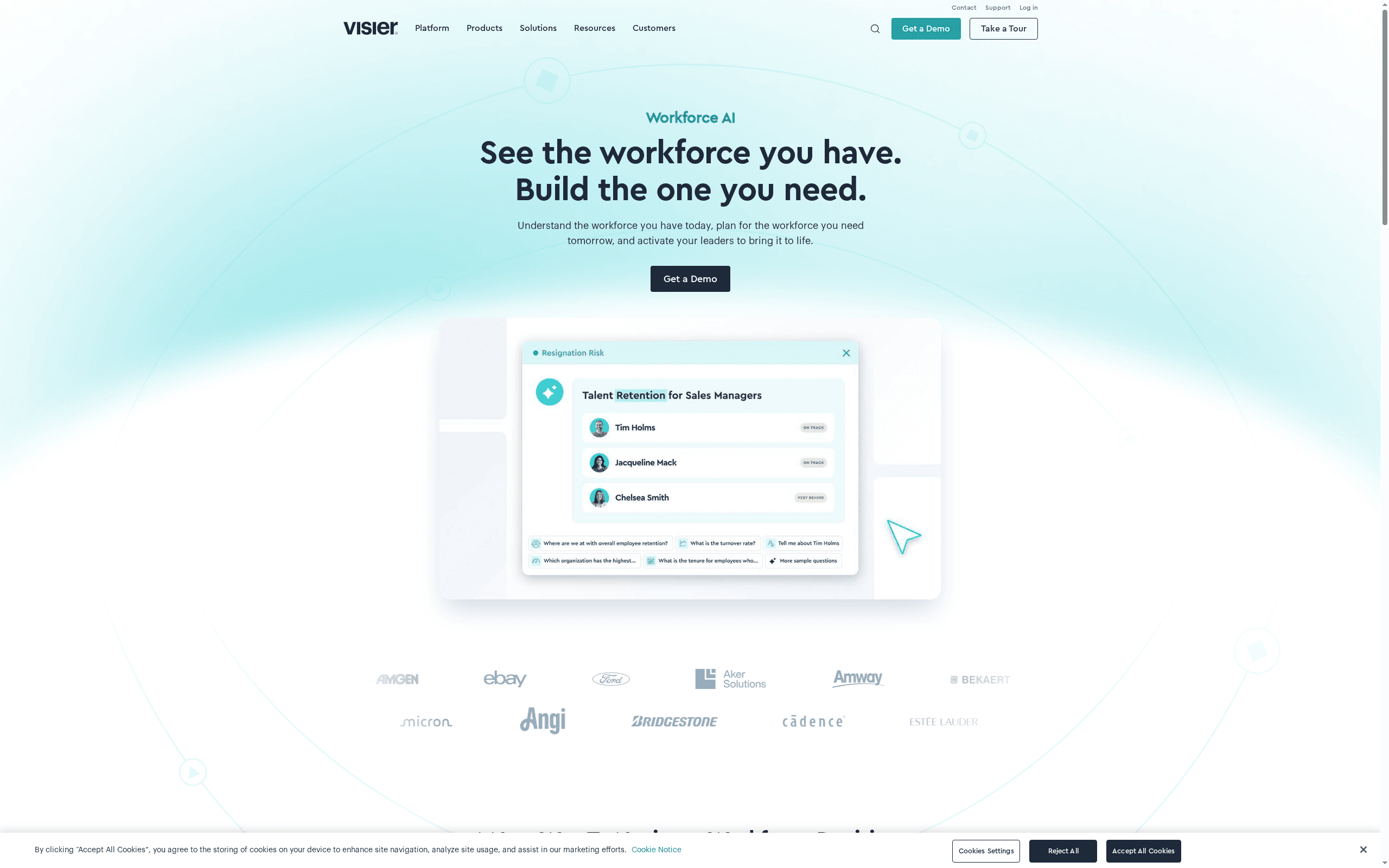
Visier is the best AI-powered people analytics platform in 2026 for organizations that need enterprise-grade workforce analytics, predictive insights, and data-driven HR decision support. Founded in 2010, Visier serves 25,000+ customers across 75 countries and has built the most comprehensive pre-built people analytics data model in the market. Unlike business intelligence tools that require data teams to build HR analytics from scratch, Visier provides pre-built analytics, benchmarking against anonymized cross-industry datasets, and AI-driven insights for attrition prediction, DEI analysis, compensation equity, and workforce planning.
VISIER VERIFIED CAPABILITIES
| Attribute | Detail |
|---|---|
| Pricing | Custom (headcount-based, 1-3 year contracts) |
| Customers | 25,000+ customers across 75 countries |
| Core capability | Pre-built people analytics + AI-driven workforce planning |
| Predictive AI | Attrition prediction, compensation equity, DEI analysis |
| Benchmarking | Cross-industry anonymized benchmarks from 25,000+ orgs |
| Best fit | Organizations needing enterprise-grade people analytics and AI insights |
Honest Limitation
Visier is an analytics overlay, not a transactional HR system -- it does not process payroll, manage benefits, or handle recruiting. It requires clean, integrated data from your HRIS and other HR systems, which means data quality issues in source systems directly impact analytics accuracy. Custom headcount-based pricing with multi-year commitments can be significant for large organizations. Implementation takes 2-4 months depending on data source complexity. The platform requires an analytically minded HR team or dedicated people analytics function to extract full value. Natural-language query capabilities, while impressive, sometimes produce results that require analytical interpretation.
Best For
Phenom -- Best Intelligent Talent Experience Platform
Phenom is the best intelligent talent experience platform in 2026 for enterprises that want to unify the candidate, recruiter, employee, and manager experience under a single AI-powered system. Unlike point solutions that address one phase of the talent lifecycle, Phenom spans career sites and chatbots (candidate experience), sourcing and CRM (recruiter experience), internal mobility and career pathing (employee experience), and workforce intelligence (manager experience). The platform serves primarily enterprise and mid-market organizations across biotech, financial services, insurance, and technology industries.
PHENOM VERIFIED CAPABILITIES
| Attribute | Detail |
|---|---|
| Pricing | Custom enterprise pricing only |
| Customer mix | 71% enterprise; 21% mid-size (Gartner Peer Insights) |
| Platform scope | Candidate + Recruiter + Employee + Manager experience |
| AI capabilities | Personalized career sites, chatbot, skills matching, CRM |
| Industries | Biotech (15%), Financial Services (15%), Insurance (15%) |
| Best fit | Mid-to-large enterprises wanting unified talent experience AI |
Honest Limitation
Phenom's custom enterprise pricing is opaque and typically requires significant annual commitments. The platform's breadth means individual modules may not be as deep as dedicated tools (Paradox for conversational AI, Eightfold for talent intelligence, Visier for analytics). Implementation is complex and typically takes 3-6 months. The platform is optimized for enterprise organizations; smaller companies may find it over-engineered. The 71% enterprise customer mix suggests limited mid-market optimization. Career site personalization and chatbot capabilities overlap with features now embedded in many modern ATS platforms.
Best For
Leena AI -- Best AI for HR Service Desk Automation
Leena AI is the best AI platform for HR service desk automation in 2026 for large enterprises that want to deflect 70%+ of routine employee support tickets through conversational AI. Its Work AI agentic platform goes beyond traditional HR chatbots to create AI colleagues that autonomously resolve employee queries about policies, benefits, payroll, leave balances, and IT issues across channels including Slack, Microsoft Teams, email, and web portals. Serving 1 million+ employees across Fortune 500 companies including Nestle, Coca-Cola, Sony, Puma, and AirAsia, Leena AI has demonstrated 3x year-over-year growth in ticket deflection rates and released a Studio tool enabling enterprises to build custom AI agents for specific workflows.
LEENA AI VERIFIED CAPABILITIES
| Attribute | Detail |
|---|---|
| Pricing | Custom enterprise (headcount-based, no public pricing) |
| Funding | $40.1M raised total |
| Ticket deflection | 70% of enterprise support tickets (3x YoY growth) |
| Customers | 1M+ employees (Nestle, Coca-Cola, Sony, Puma, AirAsia) |
| AI platform | Work AI agentic platform + Studio for custom AI agents |
| Best fit | Large enterprises automating HR service desk and employee support |
Honest Limitation
Leena AI is enterprise-only with no published pricing, making it inaccessible to SMBs. The platform is focused on HR service delivery and employee experience -- it does not address recruiting, talent management, or people analytics. Initial setup requires significant knowledge base ingestion and training, typically 2-3 months for full deployment. The 70% deflection rate depends on the quality and completeness of the organization's HR knowledge base. Smaller organizations (under 1,000 employees) may not generate enough query volume to justify the investment. The Studio tool for building custom agents requires technical configuration that may exceed the capabilities of typical HR teams.
Best For
Beamery -- Best Enterprise Talent CRM and Lifecycle Management
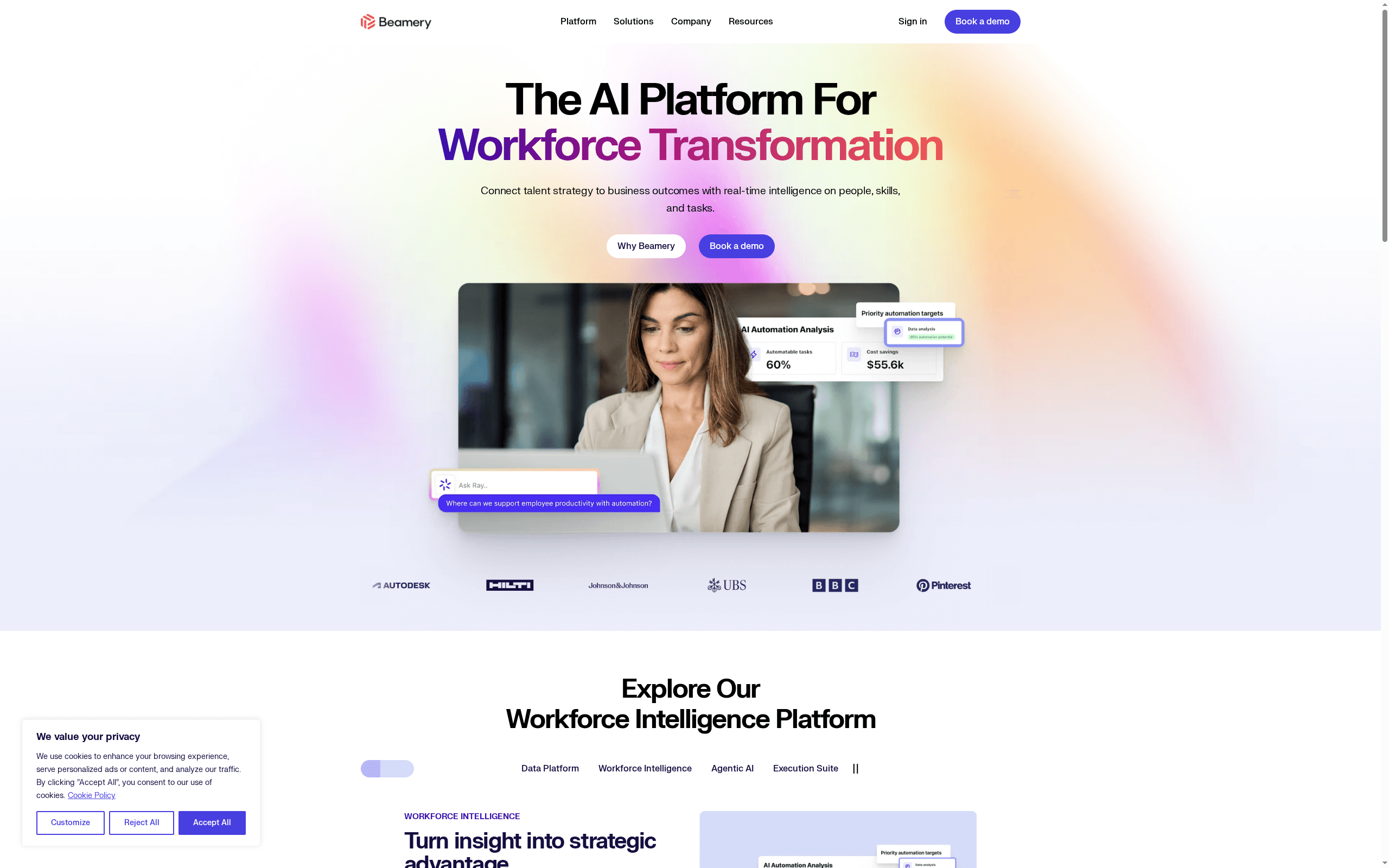
Beamery is the best enterprise talent CRM and lifecycle management platform in 2026 for large organizations that want to build and manage talent pools, power internal mobility, and apply AI-driven skills intelligence across the entire employee lifecycle. Unlike ATS platforms that focus on active hiring, Beamery takes a CRM approach to talent -- building long-term relationships with candidates, mapping skills across the workforce, and enabling proactive talent strategies driven by workforce planning data. The platform combines talent CRM, internal mobility marketplace, skills intelligence, and workforce planning into a unified system for enterprise talent acquisition and management teams.
BEAMERY VERIFIED CAPABILITIES
| Attribute | Detail |
|---|---|
| Pricing | Custom enterprise ($150K-$500K/yr typical) |
| Platform | Talent CRM + internal mobility + skills intelligence |
| AI capabilities | Skills intelligence, AI matching, talent pool scoring |
| Approach | Proactive talent relationship management (not reactive ATS) |
| Target | Large enterprises building strategic talent pipelines |
| Best fit | Enterprises wanting proactive talent CRM + skills-based workforce planning |
Honest Limitation
Beamery's $150K-500K per year pricing makes it accessible only to large enterprises. The platform requires organizational maturity in talent strategy -- organizations without dedicated TA operations teams or workforce planning functions may not extract sufficient value. Implementation is complex and typically takes 3-6 months. The CRM approach to talent requires sustained investment in content, campaigns, and community building that many organizations underestimate. Beamery is not an ATS replacement and requires integration with existing applicant tracking systems. The skills intelligence capabilities, while promising, are newer and less proven than Eightfold AI's deep learning models.
Best For
Frequently Asked Questions
What are AI tools for HR?
AI tools for HR are software platforms that use artificial intelligence -- including machine learning, natural language processing, deep learning, and generative AI -- to automate, augment, or transform human resources processes.
These tools span recruiting (AI-powered sourcing, screening, and interviewing), employee experience (conversational AI chatbots for HR service delivery), talent management (skills-based matching, internal mobility, career pathing), people analytics (predictive attrition modeling, workforce planning), and operational HR (automated workflows, document processing, compliance monitoring).
In 2026, the critical evolution is from AI features to AI agents -- autonomous systems that execute multi-step HR workflows with human confirmation rather than simply providing recommendations. The AI in HR market is valued at approximately $4.8 billion and growing at 21.3% CAGR.
How much do AI HR tools cost?
AI HR tool pricing varies dramatically by vendor and scope. Rippling starts at $8 per employee per month for its base platform, with blended costs of $25-50 per employee per month including HR and payroll modules. Eightfold AI typically runs $7-10 per employee per month with enterprise contracts of $150K-500K+ per year. Paradox (Olivia) starts around $1,000 per month with mid-size deployments costing $30K-95K per year plus $15K-35K in setup fees.
Visier uses custom headcount-based pricing with 1-3 year contract commitments. Phenom and Leena AI offer custom enterprise pricing only. Beamery enterprise contracts typically range $150K-500K per year. Most AI HR vendors do not publish official pricing -- all figures are based on third-party contract data and buyer reports from platforms like Vendr.
Will AI replace HR professionals?
AI will not replace HR professionals but will fundamentally change what they do. In 2026, AI is automating transactional HR work: answering routine employee questions (Leena AI, Paradox), screening resumes (Eightfold AI), scheduling interviews, processing standard requests, and generating reports. This frees HR professionals to focus on strategic work: organizational design, culture development, complex employee relations, change management, and workforce planning.
The Josh Bersin Company estimates that AI will automate 40-60% of transactional HR tasks by 2028, but demand for HR business partners, organizational development specialists, and people analytics professionals is increasing. The most valuable HR skill in 2026 is the ability to leverage AI tools effectively while maintaining the human judgment required for sensitive and strategic decisions.
What is agentic AI in HR?
Agentic AI in HR refers to AI systems that can autonomously execute multi-step workflows with minimal human intervention, going beyond chatbots and recommendation engines. Instead of simply suggesting actions, agentic AI takes them with human confirmation for critical decisions.
Examples in 2026 include Rippling Deep Agents that autonomously manage employee onboarding across HR, IT provisioning, and payroll setup; Paradox Olivia that handles the entire hourly hiring workflow from application to interview scheduling to offer; and Leena AI Work AI agents that resolve 70% of employee support tickets without human involvement.
The key distinction from previous AI generations is autonomy with guardrails: agentic AI operates independently for routine decisions but escalates complex or sensitive matters to human HR professionals for review and approval.
How do I evaluate AI HR tools for bias and fairness?
Evaluating AI HR tools for bias requires examining five dimensions: training data diversity (ask vendors what data their models were trained on and whether it represents diverse populations), adverse impact testing (request documentation of disparate impact analyses across protected groups), transparency and explainability (can the vendor explain why the AI made a specific recommendation), compliance with emerging regulations (NYC Local Law 144 requires annual bias audits for automated employment decision tools, and the EU AI Act classifies HR AI as high-risk), and ongoing monitoring (does the platform provide bias monitoring dashboards and regular algorithmic audits).
Ask vendors for their AI ethics documentation, bias audit results, and whether they use third-party auditors. Tools like Eightfold AI publish bias testing methodologies, while newer entrants may lack this documentation.
About Geeky Expert
Geeky Expert is a leading provider of research and insights, dedicated to helping businesses make informed decisions through comprehensive analysis.