
Best HCM Software (2026)
What is the best HCM software in 2026?
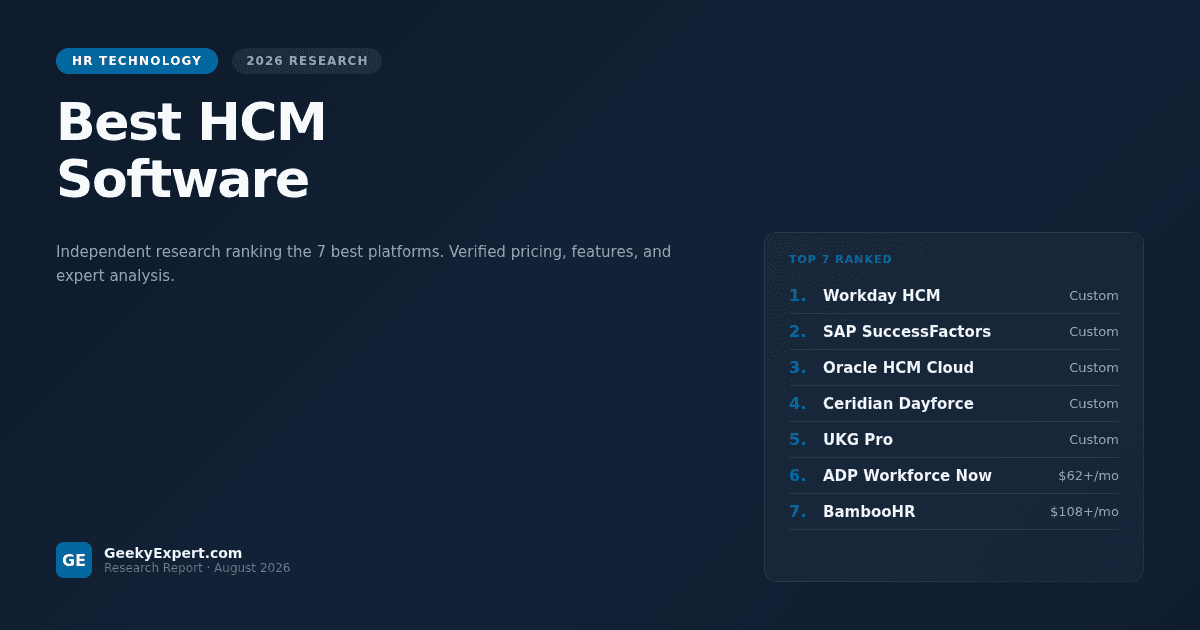
The best HCM (Human Capital Management) software in 2026 depends on your organization size, existing tech stack, and global complexity. For the strongest all-around platform combining HR, finance, and AI-powered workforce planning, Workday HCM leads at approximately $34+ PEPM for enterprises with 2,500+ employees. BambooHR is the best choice for SMBs, Ceridian Dayforce excels with its single-database architecture, and SAP SuccessFactors is ideal for organizations already on SAP ERP.
Best for your situation
- ▸SAP ecosystem: SAP SuccessFactors -- deepest ERP integration, global compliance
- ▸Oracle ecosystem: Oracle HCM Cloud -- unified ERP + HCM on OCI
- ▸Single-database real-time pay: Ceridian Dayforce -- continuous payroll calculation
- ▸Workforce management focus: UKG Pro -- best time/labor + scheduling
- ▸Mid-market payroll-first: ADP Workforce Now -- 50-1,000 employees, payroll expertise
- ▸Small business simplicity: BambooHR -- intuitive HRIS for 20-500 employees
VERIFIED PRICING DATA (2026)
| Platform | Starting Price (PEPM) | Target Size | Best For |
|---|---|---|---|
| Workday HCM | ~$34+ PEPM (custom quote) | 2,500+ employees | Best overall enterprise HCM |
| SAP SuccessFactors | ~$6-8 PEPM (core HR) | 5,000+ employees | Global enterprises on SAP |
| Oracle HCM Cloud | ~$13-15 PEPM (list) | 1,000+ employees | Oracle ecosystem enterprises |
| Ceridian Dayforce | ~$10-16 PEPM (core) | 1,000+ employees | Single-database, real-time pay |
| UKG Pro | ~$26-41 PEPM (custom) | 500-10,000+ employees | Workforce management + payroll |
| ADP Workforce Now | ~$23-30 PEPM (custom) | 50-1,000 employees | Mid-market payroll-first HCM |
| BambooHR | ~$10-25/emp/month | 20-500 employees | Best SMB HRIS/HCM |
HCM SOFTWARE MARKET (2026)
Global HCM Software Market: 2025 Market Size $30.2 billion 2033 Projected Size $56.8 billion CAGR (2025--2033) 8.2% Key Growth Drivers: • AI-powered workforce planning and skills ontology • Continuous payroll and on-demand pay adoption • Global compliance complexity across 100+ countries • Employee experience and engagement integration • Skills-based talent management replacing job-based models Market Share by Vendor (2026 est.): Workday ~24% (enterprise segment) SAP SuccessFactors ~20% (global enterprise) Oracle HCM Cloud ~14% (enterprise) ADP ~12% (mid-market + enterprise) UKG ~9% (mid-market + WFM) Source: GeekyExpert, IDC, Mordor Intelligence, 2025--2026
WHAT TO OPTIMIZE FOR (2026)
ENTERPRISE (2,500+ employees), unified HR + Finance → Workday HCM (AI Illuminate agents, single platform) → Best for Fortune 500, tech, financial services GLOBAL enterprise on SAP ERP / S/4HANA → SAP SuccessFactors (deepest ERP integration) → Best for manufacturing, global orgs with SAP backbone ORACLE ecosystem, cloud-first → Oracle HCM Cloud (unified OCI, AI Agent Studio) → Best for organizations consolidating on Oracle SINGLE DATABASE, real-time continuous payroll → Ceridian Dayforce (no batch processing, on-demand pay) → Best for complex payroll, healthcare, retail WORKFORCE MANAGEMENT is the #1 priority → UKG Pro (best-in-class time, scheduling, labor) → Best for shift-based industries, manufacturing, logistics MID-MARKET, payroll-first approach (50-1,000 employees) → ADP Workforce Now (payroll expertise, compliance) → Best for mid-size businesses wanting payroll reliability SMALL BUSINESS simplicity (20-500 employees) → BambooHR (intuitive UI, fast implementation) → Best for growing SMBs wanting simple HR without enterprise complexity
The HCM Software Market in 2026
This GeekyExpert research report evaluates the top 7 Human Capital Management (HCM) software platforms in 2026. The global HCM software market reached approximately $30.2 billion in 2025 and is projected to grow to $56.8 billion by 2033 at an 8.2% CAGR, driven by AI-powered workforce planning, continuous payroll adoption, and the shift from job-based to skills-based talent management. The core decision for HR leaders is no longer just which platform tracks employee records -- it is which system can unify HR, payroll, talent, workforce management, and analytics into a single source of truth while handling global compliance across 100+ countries.
Featured HR Technology
Workday HCM -- Best Overall HCM Platform
Workday HCM is the best overall Human Capital Management platform in 2026 for large enterprises seeking a unified HR, Finance, and Planning system with AI-native capabilities. Used by 65% of the Fortune 500 and over 11,000 organizations worldwide serving 70+ million users, Workday has established itself as the enterprise HCM standard. Its true cloud architecture (no on-premises deployments) ensures every customer runs on the same codebase with continuous updates delivered twice annually. The late-2025 launch of Workday Illuminate introduced 7 new AI agents that automate transactional HR and Finance workflows while keeping humans in the loop for critical decisions.
WORKDAY HCM VERIFIED CAPABILITIES
| Attribute | Detail |
|---|---|
| Starting price | ~$34+ PEPM (custom quote, enterprise only) |
| Full suite | $55-150 PEPM (HR + Financials + Adaptive Planning) |
| Deployment | 100% cloud SaaS (no on-premises option) |
| AI capabilities | Illuminate: 7 AI agents for HR + Finance automation |
| Market position | 65% of Fortune 500, 11,000+ organizations, 70M+ users |
| Best fit | Enterprises with 2,500+ employees needing unified HR + Finance |
Honest Limitation
Workday is expensive -- the entry point around $34 PEPM makes it impractical for organizations under 1,000 employees, and full-suite pricing can reach $150 PEPM. Implementation typically takes 9-18 months and costs 40-100% of the first year's software investment. The platform is complex and requires dedicated Workday administrators. Its payroll capabilities, while strong in the US, rely on partners for many global markets. The lack of an on-premises option is a dealbreaker for some regulated industries. Customization requires Workday-specific skills that command premium salaries.
Best For
SAP SuccessFactors -- Best for Global Enterprises on SAP

SAP SuccessFactors is the best HCM platform for global enterprises already running SAP ERP or S/4HANA. Its Employee Central module provides the deepest integration with SAP's ERP backbone, enabling seamless data flow between HR, Finance, Procurement, and Operations. With support for 100+ countries through Employee Central Payroll and a network of certified payroll partners, SuccessFactors has the broadest global payroll localization of any HCM platform. The platform includes SAP Joule, an AI copilot that assists with HR tasks across the suite, though it launched later than Workday Illuminate and remains less mature in agentic capabilities.
SAP SUCCESSFACTORS VERIFIED CAPABILITIES
| Attribute | Detail |
|---|---|
| Core HR price | ~$6-8 PEPM (Employee Central, list price) |
| Full suite | ~$28-38 PEPM (all modules, negotiated) |
| Global payroll | 100+ countries (Employee Central Payroll + partners) |
| AI copilot | SAP Joule -- generative AI assistant across HXM suite |
| ERP integration | Deepest native integration with SAP S/4HANA and ECC |
| Best fit | Global enterprises (5,000+) on SAP ERP needing 100+ country coverage |
Honest Limitation
SuccessFactors has a fragmented architecture -- modules like Recruiting, Learning, and Employee Central were built or acquired at different times and still have inconsistent UX patterns. The user interface, while improving, is not as polished as Workday's. SAP Joule lags behind Workday Illuminate in agentic AI capabilities. Implementation complexity is comparable to Workday (9-18 months for full suite) and requires SAP-specific consulting expertise. The platform's full value is heavily dependent on SAP ERP integration -- organizations not on SAP get less differentiated value. Talent management modules, while functional, trail Workday in depth for performance and succession planning.
Best For
Oracle HCM Cloud -- Best for Oracle Ecosystem
Oracle HCM Cloud is the best HCM platform for enterprises consolidating their technology stack on Oracle Cloud Infrastructure (OCI). As part of Oracle Fusion Cloud Applications, it provides a unified HCM, ERP, and EPM experience on a single cloud platform with shared data models. Oracle's 2025-2026 investments focus on Oracle AI Agent Studio, which allows organizations to build and deploy custom AI agents across HR workflows. With support for 200+ jurisdictions and localized compliance, Oracle HCM Cloud serves organizations that want a single vendor for their entire enterprise application stack.
ORACLE HCM CLOUD VERIFIED CAPABILITIES
| Attribute | Detail |
|---|---|
| List price | ~$13-15 PEPM (core modules, 1,000 employee min.) |
| Full suite | ~$25-30 PEPM list; negotiated $6-15 PEPM at scale |
| Deployment | Cloud on Oracle Cloud Infrastructure (OCI) |
| AI capabilities | Oracle AI Agent Studio -- custom AI agents for HR |
| Global coverage | 200+ jurisdictions with localized compliance |
| Best fit | Enterprises consolidating on Oracle Cloud (ERP + HCM + EPM) |
Honest Limitation
Oracle HCM Cloud's UX has historically lagged behind Workday in intuitiveness and design polish, though the Redwood UI redesign has narrowed the gap. The platform's 1,000-employee minimum makes it inaccessible to smaller organizations. Implementation timelines are comparable to Workday and SAP (9-18 months for full suite). The AI Agent Studio, while more flexible, requires more configuration than Workday's pre-built Illuminate agents. Oracle's market share in HCM is smaller than Workday and SAP SuccessFactors, meaning fewer implementation partners and a smaller user community. Quarterly updates can introduce breaking changes that require regression testing.
Best For
Ceridian Dayforce -- Best Single-Database HCM Architecture
Ceridian Dayforce is the best HCM platform for organizations that prioritize real-time, continuous payroll processing over batch-based systems. Its single-database architecture -- where HR, payroll, benefits, workforce management, and talent all share one data store -- eliminates the integration gaps and batch synchronization delays that plague multi-module HCM suites. This means a schedule change at 3 PM on a Tuesday is immediately reflected in payroll calculations, labor cost projections, and compliance tracking without waiting for an overnight batch run. Serving over 6 million users worldwide, Dayforce is particularly strong for organizations with complex payroll scenarios including multiple pay rules, union agreements, and multi-jurisdictional compliance.
CERIDIAN DAYFORCE VERIFIED CAPABILITIES
| Attribute | Detail |
|---|---|
| Core HR + Payroll | ~$10-16 PEPM (1,000+ employees) |
| Full platform | ~$22-31 PEPM (all modules) |
| Architecture | Single database -- HR, payroll, WFM, talent unified |
| Continuous payroll | Real-time calculation, no batch processing |
| On-demand pay | Dayforce Wallet -- earned wage access |
| Best fit | Organizations with complex payroll needing real-time, single-DB HCM |
Honest Limitation
Dayforce's global payroll coverage is narrower than SAP SuccessFactors and Workday, currently focusing on North America, UK, Australia, and a few other markets. The talent management modules (recruiting, learning, succession) are functional but not as deep as Workday's. The platform's implementation timeline (4-8 months) is shorter than the Big 3 but still significant. The UI, while improved, does not match Workday's design polish. The single-database architecture that is its strength also means less flexibility for organizations that prefer best-of-breed point solutions integrated via APIs.
Best For
UKG Pro -- Best for Workforce Management

UKG Pro (Ultimate Kronos Group) is the best HCM platform for organizations where workforce management -- time and attendance, scheduling, labor analytics, and absence management -- is the primary driver of their HCM investment. Born from the 2020 merger of Ultimate Software (HCM and payroll) and Kronos (workforce management), UKG combines enterprise-grade HCM with the industry's deepest time and labor management capabilities. The platform introduced UKG Bryte AI in 2025, a generative AI assistant focused on HR and workforce management insights.
UKG PRO VERIFIED CAPABILITIES
| Attribute | Detail |
|---|---|
| Pricing | ~$26-41 PEPM (custom quote only) |
| Deployment | Cloud SaaS |
| WFM strength | Best-in-class time, scheduling, labor analytics (Kronos heritage) |
| AI | UKG Bryte -- generative AI for HR and workforce insights |
| Employee sentiment | Great Place to Work integration for culture insights |
| Best fit | Mid-to-large orgs (500-10,000+) where WFM is the #1 priority |
Honest Limitation
UKG Pro's pricing at $26-41 PEPM places it in the premium tier without the unified Finance platform that justifies Workday's similar pricing. The platform's dual heritage (Ultimate + Kronos) means some modules still feel like separate products stitched together, with occasional UX inconsistencies. Global capabilities are narrower than Workday, SAP, and Oracle. Talent management modules are adequate but do not lead the market. Implementation typically takes 6-9 months. The AI assistant (UKG Bryte) is newer and less proven than Workday Illuminate. Being privately held (post-2021 buyout) means less public transparency about product roadmap and financials.
Best For
ADP Workforce Now -- Best Mid-Market Payroll-First HCM
ADP Workforce Now is the best HCM platform for mid-market organizations (50-1,000 employees) that want payroll expertise as the foundation of their HR technology stack. ADP processes payroll for approximately 1 in 6 US workers, giving it unmatched payroll compliance infrastructure, tax filing accuracy, and regulatory expertise. Workforce Now bundles core HR, payroll, benefits, time and attendance, and talent management into a single platform purpose-built for the mid-market segment -- organizations large enough to need integrated HCM but not large enough to justify the cost and complexity of Workday, SAP, or Oracle.
ADP WORKFORCE NOW VERIFIED CAPABILITIES
| Attribute | Detail |
|---|---|
| Pricing | ~$23-30 PEPM (custom quote, bundled) |
| Target size | 50-1,000 employees (mid-market) |
| Payroll expertise | Processes payroll for ~1 in 6 US workers |
| Compliance | Tax filing, ACA, W-2/1099, garnishments, new hire reporting |
| Add-ons | HR Assist (+$5-8 PEPM), Enhanced Insights (+$3-6 PEPM) |
| Best fit | Mid-market businesses (50-1,000) wanting payroll reliability |
Honest Limitation
ADP Workforce Now's pricing at $23-30 PEPM is higher than Ceridian Dayforce and BambooHR for the feature set delivered. The platform's UX is functional but dated compared to Workday and BambooHR. Talent management modules (recruiting, performance) are adequate but not competitive with best-of-breed tools. Add-on pricing ($5-8 PEPM for HR Assist, $3-6 for Enhanced Insights) can push total cost significantly above the base quote. The 50-employee minimum excludes smaller businesses. Sales-driven pricing means quoted rates can run 30-50% higher than initially indicated once add-ons are included. The platform is US-centric; global capabilities require ADP's separate GlobalView or Celergo products.
Best For
BambooHR -- Best HCM for Small Business
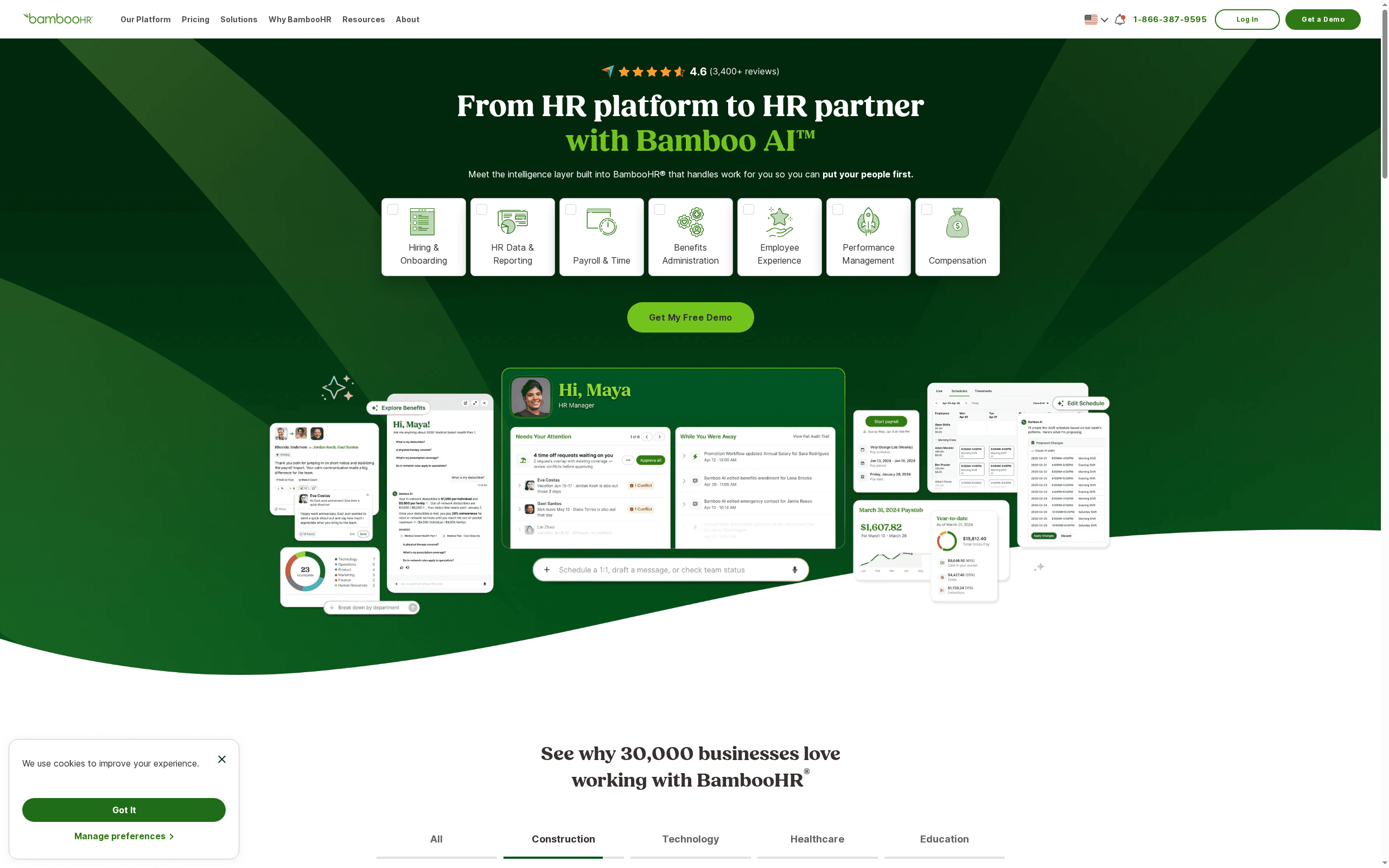
BambooHR is the best HCM platform for small businesses (20-500 employees) that want an intuitive, easy-to-implement HRIS with growing HCM capabilities. While not a full enterprise HCM suite, BambooHR covers the core needs of growing SMBs: employee records, onboarding, time-off tracking, performance management, reporting, and basic payroll. Its clean interface, minimal training requirements, and 2-4 week implementation timeline make it the fastest path to getting off spreadsheets and into a real HR system. BambooHR serves SMBs across industries and has built a strong reputation for user experience and customer support.
BAMBOOHR VERIFIED CAPABILITIES
| Attribute | Detail |
|---|---|
| Core tier | ~$10/employee/month (min. $250/mo for up to 25 employees) |
| Pro tier | ~$25/employee/month (performance, analytics, employee experience) |
| Implementation | 2-4 weeks (fastest in this ranking) |
| Payroll | US payroll add-on (not included in base) |
| UX | Industry-leading ease of use for SMBs |
| Best fit | Growing SMBs (20-500 employees) replacing spreadsheets |
Honest Limitation
BambooHR is not a full HCM suite -- it lacks advanced workforce management (scheduling, labor analytics), strategic workforce planning, succession planning depth, and global capabilities. Payroll is a US-only add-on, not a core strength. The $250/month minimum floor means very small companies (under 25 employees) pay a premium per head. Reporting, while adequate for SMBs, lacks the analytical depth of enterprise platforms. The platform has a natural ceiling -- organizations that grow past 500-800 employees often outgrow BambooHR and migrate to mid-market or enterprise HCM. Learning management is basic compared to dedicated LMS platforms.
Best For
Frequently Asked Questions
What is HCM software?
HCM (Human Capital Management) software is an integrated platform that manages the entire employee lifecycle from recruitment to retirement. It combines core HR (employee records, org charts, compliance), payroll, benefits administration, talent management (recruiting, onboarding, performance, learning), workforce management (time tracking, scheduling, absence), and people analytics into a unified system.
Unlike standalone HRIS tools that focus on employee data storage, HCM platforms provide strategic workforce planning, skills-based talent intelligence, and AI-powered decision support. In 2026, the global HCM market is valued at approximately $30.2 billion and growing at 8.2% CAGR, driven by AI adoption, continuous payroll models, and the shift to skills-based talent management.
How much does HCM software cost?
HCM software pricing varies dramatically by vendor and company size. BambooHR starts at approximately $10 per employee per month for SMBs. SAP SuccessFactors core HR modules list at $6-8 PEPM. Ceridian Dayforce ranges from $10-16 PEPM for core HR and payroll. Oracle HCM Cloud lists at $13-15 PEPM. ADP Workforce Now runs $23-30 PEPM. UKG Pro ranges from $26-41 PEPM. Workday HCM starts around $34 PEPM and can reach $80-150 PEPM for the full suite including Financials and Adaptive Planning.
None of these vendors publish official pricing -- all figures are based on third-party benchmark data. Implementation costs typically add 40-100% of the first year software investment for enterprise platforms like Workday, SAP, and Oracle. Most vendors require annual contracts with multi-year commitments for enterprise deals.
What is the difference between HCM and HRIS?
HRIS (Human Resource Information System) is a subset of HCM focused primarily on employee data management: storing records, tracking time off, managing benefits enrollment, and basic reporting. HCM (Human Capital Management) encompasses everything HRIS does plus strategic capabilities including talent acquisition, performance management, learning and development, succession planning, workforce planning, advanced analytics, and AI-driven insights.
In practice, BambooHR and parts of ADP Workforce Now function more as HRIS with some HCM features, while Workday, SAP SuccessFactors, and Oracle HCM Cloud are full HCM suites. The distinction matters for budgeting: a growing 200-person company may need HRIS now but should evaluate whether the platform can scale to HCM as the organization grows past 500-1,000 employees.
How long does HCM software implementation take?
Implementation timelines vary significantly by platform complexity and organization size. BambooHR can be deployed in 2-4 weeks for a sub-500 employee company. ADP Workforce Now typically takes 8-12 weeks for mid-market organizations. Ceridian Dayforce implementations run 4-8 months depending on payroll complexity and number of countries. UKG Pro averages 6-9 months.
Workday HCM, SAP SuccessFactors, and Oracle HCM Cloud enterprise deployments typically take 9-18 months for a full-suite rollout, with some global implementations extending to 24 months. Key timeline drivers include data migration from legacy systems, integration complexity, number of countries and payroll rules, change management, and the number of modules being deployed simultaneously versus phased.
Which HCM software is best for global companies?
For truly global organizations operating in 50+ countries, Workday HCM, SAP SuccessFactors, and Oracle HCM Cloud are the strongest options. SAP SuccessFactors has the deepest global payroll localization, supporting 100+ countries through Employee Central Payroll and certified payroll partners. Workday HCM covers 200+ countries for core HR and supports payroll natively in 30+ countries with partner coverage for the rest. Oracle HCM Cloud supports 200+ jurisdictions with localized compliance.
Ceridian Dayforce is strong in North America, UK, and Australia but has narrower global coverage. For mid-market global operations, ADP offers global payroll capabilities through its GlobalView and Celergo products. The key evaluation factor is whether the vendor supports native payroll in your specific countries or relies on third-party payroll partners, which adds cost and integration complexity.
About Geeky Expert
Geeky Expert is a leading provider of research and insights, dedicated to helping businesses make informed decisions through comprehensive analysis.