
Best Succession Planning Software (2026)
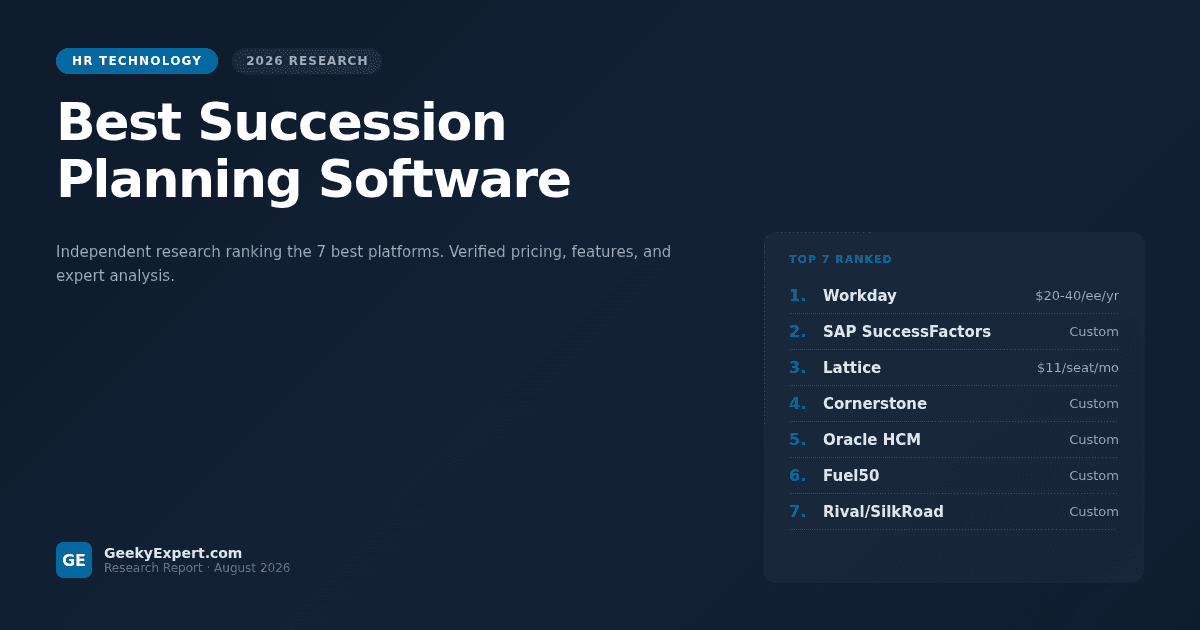
What is the best succession planning software in 2026?
The best succession planning software in 2026 depends on your organization size, existing HCM stack, and whether you prioritize AI-driven talent intelligence or deep 9-box calibration workflows. For the strongest all-around combination of succession depth, AI analytics, and talent pool management, Workday leads with its Skills Cloud AI and HiredScore integration. SAP SuccessFactors is the best choice for global enterprise compliance, Lattice excels for mid-market people management, and Fuel50 offers the most advanced AI-driven career pathing.
Best for your situation
- ▸Global enterprise succession: SAP SuccessFactors -- 100+ country compliance, succession org charts
- ▸Mid-market people management: Lattice -- successor tagging, IDPs, AI growth plans from $11/seat/mo
- ▸Learning-driven succession: Cornerstone OnDemand -- deep LMS integration, skills gap analysis
- ▸AI career pathing & mobility: Fuel50 -- AI career path mapping, talent marketplace, Career Coach Agent
VERIFIED PRICING DATA (2026)
| Platform | Starting Price | Type | Best For |
|---|---|---|---|
| Workday | ~$20-40/employee/year (Talent module) | Cloud HCM Suite | Best overall succession planning |
| SAP SuccessFactors | ~$3-6 PEPM (Succession module) | Cloud HXM Suite | Global enterprise succession |
| Lattice | $11/seat/month (Talent Management) | Cloud People Platform | Mid-market people management |
| Cornerstone OnDemand | $8-18 PEPM (Full TXP) | Cloud Talent Suite | Learning-driven succession |
| Oracle HCM Cloud | $4-9 PEPM list / $2-6 negotiated | Cloud HCM Suite | Finance & government sectors |
| Fuel50 | From $4.54/user/year (10K, 3-year) | AI Talent Marketplace | AI career pathing & mobility |
| Rival (SilkRoad) | Custom (~$5-10 PEPM estimated) | Cloud Talent Suite | Talent acquisition to succession lifecycle |
SUCCESSION PLANNING SOFTWARE MARKET (2026)
Global Talent Management Software Market: 2025 Market Size ~$30 billion+ 2030 Projected Size ~$56 billion CAGR (2025--2030) ~13.1% Succession Planning as a Segment: • Part of the broader talent management market • C-suite risk mitigation is the #1 driver • 86% of leaders say succession planning is urgent or important • Only 14% of organizations believe they have a strong bench Key Growth Drivers: • CEO and C-suite turnover acceleration • AI-powered skills ontologies and talent intelligence • Board-level governance requirements for leadership continuity • Integration of succession with internal mobility and career pathing • Regulatory pressure for diversity in leadership pipelines Adoption by Company Size (2026): Enterprise (5000+) 78% have formal succession plans Mid-market (500--4999) 45% have formal succession plans SMB (under 500) 18% have formal succession plans Source: GeekyExpert View Research, Gartner, Deloitte, 2025--2026
WHAT TO OPTIMIZE FOR (2026)
LARGE ENTERPRISE (2,000+ employees), AI-first → Workday (Skills Cloud AI, HiredScore, Peakon flight-risk) → Best for organizations wanting AI-driven succession intelligence GLOBAL ENTERPRISE, multi-country compliance → SAP SuccessFactors (100+ country support, succession org charts) → Best for multinationals needing localized talent pools MID-MARKET (50--5,000), modern people platform → Lattice (successor tagging, IDPs, AI growth plans) → Best value for growing companies at $11/seat/month LEARNING-DRIVEN succession, skills gap closure → Cornerstone OnDemand (deep LMS, career pathing, 9-box) → Best for L&D-heavy organizations linking learning to readiness FINANCE & GOVERNMENT sectors, Oracle ecosystem → Oracle HCM Cloud (Dynamic Skills AI, risk-of-loss, ERP integration) → Best for regulated industries already on Oracle AI CAREER PATHING & INTERNAL MOBILITY → Fuel50 (skills ontology, talent marketplace, Career Coach Agent) → Best for employee-driven career development at scale FULL LIFECYCLE (hire-to-retire), mid-size → Rival/SilkRoad (onboarding to performance to succession) → Best for 500--5,000 employee unified talent lifecycle
The Succession Planning Software Market in 2026
This GeekyExpert research report evaluates the top 7 succession planning software platforms in 2026. Succession planning is a subset of the broader talent management software market, which reached approximately $30 billion in 2025 and is projected to grow to $56 billion by 2030 at a 13.1% CAGR. The urgency is clear: 86% of leaders say succession planning is urgent or important, yet only 14% of organizations believe they have a strong leadership bench. C-suite turnover is accelerating, boards are demanding formal succession governance, and AI-powered talent intelligence is transforming how companies identify, develop, and promote future leaders. The core decision is not just which tool has the best 9-box grid, but which one integrates succession with your existing talent ecosystem -- performance data, skills inventories, learning platforms, and engagement signals.
Featured HR Technology
Workday -- Best Overall Succession Planning Software
Workday is the best overall succession planning software in 2026 for large enterprises that want AI-powered talent intelligence fully integrated with their HCM platform. Its Skills Cloud AI maps over 55,000 skills across the workforce, HiredScore integration surfaces non-obvious successor candidates based on skills adjacency and career trajectory, and Peakon engagement signals serve as real-time flight-risk indicators for critical talent. The unified platform means succession decisions are informed by live performance reviews, compensation data, skills inventories, and engagement sentiment rather than static spreadsheets updated once a year. Workday serves over 10,000 organizations globally, including more than 60% of the Fortune 500.
WORKDAY VERIFIED CAPABILITIES
| Attribute | Detail |
|---|---|
| Talent module pricing | ~$20-40/employee/year |
| Full HCM pricing | ~$10-15/user/month |
| AI capabilities | Skills Cloud AI (55K+ skills), HiredScore integration |
| 9-box calibration | Yes -- multi-rater, bias-checking, historical trends |
| Flight-risk indicators | Peakon engagement signals, compensation benchmarks |
| Best fit | Large enterprise (2,000+ employees) wanting AI-driven succession intelligence |
Honest Limitation
Workday is priced for large enterprise and is not cost-effective for organizations under 1,000 employees. Implementation timelines are typically 6-18 months, and total cost of ownership including implementation services can be significant. The full value of succession planning requires adoption of the broader Workday HCM ecosystem -- using just the talent module without Workday as your core HRIS diminishes the data integration advantage. The interface, while powerful, has a learning curve for HR administrators. Smaller organizations should consider Lattice for a faster, more affordable path to succession planning.
Best For
SAP SuccessFactors -- Best for Global Enterprise Succession

SAP SuccessFactors is the best succession planning software for global enterprises that need multi-country compliance, localized talent pools, and succession org charts that span complex organizational structures across 100+ countries. As part of the SAP Human Experience Management (HXM) suite, SuccessFactors integrates succession planning with performance management, learning, compensation, and workforce analytics in a single platform. Its succession module includes talent pools, 9-box calibration matrices, succession org charts with visual pipeline depth, mentoring programs, and compliance frameworks for regulated industries. SAP SuccessFactors serves over 12,000 customers in more than 200 countries.
SAP SUCCESSFACTORS VERIFIED CAPABILITIES
| Attribute | Detail |
|---|---|
| Succession module pricing | ~$3-6 PEPM |
| Full HXM suite pricing | $6-38 PEPM (module-dependent) |
| Global compliance | 100+ countries, localized talent pools |
| 9-box calibration | Yes -- succession org charts, talent pools |
| Mentoring | Built-in mentoring programs and matching |
| Best fit | Global enterprises (1,000-100,000+ employees) in regulated industries |
Honest Limitation
SAP SuccessFactors has a steeper learning curve than modern platforms like Lattice. The user interface, while improved in recent years, still feels more enterprise-functional than consumer-grade. Implementation timelines for the full HXM suite are typically 9-18 months. The AI and analytics capabilities, while solid, trail Workday's Skills Cloud and HiredScore integration in sophistication. Pricing for the full suite can escalate quickly when adding modules beyond the succession core. Organizations under 1,000 employees will find the platform over-engineered for their needs.
Best For
Lattice -- Best for Mid-Market People Management
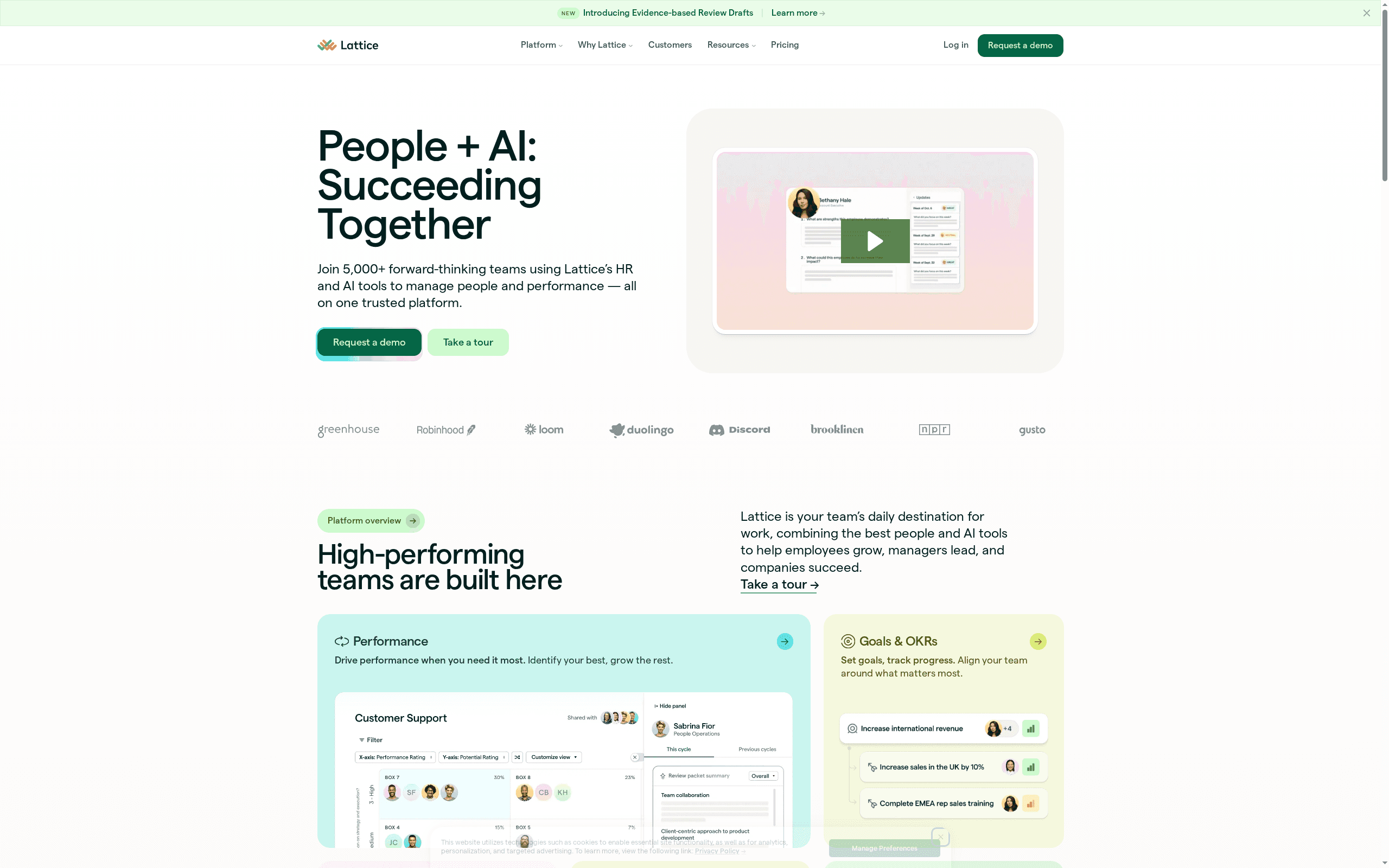
Lattice is the best succession planning software for mid-market companies that want a modern, intuitive people management platform combining performance reviews, engagement surveys, career development, and succession planning at an accessible price point. Unlike enterprise suites from Workday and SAP that require 6-18 month implementations, Lattice can be deployed in weeks and delivers a consumer-grade user experience that drives adoption among managers and employees. Its Talent Management bundle at $11/seat/month includes successor tagging with readiness levels, pipeline strength assessment, individual development plans (IDPs), and AI-powered growth plans -- making it the best value for growing companies that need succession capabilities without enterprise complexity.
LATTICE VERIFIED CAPABILITIES
| Attribute | Detail |
|---|---|
| Talent Management bundle | $11/seat/month ($4K/year minimum) |
| Successor tracking | Successor tagging with readiness levels (Ready Now, 1-2 Years, 3+ Years) |
| Pipeline assessment | Pipeline strength assessment with visual indicators |
| Development tools | IDPs, AI-powered growth plans, competency frameworks |
| Integrations | Slack, HRIS (BambooHR, Workday, Rippling), SSO, API |
| Best fit | SMB to mid-market (50-5,000 employees) wanting modern UX at accessible price |
Honest Limitation
Lattice's succession planning is less mature than Workday or SAP SuccessFactors for deep calibration workflows, scenario modeling, and enterprise-scale talent pool management. It lacks the 9-box calibration session facilitation tools that enterprise platforms provide. Global compliance features are limited compared to SAP SuccessFactors. The $4,000/year minimum means very small teams (under 30 employees) may find it expensive per head. Organizations with 5,000+ employees may outgrow Lattice's succession depth and need to migrate to an enterprise platform.
Best For
Cornerstone OnDemand -- Best for Learning-Driven Succession
Cornerstone OnDemand is the best succession planning software for organizations where learning and development is the primary driver of succession readiness. Its Talent Experience Platform (TXP) uniquely integrates succession planning with one of the deepest learning management systems (LMS) in the market, meaning successors are not just identified and tracked but actively developed through targeted learning paths, skills assessments, and competency-based certifications. The 9-box grid, skills gap analysis, and career pathing tools are all connected to Cornerstone's content marketplace of over 100,000 learning objects, creating a closed loop from talent identification to readiness development. Cornerstone serves over 7,000 organizations and 100 million users worldwide.
CORNERSTONE ONDEMAND VERIFIED CAPABILITIES
| Attribute | Detail |
|---|---|
| Full TXP pricing | $8-18 PEPM |
| 9-box calibration | Yes -- performance vs. potential, configurable axes |
| Skills gap analysis | Automated gap identification with learning recommendations |
| LMS integration | Native -- 100,000+ learning objects, content marketplace |
| Career pathing | Visual career paths linked to competency requirements |
| Best fit | Organizations (500-50,000+ employees) where L&D drives succession readiness |
Honest Limitation
Cornerstone's platform can feel complex and feature-heavy, with a steeper learning curve than Lattice. The AI and analytics capabilities trail Workday's Skills Cloud for pure talent intelligence sophistication. The user interface has improved but still feels more functional than modern. Pricing at $8-18 PEPM for the full TXP can escalate for large organizations. Organizations that do not prioritize learning-driven development may find the LMS integration unnecessary and prefer a simpler succession tool. Implementation timelines are typically 3-12 months depending on configuration complexity.
Best For
Oracle HCM Cloud -- Best for Finance and Government Sectors
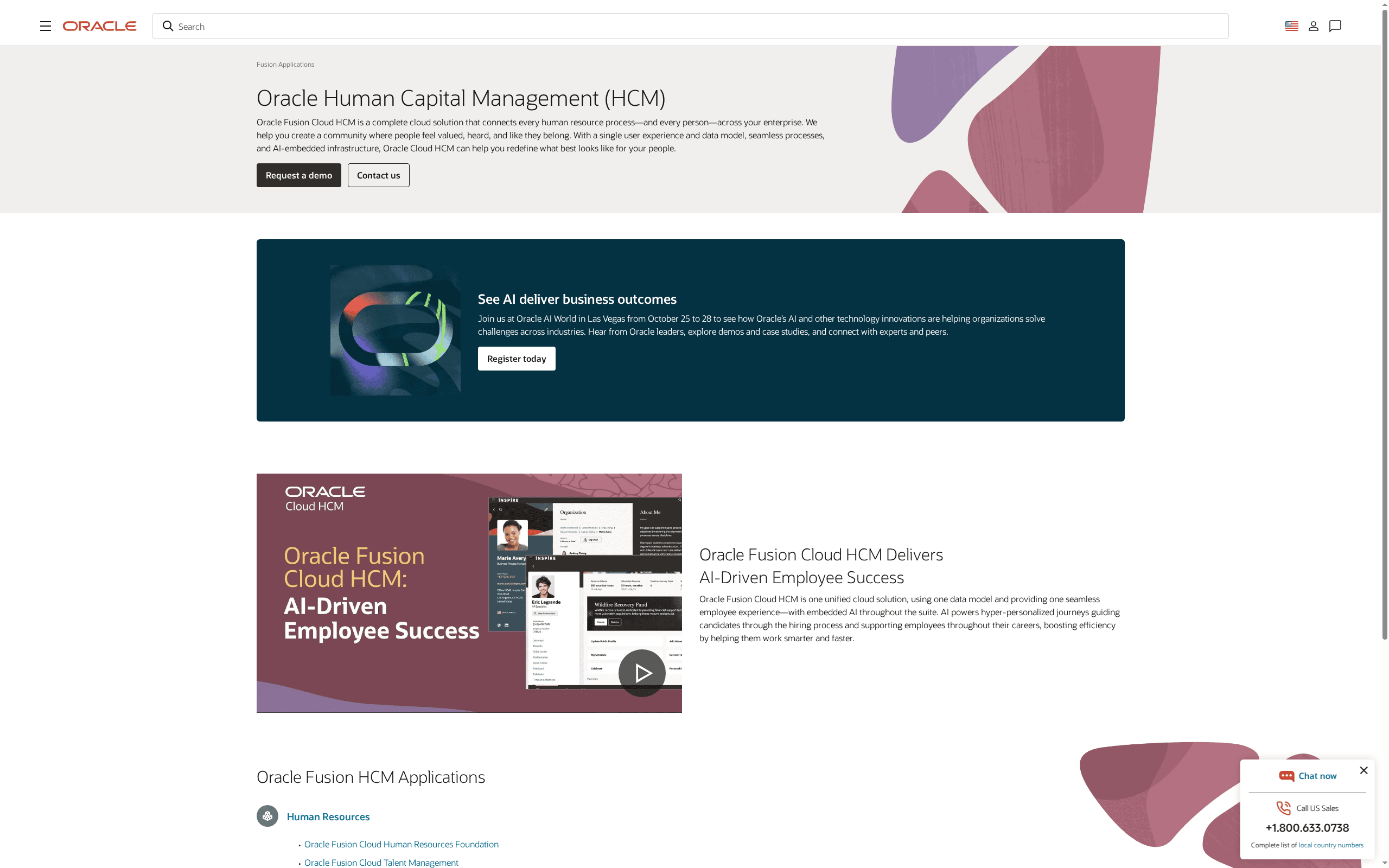
Oracle HCM Cloud is the best succession planning software for large organizations in finance, government, and public sector that need deep ERP integration, regulatory compliance, and enterprise-grade security. Oracle's talent management module includes Dynamic Skills AI for intelligent skill mapping, risk-of-loss indicators that flag employees likely to leave, career development planning linked to learning paths, and succession dashboards built for board-level reporting. As part of Oracle Fusion Cloud HCM, succession planning integrates natively with Oracle's financial, supply chain, and human capital modules -- a critical advantage for organizations that run Oracle as their enterprise backbone.
ORACLE HCM CLOUD VERIFIED CAPABILITIES
| Attribute | Detail |
|---|---|
| Talent suite pricing | $4-9 PEPM list / $2-6 PEPM negotiated |
| AI capabilities | Dynamic Skills AI, risk-of-loss indicators |
| Career development | Career paths linked to Oracle Learning paths |
| ERP integration | Native -- Oracle Financials, SCM, HCM unified |
| Security & compliance | FedRAMP, SOC 2, GDPR, government-grade audit trails |
| Best fit | 5,000+ employee organizations in finance, government, public sector |
Honest Limitation
Oracle HCM Cloud is firmly positioned for large enterprise and is not cost-effective or practical for organizations under 2,000 employees. Implementation timelines are long (typically 9-24 months) and total cost of ownership including implementation services is significant. The user interface is functional but less intuitive than modern platforms like Lattice. The AI capabilities, while strong, trail Workday's Skills Cloud and HiredScore combination for pure talent intelligence depth. Organizations not already on Oracle's technology stack will face integration complexity that may negate the platform's advantages.
Best For
Fuel50 -- Best for AI-Driven Career Pathing and Internal Mobility
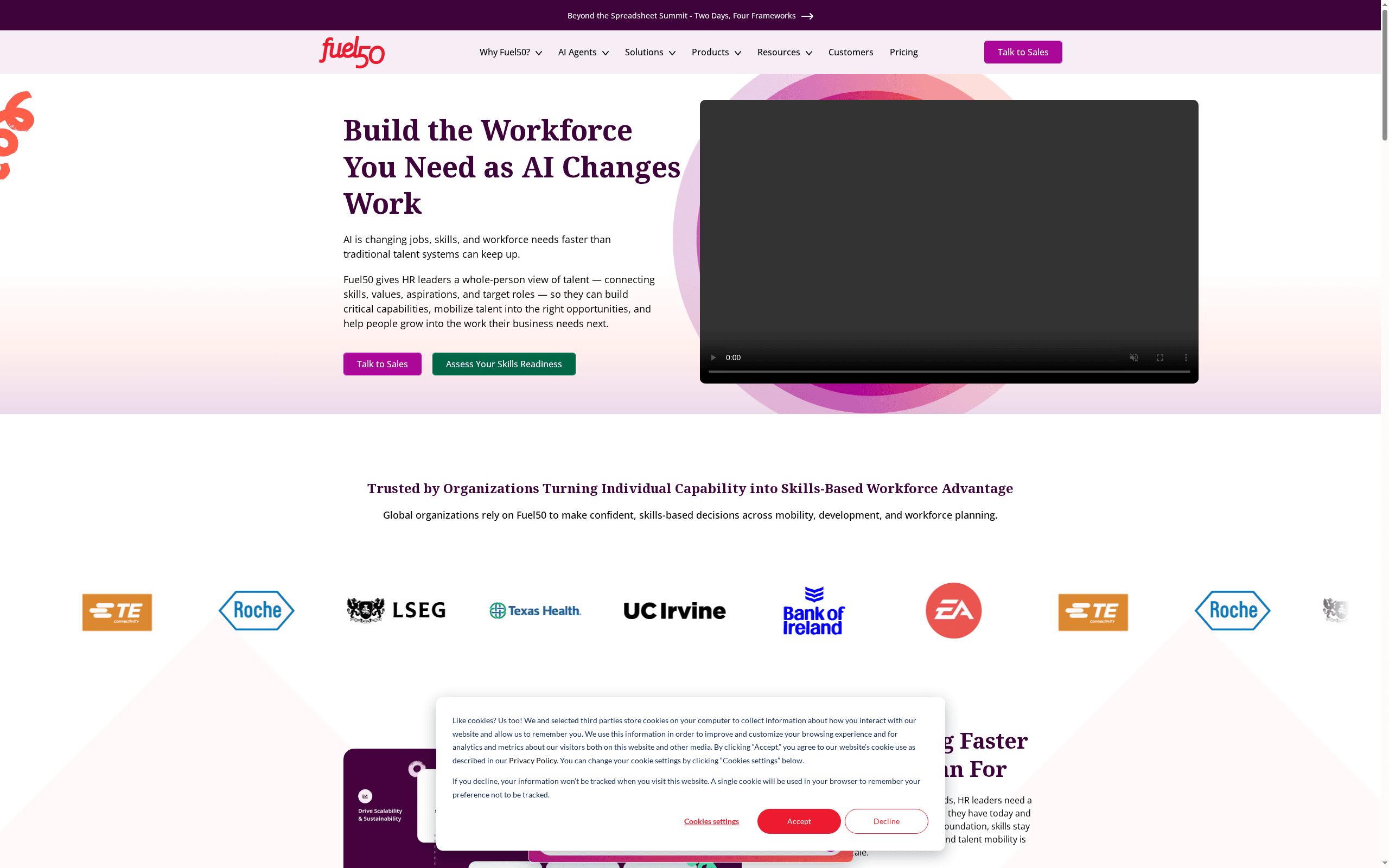
Fuel50 is the best succession planning software for organizations that want to approach succession from the employee's perspective -- using AI-driven career pathing, skills ontology, and an internal talent marketplace to build leadership pipelines organically rather than through top-down nomination alone. Unlike traditional succession tools that focus on manager-driven 9-box calibration, Fuel50 empowers employees to explore career paths, identify skills gaps, and self-direct development toward leadership readiness. Its Career Coach Agent, launched in March 2026, uses AI to provide personalized career guidance at scale, effectively democratizing career development conversations that were previously limited to annual manager reviews.
FUEL50 VERIFIED CAPABILITIES
| Attribute | Detail |
|---|---|
| Pricing | From $4.54/user/year (10K employees, 3-year contract) |
| AI career pathing | AI-powered career path mapping with skills adjacency |
| Skills ontology | Proprietary ontology mapping organizational skills landscape |
| Talent marketplace | Internal gigs, projects, mentoring, stretch assignments |
| Career Coach Agent | AI agent for personalized career guidance (launched March 2026) |
| Best fit | Organizations (1,000-50,000+ employees) prioritizing internal mobility and career development |
Honest Limitation
Fuel50's succession planning depth for traditional 9-box calibration, successor nomination workflows, and board-level succession reporting is less mature than Workday, SAP SuccessFactors, or Cornerstone OnDemand. Organizations that need formal, executive-driven succession governance with calibration session facilitation will find Fuel50 complementary rather than a standalone replacement. The talent marketplace concept requires organizational buy-in and cultural readiness for internal mobility. Implementation requires significant skills data foundation -- organizations without a mature skills inventory will need to invest in data collection before seeing full value. Integration with HRIS platforms, while supported, requires configuration rather than being native.
Best For
Rival (SilkRoad) -- Best for Talent Acquisition to Succession Lifecycle

Rival (formerly SilkRoad, rebranded November 2023) is the best succession planning software for mid-size organizations that want a unified talent lifecycle platform covering the full journey from hiring through onboarding, performance management, and succession planning. Unlike point solutions that handle only one piece of the talent puzzle, Rival connects recruitment data to performance trajectories to succession readiness, creating a continuous talent intelligence thread from day one. Its 360-degree feedback, goal planning, performance review, and succession modules work as an integrated system rather than bolted-on additions, making it the strongest choice for organizations with 500 to 5,000 employees that want one vendor for the complete talent lifecycle.
RIVAL (SILKROAD) VERIFIED CAPABILITIES
| Attribute | Detail |
|---|---|
| Pricing | Custom (~$5-10 PEPM estimated) |
| Rebranded | From SilkRoad to Rival in November 2023 |
| 360-degree feedback | Multi-rater feedback integrated with succession assessment |
| Talent lifecycle | Recruiting, onboarding, performance, succession in one platform |
| Performance reviews | Configurable review cycles, goal planning, cascading objectives |
| Best fit | Mid-size organizations (500-5,000 employees) wanting unified talent lifecycle |
Honest Limitation
Rival's AI and analytics capabilities are less sophisticated than Workday, SAP SuccessFactors, or Fuel50 -- it relies more on structured workflows than machine learning for succession recommendations. The brand is still building awareness after the November 2023 rebrand from SilkRoad, and the ecosystem of third-party integrations is narrower than larger competitors. Succession planning depth for complex enterprise scenarios (multi-entity global calibration, advanced scenario modeling) trails the enterprise platforms. Custom pricing with no published price list reduces transparency. Organizations over 5,000 employees may outgrow the platform's succession capabilities and need to migrate to Workday or SAP.
Best For
Frequently Asked Questions
What is succession planning software?
Succession planning software is a platform that helps organizations identify, develop, and prepare employees to fill critical leadership and key roles when incumbents leave, retire, or are promoted.
Modern platforms go beyond simple replacement charts to include AI-powered skills gap analysis, 9-box calibration grids that plot employees by performance and potential, talent pool management for building leadership pipelines, career pathing tools, individual development plans (IDPs), flight-risk indicators using engagement and compensation data, and scenario modeling to simulate succession readiness across the organization.
In 2026, succession planning is a core module within broader talent management suites valued at over $30 billion globally, driven by accelerating C-suite turnover, board-level governance requirements, and the integration of AI-powered talent intelligence.
How much does succession planning software cost?
Succession planning software typically costs between $3 and $40 per employee per month in 2026, depending on whether you purchase a standalone module or a full HCM suite. SAP SuccessFactors offers its succession module starting at approximately $3-6 PEPM. Lattice bundles succession into its Talent Management package at $11 per seat per month with a $4,000 annual minimum. Cornerstone OnDemand ranges from $8-18 PEPM for the full Talent Experience Platform.
Workday prices its talent module at approximately $20-40 per employee per year, with full HCM at $10-15 per user per month. Oracle HCM Cloud lists at $4-9 PEPM but typically negotiates to $2-6 PEPM. Fuel50 offers the most aggressive pricing at approximately $4.54 per user per year for 10,000-employee deployments on multi-year contracts. Most enterprise vendors require custom quotes based on employee count and module selection.
What features should I look for in succession planning software?
Essential features include 9-box calibration grids (performance vs. potential), successor nomination with readiness tracking (Ready Now, 1-2 Years, 3+ Years), talent pool management for segmenting leadership pipelines, skills gap analysis that identifies development needs for successor candidates, and integration with your HRIS and performance management system.
Advanced features to evaluate include AI-powered talent intelligence that recommends successors based on skills adjacencies and career trajectories, flight-risk indicators combining engagement, compensation, and tenure data, scenario modeling to stress-test succession plans against multiple departure scenarios, individual development plans (IDPs) linked to readiness milestones, career pathing that shows employees promotion trajectories, diversity analytics for leadership pipeline equity, and board-ready reporting for governance requirements.
The most critical factor is data integration -- succession planning is only as accurate as the performance, skills, and engagement data feeding it.
What is a 9-box grid in succession planning?
A 9-box grid is the most widely used framework for succession planning talent calibration. It plots employees on two axes: current performance (low, moderate, high) on the horizontal axis and future potential (low, moderate, high) on the vertical axis, creating nine quadrants. Employees in the top-right quadrant (high performance, high potential) are primary succession candidates and future leaders.
Those in the middle quadrants may be strong performers who need development to reach leadership readiness. The grid facilitates calibration discussions where leadership teams align on talent assessments and reduce individual manager bias. All seven platforms in this ranking support 9-box grids, but Workday, SAP SuccessFactors, and Cornerstone OnDemand offer the deepest calibration session facilitation with multi-rater input, bias-checking features, and historical trend tracking.
Modern platforms are expanding beyond the 9-box to include skills-based assessments and AI-powered potential scoring.
Can succession planning software integrate with existing HR systems?
Yes, modern succession planning tools integrate with HRIS, performance management, learning management, and engagement platforms. Workday and Oracle HCM Cloud offer the deepest integration because succession planning is a native module within their unified HCM suites -- performance reviews, skills data, compensation, learning completions, and engagement signals all flow into succession dashboards automatically without API connectors or scheduled syncs.
SAP SuccessFactors similarly provides end-to-end integration within the SAP HXM ecosystem. For best-of-breed tools like Lattice, Fuel50, and Cornerstone OnDemand, integration happens through pre-built connectors with major HRIS platforms (Workday, SAP, ADP, BambooHR, Rippling) and open APIs for custom connections. The critical factor is whether succession data reflects real-time performance and skills information or relies on periodic manual updates.
Native suite integration delivers continuous data flow; point solutions may require scheduled imports that introduce data lag.
About Geeky Expert
Geeky Expert is a leading provider of research and insights, dedicated to helping businesses make informed decisions through comprehensive analysis.