
Best VR Training Platforms for Workplace Safety (2026)
What is the best VR training platform for workplace safety in 2026?
The best VR training platform for workplace safety in 2026 is Ludus Global -- purpose-built for high-risk industrial HSE with 23 simulations, 700+ exercises, 17 languages, and a 97% customer renewal rate. Strivr leads for Fortune 500 custom builds, PIXO VR for US off-the-shelf marketplace with AI authoring, and Pixaera for oil & gas IOGP-aligned safety programs.
Best for your situation
- ▸Multilingual industrial HSE: Ludus Global
- ▸Fortune 500 custom builds: Strivr
- ▸US off-the-shelf + AI authoring: PIXO VR
- ▸Oil & gas / IOGP safety: Pixaera
- ▸French/EU heavy industry: Immersive Factory
- ▸Workforce dev & credentials: Transfr
VR SAFETY EFFECTIVENESS & COST DATA (2026)
| Metric | Figure | Source |
|---|---|---|
| Global VR training market size (2025) | $4.7 billion | MarketsandMarkets, 2025 |
| VR training market CAGR (2025--2030) | 28.4% | MarketsandMarkets, 2025 |
| Knowledge retention -- VR vs. classroom | 75% vs. 10% after 1 year | PwC VR Study, 2022 |
| Workplace injury reduction with VR training | 43% fewer incidents | National Safety Council, 2024 |
| Training time reduction with VR | 40--60% faster completion | PwC, 2022 |
| VR learner confidence vs. classroom | 275% more confident to act | PwC, 2022 |
| Off-the-shelf VR safety module cost | $5--25 per user per module | Industry estimates, 2026 |
| Custom VR simulation development | $50,000--$250,000+ per module | Industry estimates, 2026 |
WHY IMMERSIVE BEATS CLASSROOM
CLASSROOM / VIDEO VR / IMMERSIVE +---------------------------+ +---------------------------+ | Passive watching | | Active doing | | 2D slides, text | | 3D spatial memory | | No consequence for error | | Fail safely, learn fast | | 10% retention @ 1 year | | 75% retention @ 1 year | | One-size-fits-all pace | | Adaptive, self-paced | | Hard to verify skill | | Data-driven competency | +---------------------------+ +---------------------------+ Cost: Low Cost: Medium Risk: High Risk: Low Proof: Attendance Proof: Performance data
OFF-THE-SHELF vs CUSTOM vs MARKETPLACE
OFF-THE-SHELF (Ludus, PIXO, Immersive Factory) +-----------------------------------------------+ | Ready in days, not months | | $5--25/user/module | | Pre-validated scenarios | | Limited customisation | | Best for: standard HSE compliance | +-----------------------------------------------+ CUSTOM BUILD (Strivr, Pixaera) +-----------------------------------------------+ | Tailored to your exact environment | | $50K--$250K+ per module | | 3--12 month development cycle | | Maximum realism and brand alignment | | Best for: unique or high-stakes processes | +-----------------------------------------------+ MARKETPLACE / HYBRID (PIXO VR, Transfr) +-----------------------------------------------+ | Browse + buy from content library | | AI authoring tools to customise | | Per-seat or subscription pricing | | Mix off-the-shelf with custom modules | | Best for: variety + some customisation | +-----------------------------------------------+
Why VR Training for Workplace Safety Matters in 2026
Featured EdTech & Workplace Safety
Ludus Global -- Best for Multilingual, High-Risk Industrial HSE
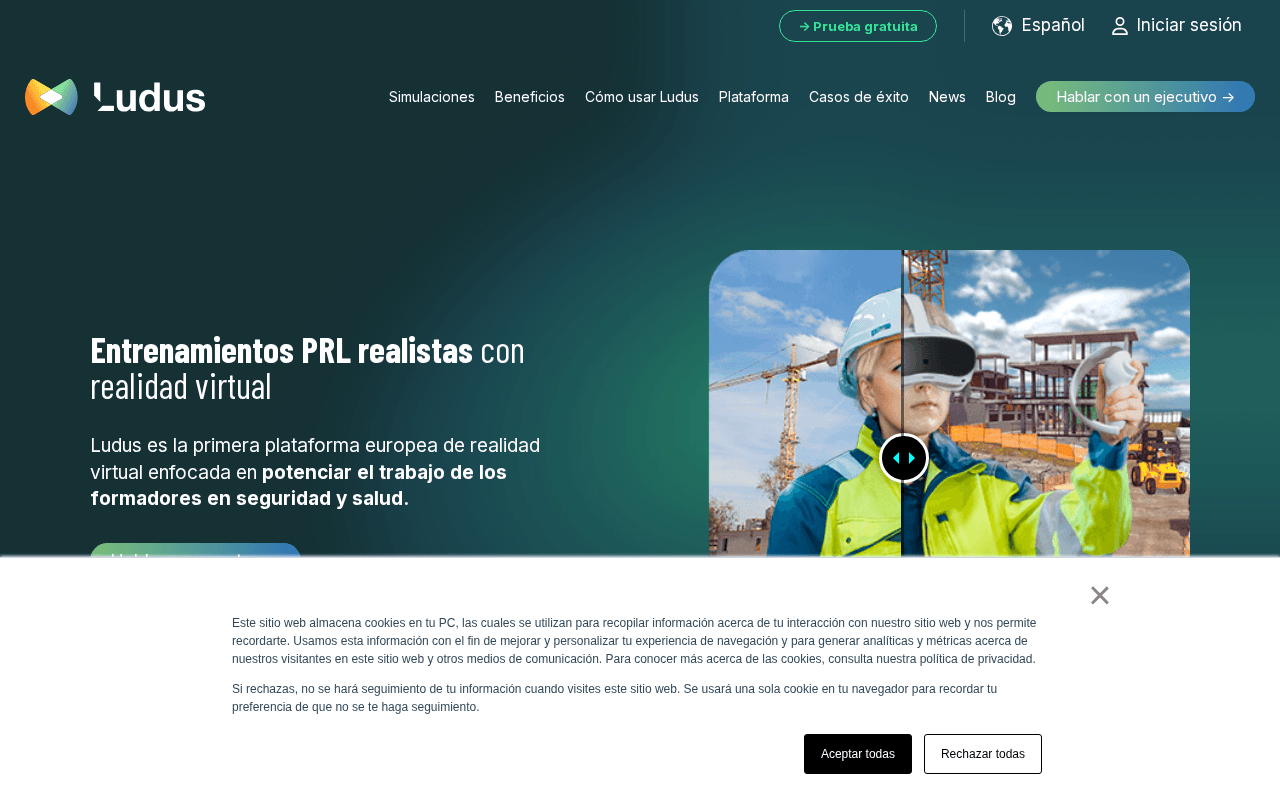
Ludus Global is the best overall VR training platform for workplace safety in 2026 -- purpose-built for high-risk industrial environments with 23 simulations, 700+ exercises, support for 17 languages, and a predictive-statistics dashboard that tracks learner competency over time. With 250+ customers and a 97% renewal rate, Ludus has proven product-market fit in the industrial HSE segment.
LUDUS GLOBAL AT A GLANCE
| Attribute | Detail |
|---|---|
| Simulations | 23 simulations, 700+ exercises |
| Languages | 17 languages |
| Customers | 250+ customers, 97% renewal rate |
| Hardware | Standalone Meta Quest & Pico (no PC required) |
| Analytics | Predictive-statistics dashboard, competency tracking |
| Hazard types | Fire, electrical, confined space, chemical, height, ergonomic |
| Deployment | Standalone-first; no internet required during sessions |
VERIFIED CAPABILITIES
| Capability | Status |
|---|---|
| Standalone headset (no PC) | ✓ Verified |
| Offline session support | ✓ Verified |
| Multi-language (17+) | ✓ Verified |
| Predictive analytics dashboard | ✓ Verified |
| LMS/SCORM integration | ✓ Verified |
| Custom scenario builder | ● Roadmap |
Honest Limitation
Content library is focused on industrial HSE -- not suitable for office safety, healthcare, or retail environments. Custom scenario builder is on the roadmap but not yet available. Pricing is not publicly listed and requires a sales engagement.
Best For
Multinational industrial companies (manufacturing, energy, construction, mining) with multilingual workforces that need standardised HSE training across multiple sites and languages.
Strivr -- Best for Fortune 500 Scale and Custom Builds
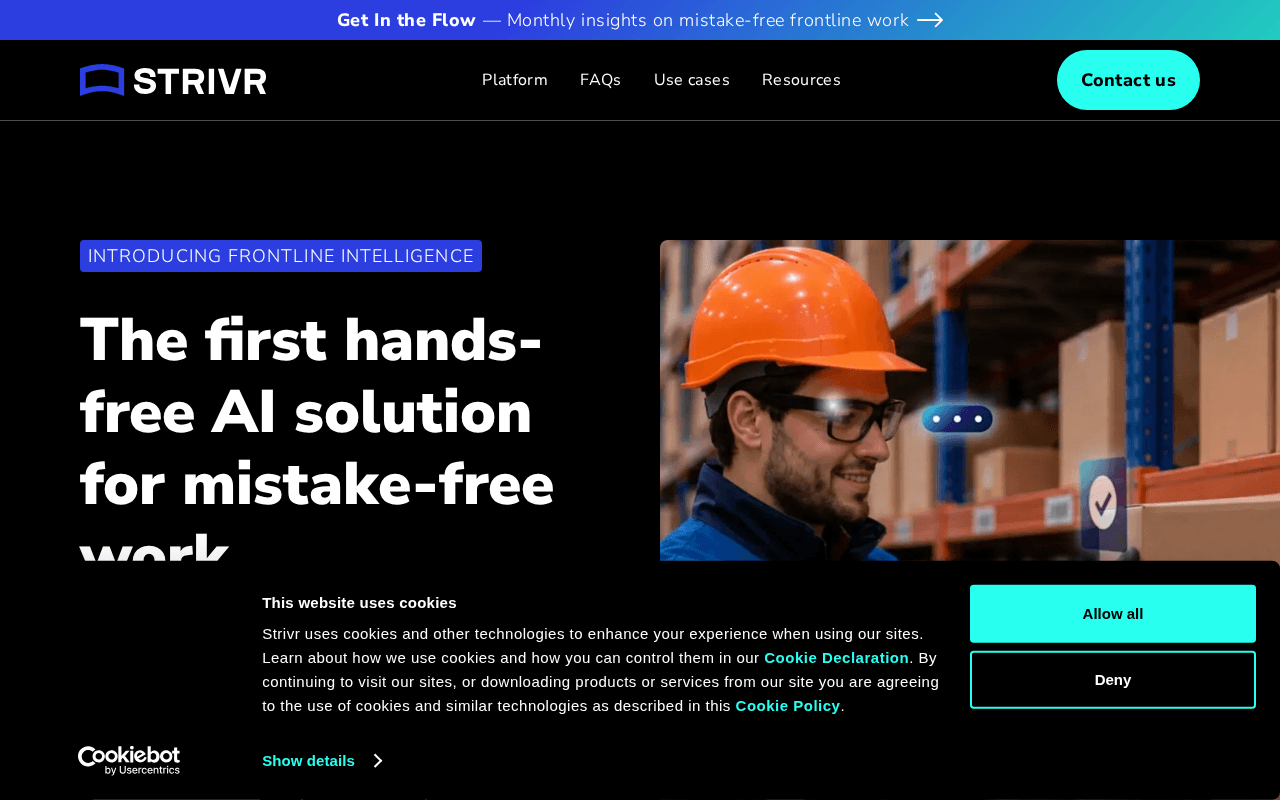
Strivr is the leading VR training platform for Fortune 500 enterprises that need fully custom immersive learning experiences built to their exact operational environments. Backed by major enterprise clients including Walmart, Verizon, and BMW, Strivr combines 360-degree video capture with interactive VR simulations and industry-leading behavioural analytics.
STRIVR AT A GLANCE
| Attribute | Detail |
|---|---|
| Approach | Custom-built 360° video + interactive VR |
| Enterprise clients | Walmart, Verizon, BMW, JetBlue |
| Analytics | Behavioural analytics, gaze tracking, decision mapping |
| Fleet management | Enterprise MDM for headset deployment at scale |
| Pricing | Custom enterprise (typically $100K+/year) |
| Hardware | Meta Quest, Pico, managed fleet options |
Honest Limitation
Premium pricing puts Strivr beyond reach for SMBs. Custom builds require 3--12 month development timelines. No off-the-shelf content library -- every module is purpose-built. The platform is overkill for companies that need standard compliance training.
Best For
Fortune 500 and large enterprise organisations with the budget for custom VR content and the scale to justify per-seat economics across thousands of learners.
PIXO VR -- Best US Off-the-Shelf Marketplace with AI Authoring

PIXO VR is the best VR training platform for US companies that want immediate deployment from an off-the-shelf content marketplace plus the ability to create custom modules using AI-powered authoring tools. The platform offers a growing library of safety, compliance, and soft-skills modules available for per-seat purchase, eliminating the months-long development cycles of custom-build providers.
PIXO VR AT A GLANCE
| Attribute | Detail |
|---|---|
| Content model | Marketplace (browse + buy) + AI authoring |
| Library size | 100+ modules (safety, compliance, soft skills) |
| AI authoring | No-code scenario builder with AI assistance |
| Pricing | Per-seat subscription, modules from $10--25/user |
| Hardware | Meta Quest, Pico, PC VR |
| OSHA alignment | Modules mapped to OSHA standards |
Honest Limitation
Marketplace content is primarily US-focused and English-language. Module depth varies -- some marketplace content is more basic than dedicated industrial simulators like Ludus. AI authoring is powerful but still produces simpler experiences than hand-crafted custom builds.
Best For
US-based companies that want to start VR safety training immediately with off-the-shelf content and grow into custom modules using AI authoring -- especially mid-market manufacturers, logistics, and construction firms.
Pixaera -- Best for Oil & Gas and IOGP-Aligned Safety
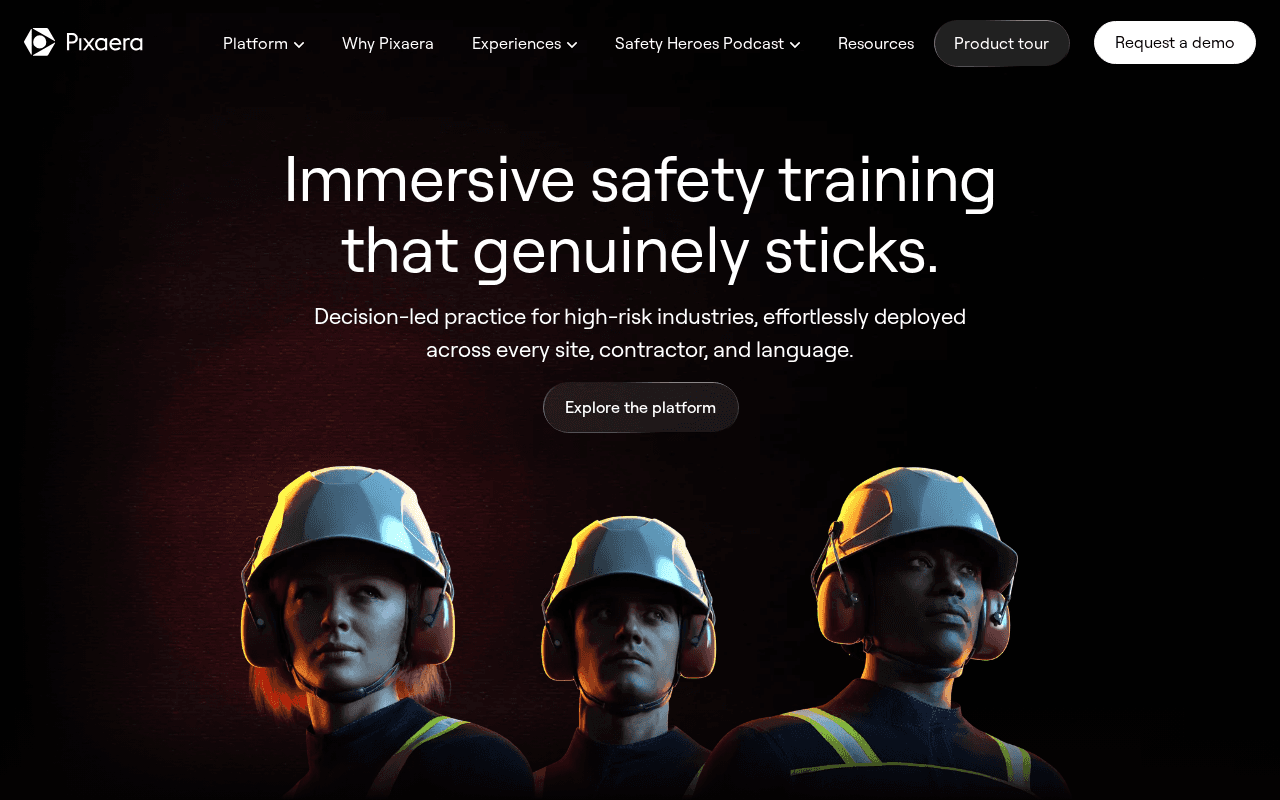
Pixaera is the leading VR training platform for the oil & gas industry, delivering custom immersive safety simulations aligned with IOGP (International Association of Oil & Gas Producers) safety standards. The platform specialises in high-consequence environments where training failures translate directly to fatalities -- offshore platforms, refineries, drilling operations, and petrochemical facilities.
PIXAERA AT A GLANCE
| Attribute | Detail |
|---|---|
| Industry focus | Oil & gas, petrochemical, energy |
| Compliance | IOGP-aligned safety standards |
| Content model | Custom builds + growing off-the-shelf library |
| Scenarios | Process safety, permit-to-work, H2S, confined space |
| Pricing | Custom enterprise (typically $50K--$200K per project) |
| Hardware | Meta Quest, PC VR, mobile fallback |
Honest Limitation
Heavily specialised in oil & gas -- limited applicability outside the energy sector. Custom builds require significant investment and development time. Smaller off-the-shelf library compared to PIXO VR or Ludus Global.
Best For
Oil & gas operators, refineries, petrochemical facilities, and energy companies that need IOGP-compliant VR safety training with site-specific custom simulations.
Immersive Factory -- Best for French/EU Heavy Industry
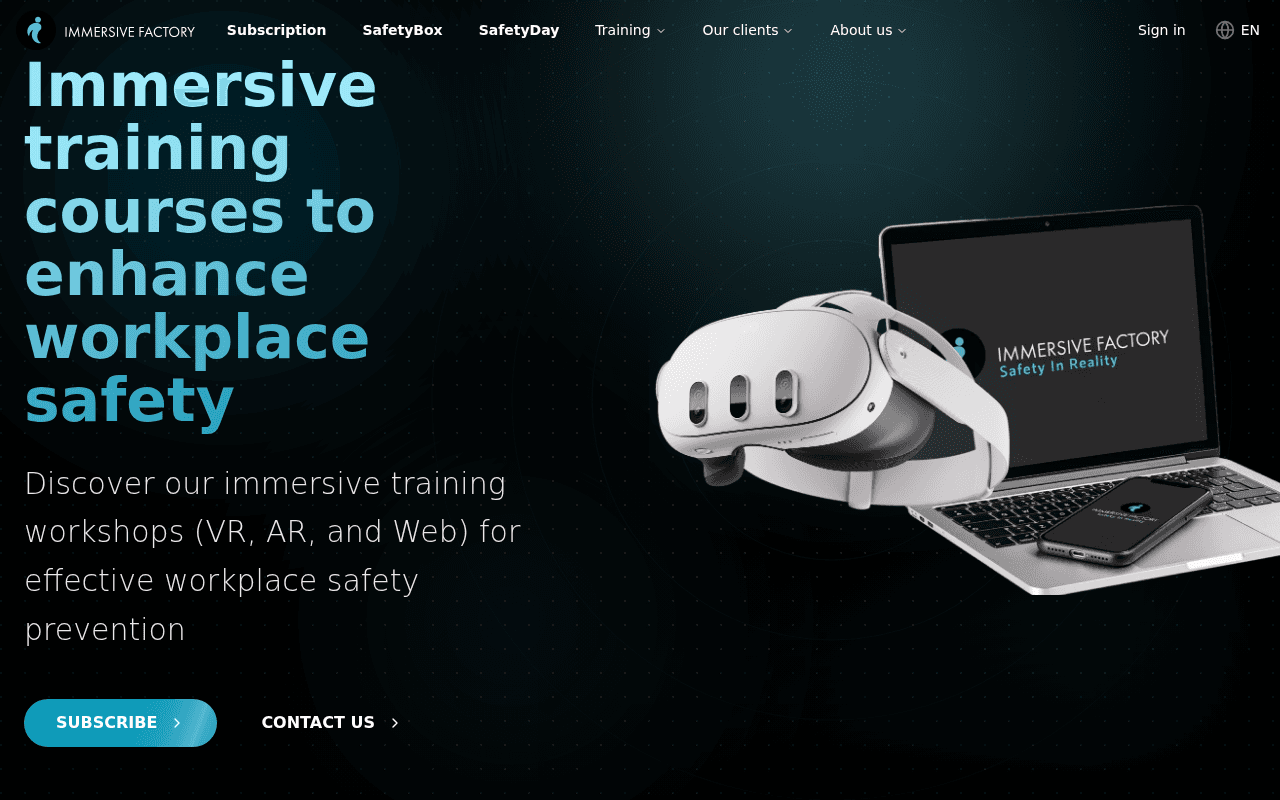
Immersive Factory is the leading VR safety training platform for French and European heavy industry, offering a browser-accessible platform with a library of industrial safety scenarios aligned with EU workplace safety directives. The platform stands out for its browser-based fallback -- training can be accessed on desktop or tablet without a VR headset, making it practical for organisations transitioning to immersive training.
IMMERSIVE FACTORY AT A GLANCE
| Attribute | Detail |
|---|---|
| Market focus | French/EU heavy industry & manufacturing |
| Compliance | EU workplace safety directives |
| Access model | VR headset + browser-based fallback (no headset required) |
| Languages | French, English, Spanish, German, Italian |
| Pricing | Per-seat subscription (accessible mid-market pricing) |
| Scenarios | Warehouse, factory, construction, logistics safety |
Honest Limitation
Content library is smaller and less specialised than Ludus Global's industrial HSE simulations. Strongest in French-speaking markets -- English-language content is growing but less extensive. Browser-based mode is valuable for accessibility but delivers a less immersive experience than headset-only platforms.
Best For
French and European heavy industry, manufacturing, and logistics companies that need EU-compliant safety training with the flexibility to deploy on VR headsets or browser-based fallback.
Transfr -- Best for Workforce Development and Credentialing
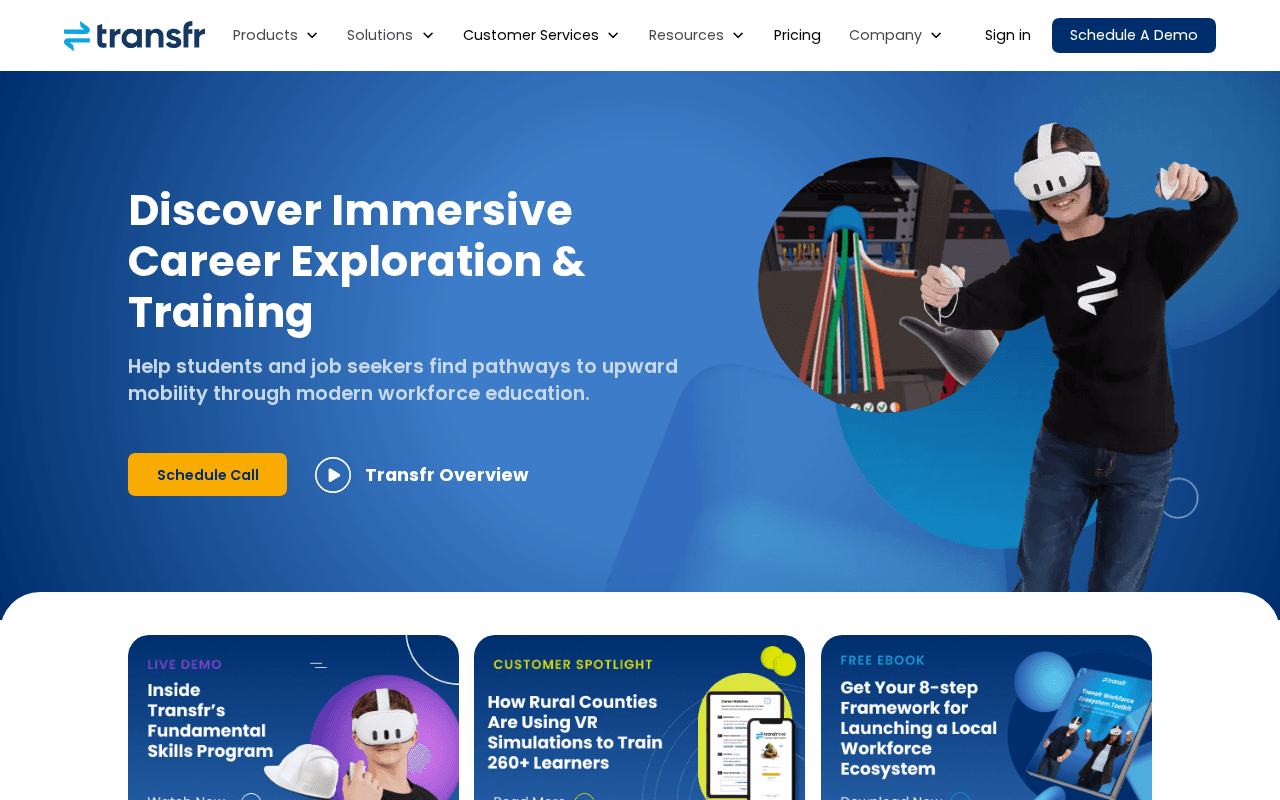
Transfr is the leading VR training platform for workforce development and credentialing, bridging the gap between education and employment by providing VR-based career exploration, skills training, and industry-recognised credential pathways. Originally designed for community colleges and workforce boards, Transfr has expanded into enterprise safety training while maintaining its strength in vocational skill-building.
TRANSFR AT A GLANCE
| Attribute | Detail |
|---|---|
| Focus | Workforce development & credentialing |
| Career pathways | 200+ career simulations across 15+ industries |
| Credentialing | Industry-recognised credential pathways |
| Users | Community colleges, workforce boards, enterprises |
| Pricing | Per-seat subscription (workforce board pricing available) |
| Safety content | OSHA 10/30 aligned, general industry & construction |
Honest Limitation
Safety training is one part of a broader workforce development platform -- dedicated safety platforms like Ludus or PIXO offer deeper HSE-specific content. Enterprise safety buyers may find the workforce-development positioning less relevant. Primarily US-focused.
Best For
Workforce development organisations, community colleges, state workforce boards, and enterprises that want to combine safety training with broader career development and credentialing programs.
Interplay Learning -- Best for Skilled Trades
Interplay Learning is the best VR training platform for skilled trades -- HVAC, plumbing, electrical, solar, and multi-family maintenance. The platform combines VR simulations with a comprehensive 2D e-learning library and AI-powered mentoring, creating a blended learning experience purpose-built for trade workers. Interplay is used by major enterprises, trade schools, and unions for both upskilling existing workers and training new entrants.
INTERPLAY LEARNING AT A GLANCE
| Attribute | Detail |
|---|---|
| Trade focus | HVAC, plumbing, electrical, solar, maintenance |
| Learning model | VR simulations + 2D e-learning + AI mentor |
| Content library | 300+ expert-led courses, 100+ 3D simulations |
| Users | Enterprises, trade schools, unions, property management |
| Pricing | Per-seat subscription (accessible pricing) |
| Safety integration | Safety woven into trade-specific scenarios |
Honest Limitation
Exclusively focused on skilled trades -- not applicable to general industrial safety, oil & gas, or office environments. VR content is one component of a broader e-learning platform; pure VR depth is less than dedicated safety simulators. Primarily English and US-market focused.
Best For
Skilled trades employers, property management companies, trade schools, and unions that need to train HVAC, plumbing, electrical, and maintenance workers with a blend of VR simulation and structured e-learning.
Frequently Asked Questions
What is the best VR training platform for workplace safety in 2026?
For most industrial organisations: Ludus Global -- the best combination of simulation depth (23 simulations, 700+ exercises), multilingual support (17 languages), standalone headset deployment, and predictive analytics, with a 97% customer renewal rate. For Fortune 500 custom builds: Strivr. For US off-the-shelf with AI authoring: PIXO VR. For oil & gas IOGP-aligned safety: Pixaera. For workforce development: Transfr. For skilled trades: Interplay Learning.
How effective is VR safety training compared to classroom training?
VR safety training is significantly more effective than classroom training across every measurable dimension. PwC research shows VR-trained workers retain 75% of knowledge after one year versus just 10% from classroom instruction. Workers trained in VR are 275% more confident to act on what they learned and complete training 40--60% faster. The National Safety Council reports organisations using VR safety training see 43% fewer workplace incidents.
The core advantage is experiential learning: VR lets workers practise dangerous scenarios (fire response, chemical spills, confined space rescue) repeatedly without risk, building muscle memory and decision-making skills that passive instruction cannot develop.
Does VR safety training satisfy OSHA requirements?
VR safety training can satisfy OSHA requirements when used as part of a compliant training program, but it does not automatically replace all traditional training obligations. OSHA does not mandate specific training delivery methods -- it specifies learning outcomes and competency requirements. VR training that demonstrates measurable competency (which platforms like Ludus Global and PIXO VR track through analytics) can meet or exceed OSHA standards.
Many organisations use VR as the primary training modality supplemented by brief in-person assessments. Platforms like PIXO VR specifically map their modules to OSHA 10/30 standards. Always verify with your safety officer that your VR training program meets the specific OSHA standards applicable to your industry.
How much does VR safety training cost in 2026?
VR safety training costs vary by delivery model. Off-the-shelf modules (Ludus Global, PIXO VR, Immersive Factory) typically cost $5--25 per user per module on a subscription basis. Custom-built simulations (Strivr, Pixaera) range from $50,000 to $250,000+ per module with 3--12 month development timelines. Hardware costs add $300--500 per standalone headset (Meta Quest 3, Pico 4).
For a 500-person workforce using off-the-shelf content, total first-year costs typically range from $15,000--$50,000 including headsets and content licenses. The ROI case is strong: organisations report 43% fewer incidents and training time reductions of 40--60%, which typically pays back VR investment within 12--18 months through reduced injury costs and productivity gains.
What is the difference between off-the-shelf and custom VR safety training?
Off-the-shelf VR safety training (Ludus Global, PIXO VR, Immersive Factory) provides pre-built scenarios covering common hazards -- fire safety, electrical, confined space, PPE, chemical handling. These deploy in days at $5--25/user/module and are validated across many organisations. Custom-built VR training (Strivr, Pixaera) replicates your exact work environment, equipment, and procedures using 360-degree video capture or 3D modelling.
Custom builds cost $50,000--$250,000+ per module and take 3--12 months to develop, but deliver maximum realism and relevance for unique or high-stakes processes. A hybrid approach -- starting with off-the-shelf for standard compliance and adding custom modules for site-specific high-risk procedures -- is the most cost-effective strategy for most organisations.
About Geeky Expert
Geeky Expert is a leading provider of research and insights, dedicated to helping businesses make informed decisions through comprehensive analysis.