Direct answer: An AI visibility tracker measures how your brand appears inside AI-generated answers — tracking mentions, citations, and sentiment across platforms like ChatGPT, Gemini, and Perplexity where traditional SEO tools provide no data.
Key Takeaways:
• Measure brand presence and tone inside AI responses, not just keyword rankings.
• Track prompts that reflect how real buyers search and compare options across AI platforms.
• Use structured metrics — mention rate, share of voice, sentiment, citation presence — to guide steady, measurable optimization decisions.
An AI visibility tracker helps brands see how they show up inside AI-generated answers. Instead of only measuring clicks or keyword rankings, these tools look at whether your brand is mentioned, how it is described, and whether the AI cites you as a source. As more people rely on AI platforms for quick, direct answers, brand discovery is starting to happen inside the response itself — making mentions, citations, and sentiment the metrics that matter most.
What Is an AI Visibility Tracker and How Does It Differ From Traditional SEO Tools?
Futuristic AI visibility tracker command center with dashboards tracking citations and brand presence across AI platforms
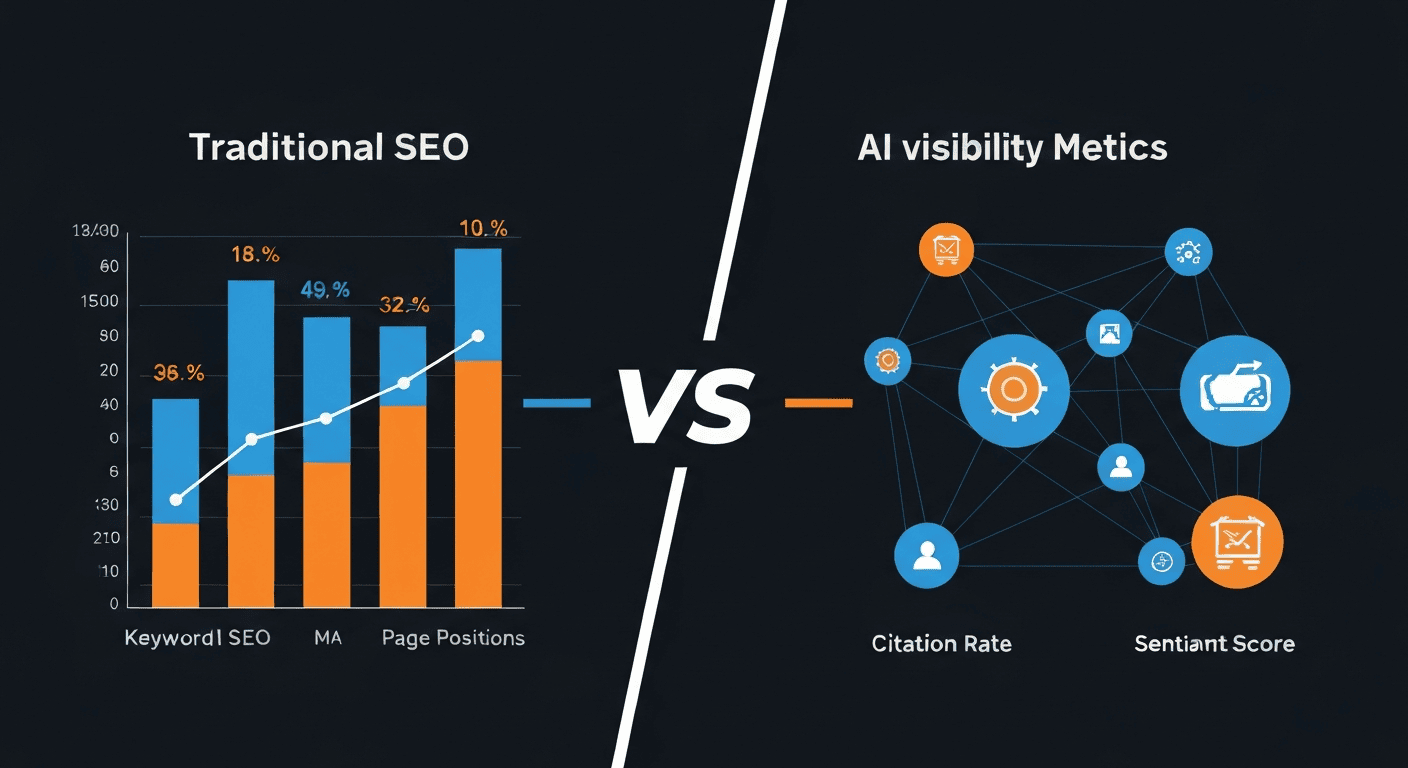
Think of it this way: old SEO tools told you where you stood on a page full of links. An AI visibility tracker tells you if you are in the conversation. The difference is fundamental. Traditional SEO tracks your position for a keyword on a search engine results page. An AI tracker analyzes the actual text response generated by a large language model — it looks for your name, checks if the tone is positive or negative, and sees if you are cited as a source.
As AI-generated answers become more common in zero-click discovery, the old SEO reporting model no longer captures the full impact of visibility inside AI responses.
"Traditional SEO metrics don't catch them, it's crucial for websites to use AI visibility tools to track a brand-new set of metrics." — The HOTH [1]
Why does this shift matter so much? Because users are clicking less often and relying more on AI summaries. They get a single, synthesized answer. If you are not in that summary, you are invisible for that query. Here is the main difference at a glance:
What's Tracked: Traditional SEO focuses on where you rank for specific keywords. AI tracking measures whether you appear inside the answer itself.
The Output: Search engines show lists. AI systems deliver complete answers with citations.
The Input: SEO relies on static keywords. AI tracking uses dynamic, conversational prompts that mirror real user behavior.
This new reality requires different tools, different metrics, and a different way of thinking about online presence altogether — which is why tracking AI search rankings has become a separate discipline from traditional SEO.
Why Are AI Visibility Trackers Critical for Brands in 2025?
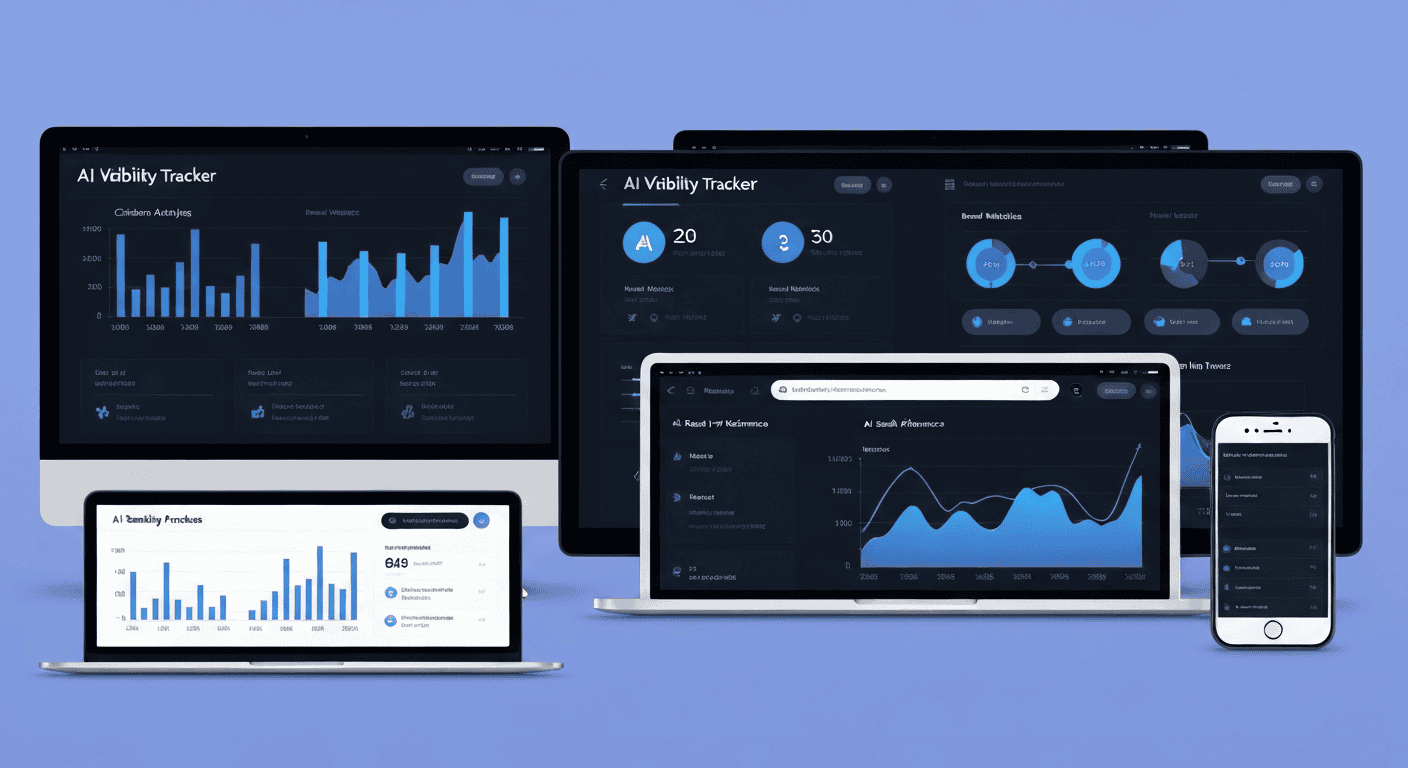
AI visibility tracker dashboard across devices showing citation analysis, brand mentions, and AI search performance metrics
AI visibility is no longer about appearing in a ranked list of links. Brands must become recognized entities inside the answer itself.
"It's not about being on a list; it's about being part of the answer." — uSERP [2]
AI platforms have become the ultimate shortcut. A user asks "What are the best project management tools for small teams?" and gets a neat, compared list. Their journey might begin and end right there. If your tool is not on that list — or is described inaccurately — you have lost a potential customer before they even knew you existed.
This makes visibility a direct reputational issue, not just a traffic one. These AI summaries shape early opinions, influence comparisons, and build or break trust. Brands that monitor their presence can spot problems early: a missing mention, a negative tone, a competitor being unfairly favored.
Brands that do not track are flying blind — unaware of how they are being represented to a growing audience that never clicks through to their site. As AI gets woven into more devices and apps, this kind of tracking is becoming a standard layer for understanding your brand's health, as essential as brand monitoring has always been in traditional PR.
How Do AI Visibility Trackers Work Across LLM Platforms?
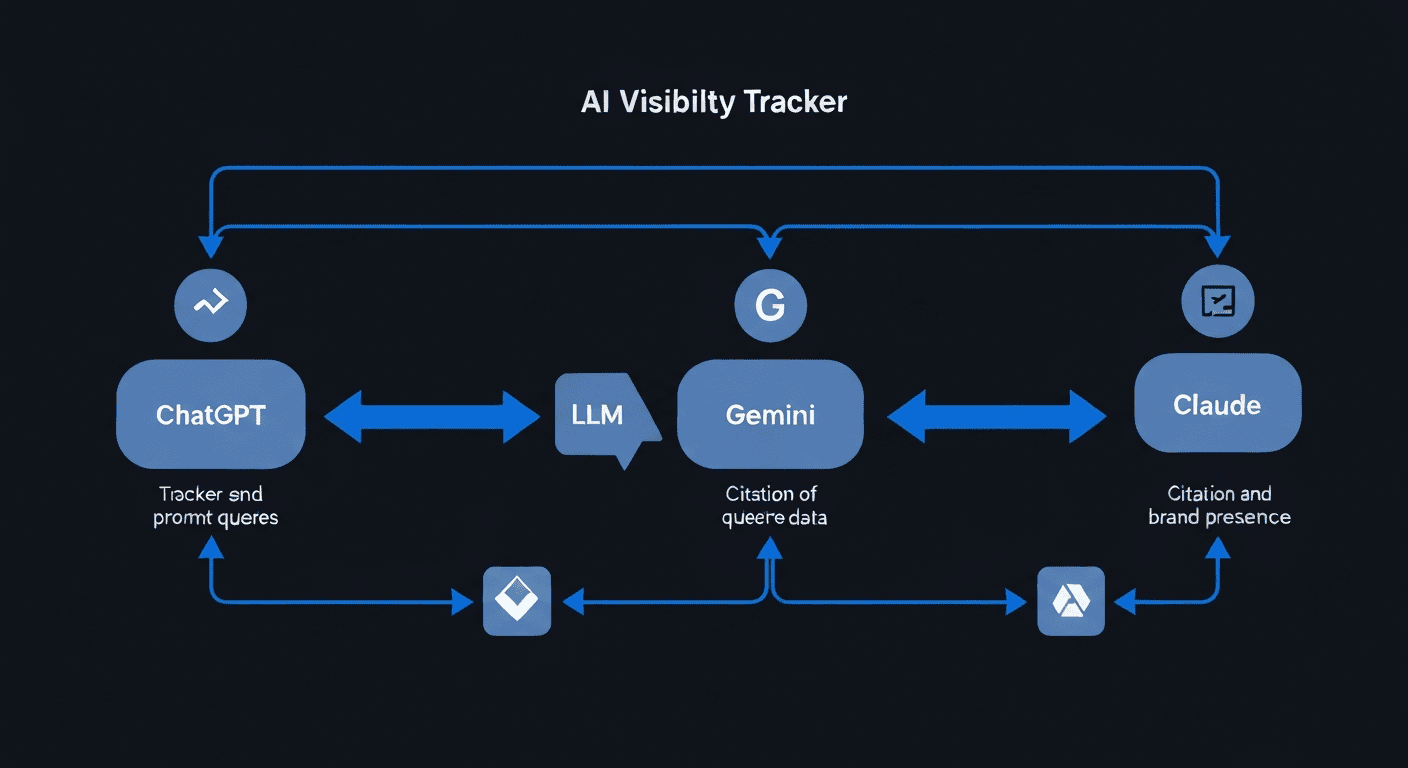
Diagram of AI visibility tracker sending prompts across LLM platforms to measure citations and brand presence in AI-generated answers
These trackers run libraries of prompts — simulated user questions — across different language models. Think 20 to 50 prompts for a category like "wireless earbuds." They do not just ask once; they run these prompts repeatedly to catch variations and track changes over time. The goal is to mirror how real people discover and evaluate products.
Once the AI generates an answer, the tracker breaks it down. It looks for your brand name, notes whether the mention is positive or negative, and records if the AI cites any websites. All of that gets organized into reports so you can see visibility trends more easily. This process aligns with what we call LLM citation monitoring — systematic tracking of how AI systems reference brands across platforms.
The process is built for consistency, allowing comparative assessments across different AI systems including ChatGPT, Gemini, Claude, and Perplexity. Consistent methodology is what separates directional insights from noisy, unreliable data.
Which Metrics Matter Most in AI Visibility Tracking?
To manage AI visibility effectively, you need a few dependable metrics that show what is happening in real AI responses. Rather than tracking everything, teams often monitor a small core set each week to spot trends and stay grounded in the data. Each metric answers a specific, practical question about your brand's AI presence — and they make the most sense considered as a group, not in isolation.
Metric
What It Measures
Why It Matters
Mention Rate
How often your brand appears in AI answers
Your baseline visibility — if it's low, you're simply not in the conversation
Share of Voice
Your visibility compared to direct competitors
Shows if you're a leader or an afterthought in AI recommendations
Sentiment Score
Whether the tone around your mention is positive, neutral, or negative
A direct reflection of your brand's reputation health in AI spaces
Citation Presence
Whether the AI links to or references your site as a source
Indicates if you're seen as an authority worth backing up
Mention Frequency Trend
How your mention rate changes over weeks or months
Reveals if visibility is growing, holding steady, or quietly slipping
These numbers are only useful when they lead to action. A dip in sentiment might mean you need to clarify messaging on your site. A low citation rate could signal it is time to strengthen authority signals on your key pages. The metrics point the way.
Which AI Visibility Tracker Tools Are Leading the Market?
The market for these tools is still shaping up, but platforms like Semrush AI Toolkit, Peec AI, Otterly, and Profound emphasize repeatable monitoring. These AI citation tracking tools allow consistent checking of prompts, sentiment, and source visibility. When evaluating tools, consistency and historical data depth matter more than breadth of features.
Capability
What It Supports
Why Teams Use It
Prompt Monitoring
Simulates different stages of the buyer journey
Mirrors how real customers search, so data reflects real-world behavior
Citation Tracking
Shows when and where your site is referenced as a source
Identifies if you're building authority or being passed over
Sentiment Analysis
Automatically scores the tone of brand mentions
Detects reputation shifts quickly without manually reading every response
Trend Analysis
Tracks metrics over time in clear dashboards
Turns raw data into a story showing what's working and what's not
Alerts
Notifies you of sudden drops or spikes
Enables faster response to visibility crises or opportunities
GeekyExpert brings these capabilities together across ChatGPT, Gemini, Claude, and Perplexity — with daily automated prompt tracking and competitive benchmarking built in. Run a our research reports to see how your brand currently appears across AI platforms.
How Should Teams Deploy an AI Visibility Tracker Effectively?
Professional reviewing AI visibility tracker data dashboard with citation tracking graphs and visibility metrics
The biggest mistake is trying to track everything at once. Start small — a focused, scoped deployment will teach you more and deliver value faster than a sprawling, unmanageable one. Success here depends on having clear ownership. Someone needs to be responsible for reviewing the data and acting on it. Without that, even the best tool becomes just another report no one reads.
A simple, effective deployment looks like this:
Define a tight scope: Pick one or two core product categories or service areas to monitor. Add your top 3–5 competitors in that space.
Build a focused prompt library: Create dozens of prompts that cover how people discover and compare offerings in your category. Keep them natural and conversational.
Set a realistic cadence: For most teams, a weekly check-in is enough. For high-velocity markets, review key alerts daily.
Assign an owner: Make one person or team responsible for the weekly review and for triggering any response actions.
Turn on key alerts: Configure notifications for drastic changes — like your mention rate dropping by 30% or sentiment turning negative.
This approach keeps the process from becoming a burden. Once you have the rhythm down, you can gradually expand to more categories and a broader prompt library.
How Do Insights From AI Visibility Trackers Drive Optimization Actions?
AI visibility tracker infographic comparing traditional SEO vs AI visibility with mention rate, citations, and sentiment metrics
The insights you get are not about gaming the system — they are about alignment. When you see a pattern, like AI consistently missing a key feature of your product or favoring a competitor in comparisons, it usually points to a content gap or a clarity issue on your own site. We treat the data as a directional signal: a single weird answer is a fluke, but a pattern across dozens of prompts is a clue.
The goal is to make it easier for AI systems to find and accurately summarize your information. Common optimization steps include:
Updating comparison content: If AI is misrepresenting how you stack up against a competitor, revisit your comparison pages or feature lists. Make your differentiators obvious and factual.
Strengthening entity pages: Ensure pages about your core products or services have clear, concise definitions at the top. Help the AI understand exactly what you are.
Improving summary content: Look at meta descriptions, introductory paragraphs, and conclusion sections on key pages — these are often the snippets AI pulls from. Make them accurate and compelling.
Aligning tone: If sentiment is neutral or negative, audit your public-facing content. Shift the language to be more factual, confident, and trust-building.
Implementing these answer engine optimization actions reduces ambiguity and improves how a brand is portrayed across AI platforms. When your site content is clear and authoritative, AI systems are more likely to cite you accurately and position you fairly — a long-term play for stability that aligns with AEO optimization strategy.
What Challenges and Limitations Should Users Expect?
The outputs from large language models have natural volatility. Responses can change based on the model version, the exact phrasing of the prompt, or even the time of day. This is not a flaw in the tracker — it is a feature of the environment you are measuring. The key is to monitor trends over weeks, not individual data points from a single query.
Main limitations to plan for:
Model variability: Different AI platforms — and even different versions of the same platform — can produce different answers for the same prompt. Track across multiple sources to get a reliable picture.
Prompt sensitivity: Small changes in how a question is asked can lead to big changes in the answer. Your prompt library needs to account for this variety.
The black box: We have limited transparency into exactly how an AI chooses one source over another. We can observe outcomes and adapt, but cannot see the internal ranking logic.
The need for human judgment: The data informs you, but it does not think for you. A human still needs to interpret patterns, rule out anomalies, and decide on the appropriate strategic response.
Understanding these limits from the start prevents overreaction and helps you use the tracker for what it is: a powerful lens into a new and unpredictable landscape, giving you the insight to navigate it more confidently.
AI Visibility Tracker: Practical Takeaways for Long-Term Brand Presence
An AI visibility tracker helps us understand how brands appear inside AI-generated answers — where decisions increasingly happen. By focusing on mentions, sentiment, and citations, we gain clarity beyond traditional rankings. When applied with structure and discipline, AI visibility tracking becomes a steady measurement system rather than a reactive tool.
Our teams use this approach to support responsible, long-term visibility management across AI search environments. The brands that build this habit now will have a measurable data advantage as AI becomes the primary discovery layer for more and more queries.
Learn more about how we apply these systems in practice by exploring GeekyExpert. To start tracking your brand's AI visibility today, GeekyExpert automates daily prompt monitoring across ChatGPT, Gemini, Claude, and Perplexity — run a our research reports and see exactly what AI search is saying about your brand right now.
What is AI visibility tracking, and why does it matter for our brand today?
AI visibility tracking measures how often your brand appears in AI-generated answers across platforms like ChatGPT, Gemini, and Perplexity. It tracks mentions, citations, and sentiment to show whether AI systems recommend or accurately reference you. This matters because many users now get complete answers directly inside AI tools without visiting websites, which shapes early brand trust and purchase decisions before a single click occurs.
How can a ChatGPT ranking monitor help us understand AI search rankings better?
A ChatGPT ranking monitor shows whether your brand appears in AI-generated recommendations for important customer prompts. It tracks mention frequency, response consistency, citation presence, and competitor positioning over time. This helps teams understand how AI systems describe their products, where visibility is missing, and which content improvements increase accurate inclusion in AI answers — giving you data to optimize against rather than guessing.
What should we track for Perplexity visibility and Gemini brand tracking growth?
To grow visibility in Perplexity and Gemini, track brand mentions, linked citations, sentiment tone, and share of voice against competitors. These platforms often highlight sources, so authoritative citation coverage matters significantly. Monitoring prompt performance across product categories reveals whether your brand is recommended fairly, described accurately, and supported with trustworthy references that the AI feels confident citing.
How do GEO trackers and prompt tracking tools improve content optimization efforts?
GEO and prompt tracking tools reveal which customer-style questions trigger your brand's appearance in AI answers and which ones leave you absent. They help teams identify content gaps, unclear positioning, or missing comparison language that causes AI systems to choose competitors instead. By optimizing entity pages, structured summaries, and schema markup based on these insights, brands improve how AI systems interpret their offerings and increase consistent, accurate citations.
How can real-time AI alerts help us detect AI crises and protect brand reputation?
Real-time AI alerts notify teams when AI answers suddenly change, sentiment turns negative, or competitors replace your brand in recommendations. These alerts help detect misinformation, unstable brand descriptions, or emerging reputation risks early — before they compound. Fast response allows brands to correct content, strengthen authoritative pages, and reduce the chance of harmful AI-driven narratives spreading to users who rely on AI answers as their primary source of information.
About Geeky Expert
Geeky Expert is a leading provider of research and insights, dedicated to helping businesses make informed decisions through comprehensive analysis.